
Assassinations strike at the heart of political power in Mexico City
The murder of Ximena Guzmán and José Muñoz is a direct challenge to Morena, the ruling party, in its largest political stronghold
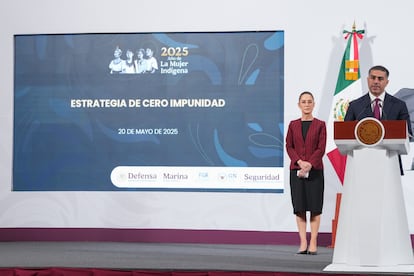

President Claudia Sheinbaum learned of the assassination of Ximena Guzmán and José Muñoz during her morning press conference. Her Secretary of Security, Omar García Harfuch — who was present at the press conference — was the first to receive the police report and sent a cell phone message to Paulina Silva, the head of the federal government’s communications department and a close associate of Sheinbaum.
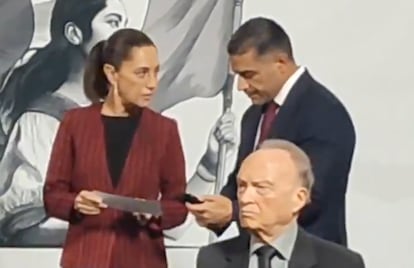
Harfuch impatiently gestured with his hand, indicating that Silva should write down the news on a card and pass it to the president. Sheinbaum, her face serious, read the note while Secretary of the Interior Rosa Icela Rodríguez spoke to the media about the government’s efforts to address the social causes of violence: the lack of employment, education, and opportunities — the philosophy of the National Regeneration Movement, the party known as Morena. García Harfuch texted, took calls, and put together what had happened. A hitman had shot at the heart of Morena, the party founded by former president Andrés Manuel López Obrador.
García Harfuch then approached Sheinbaum to explain more details. The news: another high-profile attack, once again in Mexico City, once again targeting members of the Morena movement. Harfuch — who was Sheinbaum’s security czar during her tenure as mayor of the capital, just before Clara Brugada — was himself at the center of a shocking attack five years earlier, at the hands of the powerful Jalisco New Generation Cartel (CJNG).
But there are two major differences with that event. The obvious one: the secretary, also a member of Sheinbaum’s inner circle, survived. The other: the motive and message were clearer then, since he was leading the fight against organized crime in the capital.
That’s why the murder of Ximena Guzmán, the private secretary to Mexico City Mayor Clara Brugada, and José Muñoz, Brugada’s advisory coordinator, has so unsettled Morena. Because the attack doesn’t fit the criminal logic of targeting police or prosecutors who interfere with illicit operations.
Morena is mourning its two distinguished activists with the grief reserved for activists killed for political reasons — for their convictions and their struggles — with the solemnity used to honor the railroad workers, students, farmers, and teachers repressed in the past, the disappeared during Mexico’s Dirty War, the Indigenous people massacred by the Army in Acteal (Chiapas) and by the police in Atenco (State of Mexico).
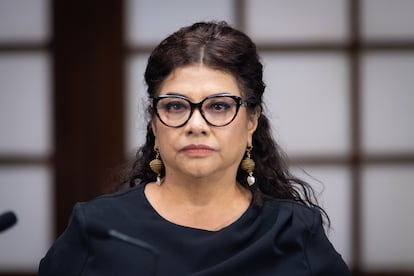
“Our hearts ache,” Brugada said hours after the crime. “We are deeply dismayed and mourning the loss of two dear colleagues.”
Brugada, officially known as head of the Mexico City’s government, held back tears during the press conference where she informed the public of what had happened. Her voice broke as she spoke. Guzmán and Muñoz were two of her longtime collaborators, whom she trained politically. They were so close that they shared with her the dreams and struggles to transform Iztapalapa — the marginalized, overpopulated Mexico City borough where Brugada was shaped and where Morena was born. So close that they became her most trusted and important collaborators.
Brugada described Ximena as “a wonderful, tireless, very good woman”; Pepe — as she calls him — she had known since he was a child, “one of the most intelligent and extremely responsible people.” “I feel very sad,” she said.
The grief was palpable. Two Morena activists were shot dead one morning as they were routinely commuting to work. Morena’s inner core has been breached, attacked.
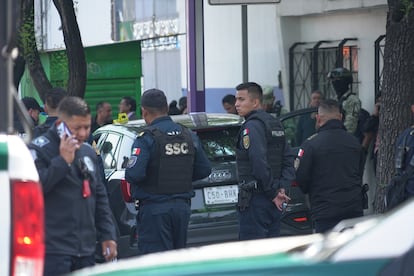
The murder is unsettling because it was carried out in the style of organized crime. A gunman fired 12 shots at the car driven by Ximena, with José in the passenger seat. He quickly fled. A motorcycle helmet covered his face, but he was more protected by the impunity of a criminal underworld that grows ever more brazen, more savage — one that increasingly acts as if it owns the country and its people, escaping justice through its entanglement with political corruption.
Ximena was a 42-year-old sports sociologist, a “runner there and back,” as she described herself in her social media bio. José, a 52-year-old political scientist, used to say: “I observe and I commit. I’ve always stood on the left.”
Morena supporters are asking: why them? Why target two activists who had done nothing but contribute to López Obrador’s movement — one whose banner is the fight for the poor, for equality, against oppression and dispossession? Now, within Morena, people are reading between the lines. Were Ximena and José the intended targets of the attack? Ximena, who managed Brugada’s personal schedule and most private communications? José, her chief adviser for years? Or was the real target the leader herself?
Or was it a message to all of Morena? Is it possible that doing politics in a government that claims to tackle the root causes of violence can cost you your life? That’s what Senator Gerardo Fernández Noroña, president of the Senate, implied. “I deeply condemn the violence being incited against us,” said the legislator, who is frequently heckled in the streets by anti-Obrador protesters.
Morena is now looking over its shoulder. “This attack is a response to the progress we’ve made on public security in Mexico City. The Fourth Transformation will remain steadfast,” said Xóchitl Bravo, coordinator of Morena lawmakers in the local Congress.
Brugada herself, after offering her condolences, also hinted at the broader context of the party’s fight against violence. “I guarantee the residents of the capital that this government will continue its relentless fight against insecurity,” she promised.
There is no record of prior threats being made against Ximena and José, as President Sheinbaum reported at her morning press conference. During Ximena and José’s wake on Tuesday night, dozens of Morena supporters shouted the same political slogans they had chanted for decades in the street protests demanding proper governance. “Zapata lives, the struggle continues!” they chanted. But this time, the demands fall on Morena — the ones now in power.
Sign up for our weekly newsletter to get more English-language news coverage from EL PAÍS USA Edition









































