
Patrick Baty, the ‘paint detective’ who has traced the hues of the past for Windsor Castle and 10 Downing Street
The British expert has played a role in the restoration of historic landmarks, specializing in the recovery of long-lost color schemes

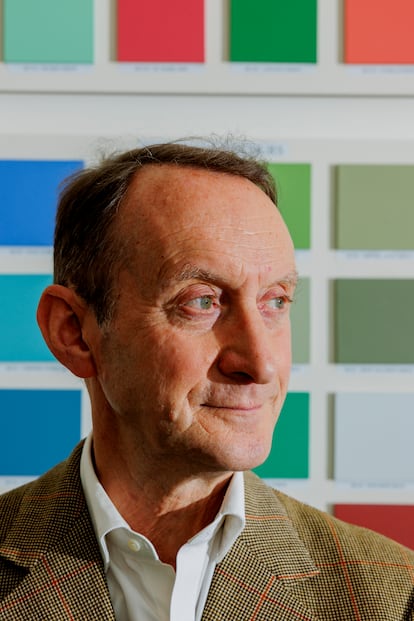
Patrick Baty, 70, thought the greatest adventure of his life would culminate in the fight against the communist insurgency in the Dhofar region of southern Oman in the 1970s. Britain’s elite Special Air Service, the feared SAS, was involved in the covert operation, and the young Baty, then a captain in the 9th/12th Royal Lancers, had already begun learning Arabic and was preparing to emulate Lawrence of Arabia.
“And then, in one of those strange turns large organizations sometimes take, they decided to send me to Northampton, two hours from London, to train and lead a group of cadets,” he tells EL PAÍS on a warm July morning as he sips his coffee in the Royal Festival Hall café on the Thames. “So I handed in my resignation. I didn’t want to steer myself toward a life of frustrations that would end with me spending my last years running a shooting range in Wales,” he says with a wry smile.
Today, in the world of interior decoration and architectural restoration, he is known as the “paint detective” or the “paint guru.” Public institutions and private owners alike seek his services to uncover the hidden past of their properties.
When he ended his army career, Baty realized that he had training from the Royal Military Academy Sandhurst and some knowledge of early 20th-century British painting, sparked by his childhood fascination with the work of his great-grandparents, Robert Bevan and Stanislawa de Karlowska. What he did not have was a university degree. That background was enough, for a time, to find work in the art galleries of London’s Bond Street, where he soon became bored stiff.
He then turned to his father, who ran a painting and wallpaper business in Chelsea, and offered to help. It was there, driven by customers’ questions and requests, that his curiosity led him into the field where he would finally achieve the fame he sought.
“Someone would come into the shop asking for the interior wall color of the Forbidden City in Beijing, or what color Robert Adam [the 18th-century architect famous for his neoclassical interior designs] would have chosen, or how to recover Sir John Soane’s masterful use of light and saturated colors,” Baty recalls.
He spent his afternoons researching treatises on color and decoration at the Royal Institute of British Architects, the National Art Library at the Victoria & Albert Museum and the British Library. His efforts culminated in an 80,000-word thesis on 18th-century decorative art at what was then the Polytechnic of East London, and in the building of a reputation as an expert in recovering long-buried colors.
Baty understood that theoretical knowledge had to be paired with forensic investigation: a scientific-detective method to unearth a building’s past before recommending the right color for a restoration.
Using a spectrophotometer, an instrument that measures in the lab the amount of light absorbed or transmitted, Baty analyzes wall samples under a microscope to find historic layers of paint. Each layer tells him a story about the building or monument.
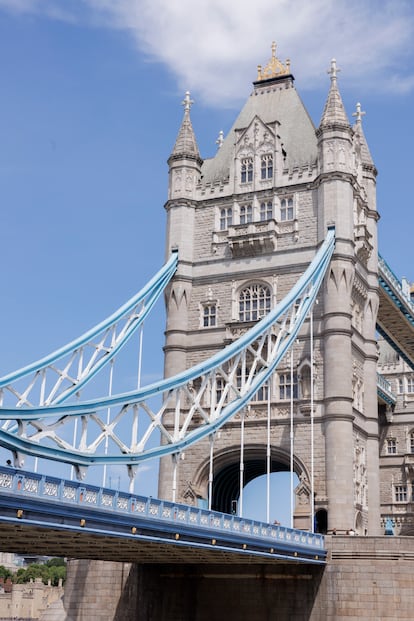
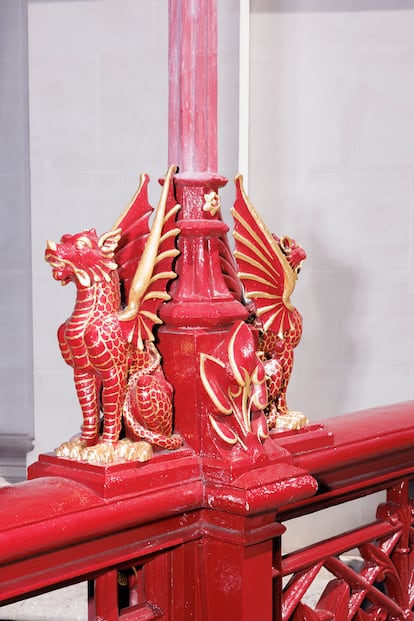
The right color is not always the original one. Among Baty’s commissions is the iconic Tower Bridge in London, with its bright blue and restrained white and red. It was painted that way in 1976 to mark the late Queen Elizabeth II’s silver jubilee. Before that, it had been light blue, grey and bronze-green. Both its color schemes and its structure changed over the decades.
“That was my recommendation to the City of London Corporation, which administers the bridge. Because if we had reverted to one of the historic colors, people would have been confused and the media would have stirred up a fuss. It was justified to keep the existing look,” explains Baty, who applies logic to something as seemingly subjective as color.
Baty is behind many restoration projects at Buckingham Palace, Windsor Castle (after the devastating 1992 fire), Hampton Court Palace, 10 Downing Street and the historic BBC Broadcasting House, as well as numerous private residences.
All of that knowledge is distilled in an exquisite, 300-plus-page art manual published by Thames & Hudson, the specialist publisher renowned for such carefully produced editions. The book is titled The Anatomy of Color.
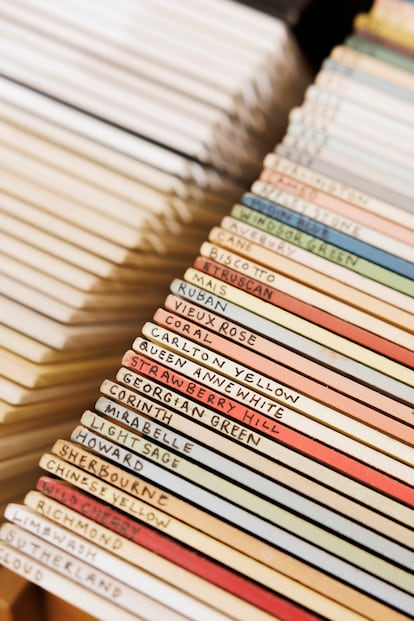
His wife, Alex, runs the business and the shop, Papers and Paints, which remains in Chelsea, where the Batys keep an immense catalog of historic hues. Thanks to that generous division of labor, Patrick was able to focus on his work as a historical and artistic consultant.
The central lobby of the Royal Festival Hall, one of the first public buildings constructed in London after World War II, is ringed by glass walls with some retaining walls. In its original scheme, a red surface sat next to a muted green, while a chocolate-brown area met a canary yellow. “A mad use of colors, until I found the hidden logic: what they call the ‘solidity of color,’ a way to provide a visual sense of strength by contrast against so much glass that, at the time, still conveyed a sense of fragility,” Baty explains.
His artistic vision embodies that blend of romanticism, Cartesian thought, and martial spirit that has produced so many British adventurers. In fact, until recently, he remained a member of the military reserves, assigned to the 21st SAS Regiment — known as the Artists’ Rifles — founded in 1859 by Edward Starling in response to fears of a new Napoleonic invasion of the island. The entire Pre-Raphaelite generation — including Dante Gabriel Rossetti and William Morris — was part of it. It attracted young painters, sculptors, musicians, and architects, as well as engineers and scientists. It eventually became one of the most prestigious military units in the United Kingdom
“Intelligent, motivated people who would go on to do extraordinary things — and whose very existence immediately drew me in,” says Baty, who recalls those experiences and that camaraderie as, curiously enough, something far more precious than his successful career as an interior restorer. “After all, paint and colors are very superficial,” he quips.
Sign up for our weekly newsletter to get more English-language news coverage from EL PAÍS USA Edition









































