
David Hockney, one of the 20th century’s most influential British artists, dies aged 88
The painter achieved massive success with his colorful scenes of California, Normandy, and the United Kingdom
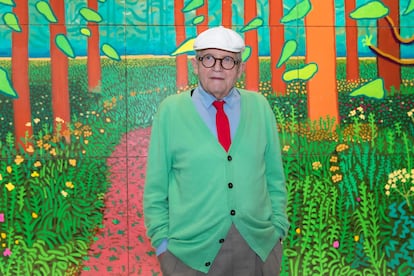

In May 2021, while the world was still trying to recover from the Covid pandemic, British artist David Hockney presented his exhibition The Arrival of Spring. Normandy, 2020, dozens of hours of meticulous work he devoted to capturing — on his iPad using the Brushes app — the essence of the changing seasons while the world was confined by tragedy. True to form, he did not give up on either innovation or joy.
Hockney, one of the most influential British artists of the 20th century, died Friday in London at the age of 88, according to a statement released by his communications team. “They can stop everything, but they can’t cancel spring,” he had written at the time to the two dozen friends to whom he sent a new painting from his tablet every day.
Hockney’s life — he was born in Bradford, UK, in 1937 — was not an eternal spring, though he did everything in his power to make it so.
His paintings of beautiful young people by the pool, basking in the sun and the dazzling light of Los Angeles — where he lived for a long time — became an icon of that pop era, in which Hockney shared friendship and fame with figures like Andy Warhol and Dennis Hopper.
But his beginnings were less glamorous, attesting to an English work ethic and dedication that the artist never abandoned throughout his life. Born into a family he himself described as “radical working class,” the fourth of five siblings was very fortunate that his parents knew how to encourage his artistic vocation from an early age.
He began his studies at Bradford College, but after two years of service in a hospital as a conscientious objector, reluctant to perform military service, he completed his training at the Royal College of Art in London, where he enrolled in 1959.
Rebellious and iconoclastic, reluctant to follow conservative academic norms (the female nude he was required to submit for his portfolio ended up being a male nude taken from a racy magazine), the academy’s professors nevertheless agreed to award him his graduate diploma, with a gold medal, overwhelmed by his immense talent.
In the 1960s, he chose to distance himself from the Abstract Expressionism that dominated the artistic avant-garde and focus on figurative work, characterized by bold lines and a naive sensibility that went against the grain of the era.
It was upon moving to Los Angeles that he found the environment conducive to the flourishing of his artistic vision. His series of swimming pools and young men, a celebration of hedonism and intimacy, cemented his reputation as a sought-after artist. A Bigger Splash (1967); Portrait of an Artist (Pool with Two Figures) (1972); and Picture of a Hollywood Swimming Pool (1964) represent the culmination of that era, in which Hockney freely celebrated a homosexuality that was still a criminal act in his native country.
He had previously explored this sexual theme in works such as We Two Boys Together Clinging, based on and named after a poem by the American Walt Whitman, who celebrated love between men in the 19th century.
Hockney also sought to capture individual intimacy through double portraits such as that of Christopher Isherwood and Don Bachardy (1968), or Mr and Mrs Clark and Percy (1971), for which he employed a technique he would use for many years before abandoning it: preparatory photographs that he later incorporated into his work.
During his lifetime, Hockney achieved the distinction of seeing his work Portrait of an Artist (Pool with Two Figures) fetch the staggering price, in November 2018, of $90.3 million at a Christie’s auction (about $78 million at today’s exchange rate).
A love for technology
If, in his final days, the iPad was the tool he chose to express his art, throughout his career he always embraced new technologies. His photo-collages, created using snapshots taken with a Polaroid camera, allowed him to circumvent the rigid rules of figurative painting to experiment with new perspectives through a modernized form of Cubism that critics likened to that of Picasso.
Hockney also made notable contributions to the artistic design of opera and theater, such as his work for Alfred Jarry’s Ubu Roi at the Royal Court Theatre in London, Stravinsky’s The Rake’s Progress for the Glyndebourne Festival, and Puccini’s Turandot for the Los Angeles Opera.
He was a heavy smoker his entire life, both of tobacco and marijuana. He had a medical marijuana card, which is legal in California, and smoked at night because it helped him sleep.
He considered both habits a direct and essential path to experiencing life’s pleasures, and he did not give them up until the very end, despite the stroke he suffered in 2012, which left him temporarily unable to speak, though he continued to work.
Shortly before the opening of one of his last major retrospectives at Tate Britain in London in 2017, one of the curators asked him what he would like people to take away from this survey of six decades of his work. “A little joy,” Hockney replied, “that they enjoy the world as I enjoy looking at it.”
A further decade of prolific work followed, accompanying him until his final days. “When I’m painting, I feel like I’m 30, like Picasso. When I’m not painting, I feel like I’m 60 or so,” he acknowledged in an interview with EL PAÍS in 2016.
In March 2021, he saw the opening of an exhibition at the Serpentine Gallery in London, featuring one of the most ambitious works of his long career: a monumental 70-meter-long canvas, inspired by the Bayeux Tapestry and his beloved changing of the seasons in Normandy.
Although it was always rumored that he had turned down a knighthood on several occasions and declined an offer to paint a portrait of Queen Elizabeth II, he accepted an invitation from the Dean of Westminster Abbey to create a stained-glass window in honor of the then-Queen of England, which was unveiled in 2017.
He settled permanently in London in 2023, and thus began an era of retrospectives and tributes to an artist who was already considered an untouchable part of the United Kingdom’s cultural heritage. His partner, Jean Pierre Gonçalves, from Lima, remained by his side until the end.
Sign up for our weekly newsletter to get more English-language news coverage from EL PAÍS USA Edition









































