Is Zapatero's farewell a backward step for women?
Great gains have been made in terms of equality during the Socialists' time in power, but given the PP's views on positive discrimination, is that about to change?
Never had so much progress been made in such a short space of time, experts agree. Policies pursuing equality between men and women - including a short-lived equality ministry - have featured prominently during the seven-year (and gender-equal) administration of José Luis Rodríguez Zapatero. The outgoing prime minister leaves behind a structure of laws, greater rights and public values such as zero tolerance of domestic abuse. As a result, changes deemed unthinkable just a decade ago have become a reality, and public opinion is much more sensitive to gender parity issues, including the salary gap.
The issue even cropped up during the recent televised debate between the two main candidates to succeed Zapatero on November 20. But while the Socialist campaigner talked about equality in a broad sense, his rival from the Popular Party (PP), Mariano Rajoy, focused on the need to reconcile work and family life.
"We've been alone in our efforts to correct an ancient system," says Rubalcaba
Four women, three of whom are from the PP, are currently regional premiers
This dual approach illustrates how both major parties are courting the female vote with different approaches. The Socialists fall back on their achievements during these last two terms in government. "We have made significant progress and we've been alone [...] in our efforts to correct a centuries-old system: the prevalence of men over women," said Rubalcaba. Or, in the words of the feminist Ángeles Álvarez, a member of the Socialist electoral committee: "We've moved from a declarative equality to the impulse of real equality."
Meanwhile, the PP - the runaway favorite to win the election - addresses the problem in a different way. The main barrier to real gender equality, say the conservatives, is the difficulty reconciling work and family life. The PP - which would like to amend recent legislation pertaining to abortion, caregiving and domestic violence - is also uncomfortable with positive discrimination and favors merit-based policies instead.
"We women spend a lot more time in caregiving and domestic work than men, and it shouldn't be that way, because it hinders personal promotion and prevents us from choosing what we want to do," says Sandra Moneo, equality spokeswoman for the PP. The party is promising a work/family balance plan that will make school and work hours more flexible and create a pool of personal time to attend private business, among other measures. Additionally, paternity leave will be extended (the Socialist government originally extended it to 13 days but refrained from a further extension to four weeks due to the crisis). A total of 275,637 men took the leave last year. "If women do not find hurdles to accessing the labor market, men will have to embrace their responsibilities in the private sphere," says Moneo.
This turn from equality policies to work/family balance illustrates a deeper change. "The former are only oriented towards women with jobs, to put more mothers on the job market. The latter encourage women's promotion in all public spheres," explains Teresa Torns, a sociology professor at Barcelona's Autónoma University. Yet neither approach touches upon "a deep root" of inequality: "sexual division of labor, including unpaid work."
"Reconciling work and family life is necessary for equality, but not vice versa," adds the sociologist Constanza Tobío, of Carlos III University.
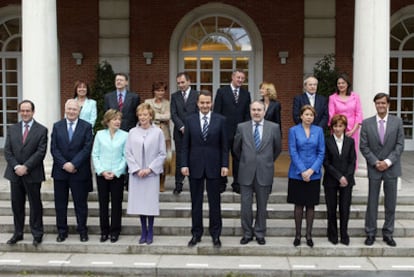
At the helm of Spain's first government to achieve gender parity, Zapatero pressed for high-profile equality policies with the inestimable help of his deputy, María Teresa Fernández de la Vega. His first piece of legislation addressed domestic violence. The 2004 law introduced harsher criminal punishment for guilty men than for guilty women in cases of abuse. Thus, domestic violence, addressed as a problem of inequality, stopped being a private problem and became a public one. Spain became a spearhead in the defense of women's rights, and fostered the first Europe-wide measure to protect victims of abuse. Meanwhile, tolerance of abuse became increasingly a thing of the past in Spain.
From gender violence, the focus moved to gender parity. The next big legislative step came in 2007, with the Effective Equality Between Women and Men Act. The law was three-pronged: it empowered women politically and economically, extended paternity leave to encourage greater co-responsibility in caregiving tasks, and established electoral parity - neither sex could represent more than 40 percent of candidates in every five-name section of a given party list. The initiative was criticized by the PP, but it increased the number of congresswomen by 37 percent and female senators by 28.2 percent. Women mayors increased 16.7 percent. Four women (three from the PP) are currently regional premiers.
The PP has always defended merit-based promotion over positive discrimination; yet its leader, Mariano Rajoy, has been very attentive to female contributions in his own team, and his party does not plan to repeal any sections of the equality legislation - not even the controversial item that garnered the most corporate complaints: the need for a greater presence of women on the boards of companies with over 250 employees. The number of female board members in major corporations has become a good thermometer of gender parity in the economic elite: the presence of women on the boards of IBEX-listed firms is now 11.3 percent, up from six percent in 2007. That is still very far from the 40 percent recommended for 2015 - but this resistance by the economic powers that be against gender equality is a Europe-wide phenomenon - so much so that the EU Commission has threatened to set up its own quotas if substantial progress is not made soon.
Yet the wave of equality is reaching male shores, and that is a significant change. "The message is starting to get through," says Tobío. "Men have the right to care for their children and women have the right to work outside the home."