"They will say that we set up the basis for a more productive model"
Zapatero defends his legacy as Socialists prepare to choose his successor
With his announcement on Saturday, Prime Minister José Luis Rodríguez Zapatero is following in the footsteps of his predecessor, José María Aznar of the Popular Party, who also decided in 2003 not to run after serving two terms as head of Spain's government. The difference is that Zapatero is leaving no heir apparent (Aznar designated current PP leader Mariano Rajoy), and so now the Socialists will hold primaries to choose the candidate.
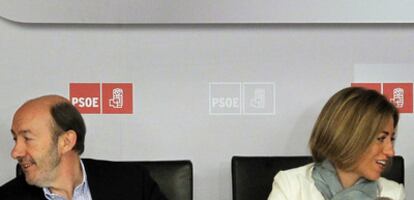
According to internal polls, the two main contenders are Deputy Prime Minister Alfredo Pérez Rubalcaba and Defense Minister Carme Chacón. Rubalcaba is way ahead of Chacón among Socialist voters, of whom 52 percent favor the deputy prime minister over the defense chief, who received 15 percent in the latest Metroscopia poll carried out for EL PAÍS and published on Sunday.
On the same day, both Rubalcaba and Chacón - at separate rallies in Palma and Alicante, respectively - were cheered on with shouts of "Mr Prime Minister!" and "Mrs Prime Minister!" Socialist officials said they will wait until after the May 22 regional and local elections to open up the candidacies for the party primary. Neither Rubalcaba nor Chacón - both members of the party's federal committee - are saying what their future plans are.
There are also notions that other candidates, such as Congressional speaker José Bono and Madrid Socialist Party (PSM) leader Tomás Gómez may also vie for the secretary general's job. But on Saturday, Gómez vehemently denied those rumors.
Following Zapatero's announcement that he was stepping down, PP Secretary General María Dolores de Cospedal called on the government to hold early elections. "The Socialists must let Spaniards decide now, because they want Mariano Rajoy as prime minister," she said at a rally in Valencia. Zapatero has vowed to remain in office "until the last day" of his current mandate. José Blanco, the Socialist deputy secretary general, said that all the PP was doing in demanding early elections was putting Rajoy "further away from La Moncloa."
Socialist regional leaders - the so-called "party barons" - had been asking Zapatero to make his decision public before the May 22 race to prevent the election from turning into "a referendum" on his government.
"Now, not one candidate can blame Zapatero for the outcome of the election," said Extremadura regional leader Guillermo Fernández-Vara on Saturday.
Just last weekend, some 40 business leaders asked Zapatero not to call early elections and serve out his term to prevent more turmoil in the markets. Some, such as Santander chief Emilio Botín, also asked him to put off announcing his future until next year.
Grappling with a more than 20-percent unemployment rate and a languishing budget deficit, which stands at about six percent of GDP, Zapatero was forced to initiate unpopular measures to rein in government spending.
In his speech on Saturday, Zapatero acknowledged that errors may have been made, but said that he and the Socialists always "held their heads high, at all times."
"We have made some necessary adjustments with the utmost consideration of fairness and helped to keep intact all of the great social policies and advances that we made during the first term. We have achieved this despite the extraordinary austerity efforts that we are undertaking," he said.
Zapatero's first term was marked by great social reforms, including the introduction of same-sex marriage and promoting gender equality in the public and private sectors. He opened the way for more than 250,000 illegal migrants to obtain their residency papers. But the term was also marred by a fruitless attempt to negotiate a peace deal with ETA, which fell part when the Basque terrorist group broke a ceasefire in September 2006 by bombing a parking garage at Madrid's Barajas International Airport, killing two people.
During his second term, the global financial crisis quickly engulfed Zapatero and his team. Reacting late to the growing problems, the prime minister began struggling to find short- and long-term solutions to help the faltering economy.
"When this crisis is over, and it will be over with the creation of jobs, it will be said that we were able to set up the basis for a renewed productive model, which is more competitive, more innovative and more capable of guaranteeing our own welfare," he said on Saturday.