
The benefits of ‘the ugliest color in the world’: A decade of evidence supports plain tobacco packaging
Twenty countries have implemented the measure based on dozens of studies and reports, but the industry insists there are negative economic consequences
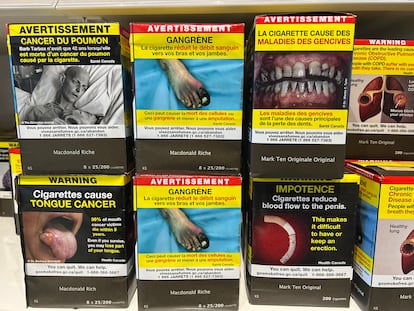

Australia became the global benchmark in the fight against tobacco addiction in 2012. That year, despite strong industry pressure, the country implemented a set of measures that many governments have since followed to address a public health problem that causes seven million deaths a year, according to the World Health Organization (WHO). One flagship decision was plain or standardized packaging, which reduces the appeal of cigarette packs by removing branding and emphasizing warnings about the harms of smoking. The government left nothing to chance and hired a consultancy to identify the least attractive color for the packs. The color chosen was Pantone 448 C, a dull blend of brown, gray and green that became known as “the ugliest color in the world” and has since been imitated by other countries.
Plain packaging has since become the focus of major legal, economic and communications battles between governments and tobacco companies, which have unsuccessfully sought multimillion-dollar compensation from several of the roughly 20 countries that have implemented it, including Belgium, Canada, Denmark, Ireland, the Netherlands, the United Kingdom and Uruguay. None of those countries has reversed course.
The industry calls the measure an “expropriation” that infringes on private property and freedom of speech, among other claims. It also argues that making brands indistinguishable encourages fraud and smuggling and shifts competition to price. In the industry’s view, this has a counterproductive effect by facilitating unregulated consumption and access to tobacco by young people. The sector also contends that the change carries significant negative economic consequences, both for tax revenue and for economic activity and employment.
Against these positions, governments and researchers have produced dozens of studies over the past decade that conclude the opposite and support the policy’s success where it has been applied. The first major evaluation was carried out by Australia’s Department of Health in 2016 and estimated that the measure had achieved, over three years, a statistically significant decrease in smoking prevalence of 0.55% during the post-implementation period, compared with the prevalence that would have occurred without the changes, equivalent to about 108,000 fewer smokers.
Armando Peruga, a researcher in the Tobacco Unit at the Catalan Institute of Oncology (ICO) and former manager of the WHO Tobacco Free Initiative, notes that “plain packaging was conceived less as a change to make people quit smoking than to reduce tobacco’s appeal to young people and lower the number who start.”
That helps explain why the measure is usually included as just one element within broader policies. “It also explains why its beneficial impact increases over time, since it reduces the number of new smokers. Australia’s first estimate, for example, predicted a decrease of up to 1% per year. But more recent studies carried out in France, England and Norway suggest that figure is between 5% and 8% per year,” Peruga adds.
The pack matters
A systematic review by Cochrane Collaboration — an international network of researchers, health professionals and patients — analyzed 51 studies with nearly 800,000 participants and concluded there was strong evidence that the change in packaging reduces “advertising and visual appeal.” “Tobacco in standardized packaging was generally perceived as worse tasting and of lower quality than branded tobacco. Plain packaging also appeared to reduce erroneous perceptions that some cigarettes are less harmful than others,” the authors add.
Another review by researchers at James Cook University (Australia), which analyzed 19 studies involving 19,000 adolescents, focused on the greater impact of health warnings after the measure was implemented: “Pictorial health warnings combined with plain packaging appear to increase adolescents’ awareness of the dangers of tobacco use.”
Tobacco companies challenge these findings by citing industry-funded reports — which are not subject to peer review and controls by scientific journals — and again point to the supposed negative economic impact of plain packaging and its contribution to smuggling and fraud.
“Of all the ‘unintended consequences’ claimed by the industry, the alleged increase in smuggling is the best studied. There is a systematic review, several post-implementation studies and official evaluations from countries that have applied the measure, and even a ruling from the World Trade Organization (WTO). And everything points in the same direction: no increase has been detected,” Peruga says. The review, conducted by British researchers, concluded that there is no evidence to suggest that illicit tobacco consumption will increase after the implementation of standardized tobacco packaging, which contradicts the tobacco industry’s arguments.
There are also no scientific studies showing the job losses predicted by the industry, and government assessments after implementing the measure, such as in the United Kingdom, have not corroborated that hypothesis. Experts say the general framework published by the World Bank more than two decades ago still applies: industry-commissioned reports focus only on some “sectoral losses” — for example, tobacco leaf producers or printing and design firms — and ignore the “spending substitution effect.” That effect means money no longer spent on tobacco is redirected to other sectors with an equal or greater capacity to generate employment and economic activity.
In a report published in 2021, the WHO compiled all the evidence supporting plain packaging as part of broader tobacco control policies. The document laments that industry pressure is delaying its adoption in many countries, attributing this to the “potential deterrent effect created by national and international litigation” promoted by the sector.
Sign up for our weekly newsletter to get more English-language news coverage from EL PAÍS USA Edition









































