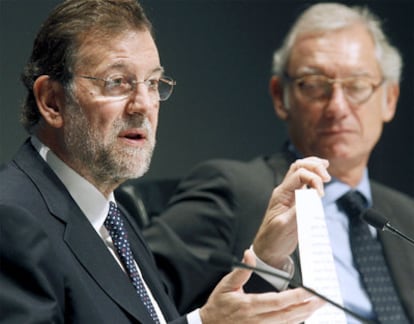
Opposition chief Mariano Rajoy offers outline of measures he will introduce if elected
PP leader promises sweeping reforms in regions and labor
The leader of the main opposition Popular Party (PP), Mariano Rajoy, in a moment of rare elaboration over the measures he will employ should he be elected prime minister, told a business congress yesterday that under a PP government Spain would curtail the powers of its regional authorities and put the brakes on privatization in the air and rail sectors.
"We have to carry out an intense budgetary adjustment," Rajoy said. "We have excessive government. It is essential that we face up to an overhaul of our state of autonomous regions, which should enjoy their benefits but do so in a viable and sustainable way."
Rajoy's discourse was sufficiently ambiguous to avoid positioning himself as a target for any fallout but strong enough to begin a process of refuting the assertion among his detractors that he has no policies. The PP leader spoke of his desire to limit the spending power of the regions, carry out a "genuine" reform of the labor market and to give the energy sector in Spain a shot in the arm. "The Spanish economy has a regulatory environment that restricts competitiveness to the point of making it nonexistent or irrelevant," Rajoy said.
The government was swift to hit back, accusing Rajoy of aping David Cameron's election strategy; the British Conservative prime minister gave little away before he took power and then instigated the greatest reform of the welfare state since World War II. Alluding to Rajoy's "secret agenda," José Blanco, a Socialist Party heavyweight, warned that Cameron had "devalued the pound, raised university fees, carried out public spending cuts without precedent and put 500,000 civil servants in the street. This is what awaits if the PP wins in Spain."