
A new test can detect Alzheimer’s from a finger prick
A study conducted in Spain and other European countries refines a method to simplify the early diagnosis of the leading cause of dementia
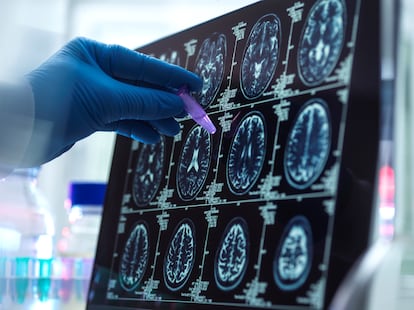

Scientists and doctors in Europe and North America have perfected a new test that detects Alzheimer’s disease from a drop of blood taken with a finger prick. This advance, still in its preliminary stages, would facilitate early detection compared to current methods. New blood-based diagnostic methods are crucial for identifying the disease in its early stages and enabling the use of new drugs that can modestly slow the progression of this neurodegenerative disease, which affects more than 50 million people worldwide.
The study confirms the quantification of proteins such as p-tau217, GFAP, and NfL in dried capillary blood, a simple method in which drops of blood from the finger are dried on special filter paper. This method allows for the identification of amyloid pathology, one of the main indicators of Alzheimer’s disease, with a diagnostic accuracy of 86%. The test has been validated in a group of 337 patients, both with and without symptoms of dementia, recruited from treatment centers in Spain, Sweden, the United Kingdom, and Italy. The results of the study were published Monday in Nature Medicine.
In current clinical practice, confirming amyloid pathology requires a lumbar puncture or PET brain scan, invasive procedures with a considerable cost for widespread application. For some years now, blood tests have been refined that can detect certain proteins, such as p-tau217, which can detect Alzheimer’s disease with an accuracy of over 90%.
The main advantage of the method published Monday is that it doesn’t require a conventional blood draw to analyze the proteins present in the plasma, but only a drop of blood obtained with a simple prick of the index or ring finger. This system doesn’t require extensive technical knowledge or a complex infrastructure for refrigerating, preserving, and transporting the samples.
“This method could accelerate the identification of people at risk of developing Alzheimer’s disease, expediting their referral to specialized memory units, where further complementary tests would be performed to confirm the diagnosis,” says pharmacist and neuroscientist Xavier Morató, director of clinical trials at the Ace Alzheimer’s Center in Barcelona and lead co-author of the study. “The goal is to democratize access to early diagnosis,” he added in a press release issued by his institution.
Alzheimer’s is currently an incurable disease. This is primarily because it progresses for years or even decades without showing symptoms. In most cases, by the time it is diagnosed, it is already too late to treat it with the new drugs available, which can delay the onset of the disease by about 18 months if administered in its early stages. The Spanish Society of Neurology estimates that more than 50% of mild cases go undiagnosed. With current methods, the time between the appearance of the first symptoms and an official diagnosis is two to three years. This makes early diagnosis with increasingly simpler methods crucial for the effective use of these drugs.
The authors of the new study believe that dried blood spot tests like the one they propose can facilitate access to diagnosis in rural areas or countries with limited healthcare resources, even allowing patients to collect samples at home. “If its reliability is confirmed, this technique could be applied in population screening programs, epidemiological studies, and longitudinal follow-up of patients in clinical trials, democratizing access to early diagnosis,” says Morató.
Raquel Sánchez Valle, from the Hospital Clínic of Barcelona and spokesperson for the Spanish Society of Neurology, who did not participate in the trial, believes that this method “simplifies things in large-scale research studies, but it shouldn’t be used in clinical practice at this time.” “The recommendation is to conduct these tests within the context of a cognitive impairment study in a healthcare setting where a comprehensive evaluation is performed. Mass screening outside of a healthcare setting or direct-to-consumer testing is not recommended, so it would have no use outside of research,” the specialist explains. Sánchez Valle sees cause for alarm regarding the potential commercialization of these technologies: “It’s a bit frightening that some company might market it directly to consumers without medical supervision. It’s not authorized in the European Union, but it is in other countries, such as the United States.”
David Pérez, a neurologist at the 12 de Octubre Hospital in Madrid, who also did not participate in the study, considers it “an interesting piece of work.” “The authors propose that the test quickly rules out most healthy people, and only those with suspicious or borderline results — about 30% of cases — would need to go to the hospital for more complex tests. This would represent a major step forward in democratizing access to early diagnosis,” he explains. However, Pérez calls for “realism,” since “its lower sensitivity compared to the venous blood test standard, and certain technical limitations in collection, suggest caution, and the technology needs to be refined before its widespread clinical application.”
Sign up for our weekly newsletter to get more English-language news coverage from EL PAÍS USA Edition









































