How the US midterms could reshape the outlook for the dollar, bonds and Wall Street
Polls point to a Democratic victory that could lead to greater scrutiny of AI and shape expectations for the 2028 presidential race, while doing little to ease concerns over the country’s debt burden
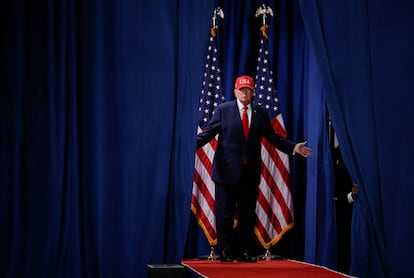

The United States heads to the polls on November 3 for the midterm elections, in which all seats in the House of Representatives and one-third of the Senate are up for grabs. The vote is shaping up as a referendum on U.S. President Donald Trump, now at his lowest ebb and with approval ratings at their weakest since returning to the White House, including during his first term.
Polls suggest Democrats are poised to regain control of Congress and point to a closely contested battle for the Senate that Republicans could also lose. The midterms therefore appear likely to usher in a new political landscape in the United States, one in which Trump’s policies could face greater legislative scrutiny — although he would retain both his veto power and his ability to govern through executive orders. The outcome is also expected to reverberate through financial markets.
Investors’ attention is currently focused on the steady rise in U.S. Treasury yields and concerns that the artificial-intelligence boom — the main driver of Wall Street’s rally — could falter. Fiscal consolidation in a country running a budget deficit of more than 6% of GDP and carrying over $40 trillion in debt is not a priority for either Republicans or Democrats. As for artificial intelligence, a Democratic victory is unlikely to result in sweeping regulation, although opposition is growing to a technology that could eliminate jobs and requires enormous quantities of water and energy to run data centers.
Nothing suggests a major disruption to the status quo of the U.S. economy. Depending on the election result, however, there could be policy shifts that become apparent later, particularly when Congress next confronts the debt ceiling and as investors begin to read Democratic legislative proposals as a preview of the party’s platform for the 2028 presidential election.
At Goldman Sachs, analysts say that “investors are expected to focus on what the results could signal for the 2028 presidential election and future policy direction.”
Analysts at Citi, meanwhile, note that the S&P 500 would be higher were it not for tariffs and the conflict with Iran, two headwinds that have accumulated under the current administration.
Impact on Wall Street and AI
Trump’s policies have undoubtedly proved less market-friendly than investors had anticipated when he returned to power. With Democrats widely expected to win the midterms — at least retaking the House of Representatives — analysts foresee both positive and negative implications for Wall Street.
Citi believes a decisive Democratic victory could prompt markets to start factoring in the political risks associated with the 2028 election cycle, particularly the prospect of higher corporate taxes and greater oversight of AI infrastructure. At the same time, the bank argues that any move to curb the president’s powers over tariffs and military action could be viewed positively by investors.
Any shift in the balance of power on Capitol Hill would likely have a greater impact on specific sectors than on a broad index such as the S&P 500. A Democratic-controlled Congress, for instance, could restore subsidies that help Americans obtain health insurance coverage, providing direct support to hospitals and insurers. It could also revive debate over higher taxes on top earners, capital gains and large corporations.
“Such proposals would not necessarily become law, but they could influence investor expectations and corporate behaviour,” says Michaela Huber, multi-asset strategist at Vontobel.
For Huber, however, the greater risk is that the honeymoon with artificial intelligence may begin to fade. “If voters increasingly associate AI with job losses, rising energy demand and limited benefits for the average worker, rather than with broad-based prosperity, policymakers could face mounting pressure to regulate aspects of the technology more aggressively,” she warns.
George Brown, senior economist at Schroders, agrees that Democratic control of both chambers would allow the party to intensify investigations, increase scrutiny of politically sensitive sectors and exert greater influence over appointments and nominations. Even so, he notes that President Trump would retain his veto power and broad executive authority.
“Democratic control of both chambers would therefore constrain the administration, but it would be unlikely to alter the overall direction of its policies,” he adds.
Republicans lost control of the House of Representatives in the 2018 midterm elections, during Trump’s first term. In the aftermath, the president made extensive use of his executive powers, escalating the trade dispute with China and stepping up his attacks on then-Federal Reserve chair Jerome Powell.
More recently, Trump has repeatedly said that the war with Iran will end after the election, even though the conflict is currently at a stalemate. The president therefore retains the levers most capable of moving markets quickly and decisively.
“Political uncertainty could simply take a different form. With Congress acting as a check, the White House could rely more heavily on executive orders, regulatory measures and foreign-policy initiatives,” Huber says.
Bonds: The key factor
Trump’s attacks on the Federal Reserve, for now defused by the appointment of Kevin Warsh, have contributed to a deterioration in confidence in U.S. institutions. That erosion in trust is reflected in the political risk premium now embedded in long-term U.S. Treasury yields and the dollar.
Underlying that risk premium is the absence of any credible fiscal-consolidation strategy aimed at reducing the budget deficit and public debt, something that is not expected from Democrats either. There is virtually no debate over the continued reliance on borrowing, whether to channel spending toward defense, as Republicans favor, or toward healthcare and the energy transition, as Democrats advocate. There are, however, important differences that bond investors are unlikely to overlook.
In principle, a Democratic victory could lead to lower bond yields. A divided government, whether because the White House loses control of both chambers or only of Congress, would make it harder to pass large new spending packages or tax cuts. That could provide some short-term relief for Treasury bonds. Such a reaction would be consistent with historical precedent and could also weigh on the dollar, as a weaker fiscal impulse would imply slower economic growth.
As George Brown points out, however, this time may be different. “The most important implications for markets are likely to stem not from the election result itself, but from the political confrontations that follow,” he warns.
The first major obstacle will be the debt ceiling, the maximum amount of borrowing authorized by Congress, which could be reached sometime between late winter and mid-summer 2027. It is currently set at $41.1 trillion, while federal debt has already surpassed $40 trillion.
According to Brown, “investors should avoid assuming that a political deadlock automatically implies fiscal austerity.” Thus, when negotiations on the debt ceiling begin, it is possible that neither side will be willing to make significant concessions. “Therefore, a last-minute compromise could end up incorporating the demands of both sides rather than forcing one side to back down. According to our estimates, this could increase the deficit by around 1% of GDP.”
For the dollar, the result would be depreciation as investors reassess their exposure to an economy facing even greater fiscal risks. The U.S. currency is currently supported by higher oil prices, since crude is traded in dollars, as well as by its traditional safe-haven status. But longer-term structural forces point in the opposite direction. Chief among them is the persistent budget deficit.
Raphaël Gallardo, chief economist at Carmignac, also expects higher public spending as a result of a new balance of power between the two parties, a development that would benefit equities but not bonds. “If the additional spending is largely unfunded, stronger growth would come hand in hand with wider fiscal deficits and increased issuance of U.S. Treasury debt,” he says.
In other words, more upward pressure on U.S. bond yields, leading the firm to adopt a cautious stance toward longer maturities. “Resilience may matter more than conviction: maintaining liquidity, avoiding excessive leverage and diversifying exposure across regions and currencies should leave investors better placed to withstand sudden policy shifts,” Brown adds.
Sign up for our weekly newsletter to get more English-language news coverage from EL PAÍS USA Edition