
The unfulfilled promises of Brexit: why the UK is worse off than before leaving the EU
Incomes have not risen, the welfare state has not improved, and bureaucracy has not decreased. Yet the same far right that cemented the Leave vote is stronger than ever before
The table‑thumping — both literal and figurative — by former British prime minister David Cameron in rainy Brussels in the autumn of 2014 now feels like a faraway memory. But that was where it all began. “We are not going suddenly to get out our checkbook and write a check for €2 billion. It is not going to happen,” the irate Conservative politician said after a European summit where his counterparts demanded his country increase its contribution. The promise of a referendum was already on the table at that point, but it still seemed distant and vague.
Few guessed what was coming: that within a year and a half the British Isles would vote “leave” at the ballot box, choosing to go it alone at a time when, more than ever, the big fish have the upper hand over the small. Today, more than a decade later, the performance of once‑mighty Great Britain would disappoint even many who voted to leave. The country is, on almost every front, worse off than those who campaigned to leave had projected.
A sluggish economy
The numbers seemed clear to those who wanted to believe: without the corset of EU rules, they said, growth would take off and the pound sterling would get stronger. Exactly the opposite has happened. Britain’s GDP is now between six and eight percentage points lower than it would have been had the UK remained in the bloc, according to a comprehensive analysis published late last year by the U.S. National Bureau of Economic Research and Stanford University. Since Brexit, the British economy has averaged annual growth of 1.4%, four tenths of a point lower than in the 15 years immediately before. The Office for Budget Responsibility (OBR) estimates that productivity today is 4% lower than it would be had the country voted to stay.
Far from an export miracle
More data from the OBR, an independent and well-respected agency, show that foreign trade is now 15% lower. And the once‑coveted trade deals with third countries outside Brussels’ supposed impositions have had “no material impact and, if any, will be gradual,” its analysis published last summer says. Compared with the sharp rise in tourism in other nearby countries such as Spain, France and Italy, the increase in tourism to Britain has been much more muted. And although the City — London’s powerful financial industry — did not suffer the collapse some predicted, the pound has nonetheless lost ground against the euro.
Movement restrictions
One of Brexit’s biggest blows has been the restrictions on movement between the UK and the EU. Those wishing to travel from one territory to the other can only do so visa‑free for up to 90 days, and since April 2, 2025 EU citizens must apply in advance for an Electronic Travel Authorisation to cross the border.
In its early days this permit, valid for two years, cost £10 (about €12). A week later it rose to £16. And since April 8, 2025 it has been £20. If the 90 days are exceeded, a visa appropriate to the purpose of the stay (study, work, non‑lucrative residence…) must be obtained. Its fee, set on a reciprocal basis, ranges from £298 to £1,884 (about €340 to €2,180).
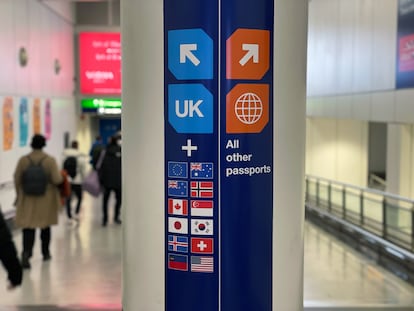
Post‑Brexit restrictions have also weakened the British passport: in 2016 it ranked third on the list of all the world’s passports according to the number of destinations their holders can access without a prior visa; today it is sixth and falling. Yet visa‑free destinations for British passport holders have increased as well: from 175 a decade ago to 185 today. The visa‑free options of its former partners have also grown, however.
Fewer students
Travel restrictions between the UK and the EU have caused a kind of disenchantment with the UK among European students, both because of higher costs and the complexity of bureaucratic procedures.
Data from the Migration Observatory at the University of Oxford show that the number of EU students enrolled in a UK higher education institution fell from 138,040 in the 2016‑2017 academic year to 75,490 in 2023‑2024, the last year for which statistics are available. The peak was recorded in 2020‑2021, months before the UK’s exit from the Union came into force.
A depleted health service
The latest British Social Attitudes survey (BSA), from March 2025, reveals that only one in four Britons is “very” or “quite” satisfied with the functioning of the NHS, the UK’s public health system and once a flagship of its welfare state. One in two said they were “very” or “quite” dissatisfied. In 2016 those figures were 63% and 22%, respectively.
Immigration, another unkept promise
Many who argued for leaving the EU were driven by an identitarian, nativist and nationalist impulse. They wanted more Britain, less Europe and, of course, less immigration. That has not been the case: although many EU nationals have moved away — in net terms, 162,000 EU citizens left between 2021 and 2025 — arrivals from non‑EU countries have surged, according to official data.
...And a great paradox: the far right is surging
Far from being penalized, those who pushed the hardest for the UK to leave the EU have in some cases benefited. The latest polls put Reform UK — the far‑right party shaped in the image of its leader, the consistently controversial and theatrical Nigel Farage, the most recognizable face of the pro‑Brexit movement — as the favorite. Pending the hope that the prospective next British prime minister Andy Burnham may inspire within the currently dispirited Labour ranks, the same populism that wrapped Brexit in impossible promises has never been closer to 10 Downing Street.
The winners: a few beneficiaries
While a majority continue to grapple with Brexit’s bitterness, a few have indeed benefited from the UK’s exit from the EU. Beyond Farage and his circle, a recent article in the Financial Times detailed how Northern Ireland now enjoys a unique economic status that allows it access to both the EU goods market and the UK market without restrictions. No other part of the UK has benefited from this or a similar arrangement.
Likewise, the customs sector has seen a notable expansion of its workforce, with around 10,000 new customs officers hired to cope with the extra paperwork, according to the Institute of Export and International Trade.
A handful of newly established companies in the food and technology sectors (with artificial intelligence at the forefront) have also profited from the shift in regulatory rules, no longer obliged to comply with EU regulations that are less flexible than national ones.
Sign up for our weekly newsletter to get more English-language news coverage from EL PAÍS USA Edition









































