
US military intervention boosts Venezuela’s economic forecasts
Trump’s announcements authorizing the purchase and exploitation of Venezuelan oil improve expectations for the country’s ailing finances
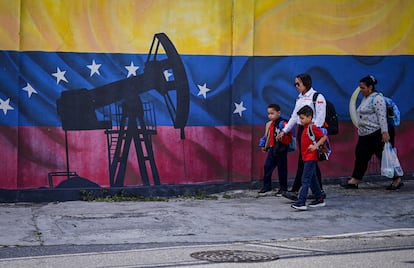
The energy agreement brokered after Nicolás Maduro’s arrest between U.S. President Donald Trump and Venezuela’s interim president, Delcy Rodríguez, has transformed Venezuela’s economic outlook in the blink of an eye. Just last December, the country faced a bleak 2026: international sanctions; triple-digit inflation spiraling out of control; a fiscal deficit of 9% of GDP; a meager wage scale; and minimal economic growth. The agreements brokered by Washington after Maduro’s removal from power have removed legal obstacles to the exploitation of the country’s natural resources, and now, in some financial circles, there is even talk of an economic resurgence.
The Trump administration has announced it will take approximately 50 million barrels of Venezuelan oil and sell it at international prices, without the discounts the Venezuelan state has had to accept in recent years due to its triangulated sales. Trump has lifted the ban on international companies and contractors interested in exploiting Venezuelan crude and has expressed a willingness to promote new investments in local oil fields. Companies like Chevron and Repsol are preparing to expand their presence in this new environment. The measures also remove obstacles for the state-owned oil company, Petróleos de Venezuela (PDVSA).
Rodríguez announced that $300 million has already entered the economy from those sales, and that money has been injected into the national banking system. Trump has announced that the White House will oversee the proper investment of local resources. The Venezuelan parliament is working on modifications to the Hydrocarbons Law with the aim of using language more conducive to private investment. The impact on the exchange rate has already been felt: the parallel dollar has seen a clear decline. Alejandro Grisanti, chief economist at the firm Ecoanalítica, has stated that the exchange rate gap could be closed within a few weeks.
“The situation in December was very precarious due to U.S. pressure: Venezuela couldn’t sell oil,” recalls Luis Oliveros, economist and dean of the Metropolitan University. Oliveros predicts a significant drop in inflation. “Exchange rate pressure should begin to ease, and fiscal relief is also coming. Venezuela’s problem in recent years wasn’t spending, but revenue: the country lost its sources of funding. We won’t reach a fiscal surplus, but in 2026 that deficit will decrease considerably.”
In local economic circles, there is already talk of double-digit growth and oil production potentially reaching 1.6 million barrels per day by the end of this year. Following the near-total collapse of its economy between 2014 and 2020 — which brought with it the debacle of PDVSA — Venezuela has lost 70% of its total GDP. The country would need to experience double-digit growth for several years to recover its traditional economic size and invest heavily in rebuilding its oil industry, severely damaged by neglect and corruption, to return to three million barrels per day.
From 2022 onward, Venezuela has been able to partially reactivate its productive sector and its economy has resumed growth, although still at precarious and insufficient rates. Formal improvements in income may provide some immediate relief to wages and employment, but much work will be needed to ensure these improvements have a concrete social impact. It has been four years since a wage increase was decreed in the country.
“I don’t think it’s wise to be offering net figures on economic growth and inflation levels for this year. It’s too early to know, because other decisions need to be made,” says José Manuel Puente, a professor at Oxford University and a member of the Venezuelan Academy of Economic Sciences. “I’m concerned about the tutelage, the country’s lack of autonomy from the United States in securing its own revenue, but in the immediate future, things are clearly going to improve significantly in every respect.” Puente points to “strengthening the country’s international reserves, which are at very low levels,” as an urgent task.
At the helm of the Chavista executive branch, interim president Rodríguez is struggling to downplay the tremendous political cost of adhering to the White House’s unilateral dictates regarding national resources, following the bombing of Caracas on January 3. For now, the incoming money is also welcome news for the Chavista regime, which is facing a deficit and burdened with debts. Rodríguez, who repeatedly asserts that the country is sovereign and owns its natural resources, has announced that these additional revenues will be used “to protect workers’ purchasing power and stabilize the economy.” Rodríguez maintains that the Venezuelan economy has also shown significant improvements in other sectors, such as mining and manufacturing.
“This Rodríguez administration understands the economy and market principles much better than Maduro did. There are more pragmatic people, and that should help,” says Oliveros. “It will be crucial for the Republic to emerge from debt default. Bondholders will demand that the nation address this urgent problem. Furthermore, it is important to regain access to international credit to consider a genuine recovery.”
During the 20th century, with the arrival of oil, Venezuela experienced at least six consecutive decades of high economic growth and single-digit inflation. The oil boom allowed the country to build significant infrastructure and establish a decent network of hospitals and schools, boasting the highest per capita income in the entire subregion. Today, its population is almost entirely mired in poverty, and its workers’ wages are among the lowest in all of Latin America.
Sign up for our weekly newsletter to get more English-language news coverage from EL PAÍS USA Edition









































