
Exiled Venezuelan oil experts in Texas warn ‘clear rules’ are needed before investment returns
Former PDVSA workers in Houston watch seized tankers arrive in the city that became their new home
At 53, Arturo lost the job where he had spent half his life. It was January 2003, and Hugo Chávez had begun mass layoffs at PDVSA, the Venezuelan state oil company. More than 18,000 people were left jobless overnight. Arturo, who was the executive manager of the company’s exploration unit and head of the technical team, learned about it from the press. “They fired us and took away all our benefits,” he recalls from his home in Houston, where he lives at 76. Two decades later, the same city that took him in after his dismissal is receiving the oil tankers that the United States is seizing from Venezuela. The same city that is ready to receive even more crude once — as Trump has promised — it begins to flow again in Venezuela as it did in the boom years.
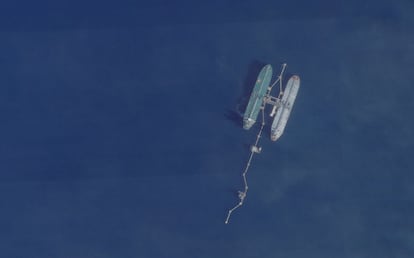
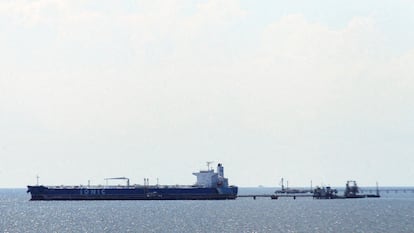
The first of the ships, the Skipper, was intercepted last December while transporting 1.8 million barrels of heavy crude. It was taken to the coast of Galveston, about 50 miles from Houston, where it remains in custody. At over 300 meters in length, it cannot enter the port, so it is anchored offshore.
Since then, other vessels have been targeted by the Trump administration in its efforts to block tankers carrying sanctioned Venezuelan crude. The Centuries was intercepted on December 20 in the Caribbean. The Bella was pursued for weeks in the North Atlantic and finally captured in January, after futilely claiming Russian protection, as part of the ghost fleet evading international economic sanctions on the high seas.
Arturo, who asked that his last name be withheld, is one of nearly 20,000 Venezuelans working in Houston’s energy sector, according to Dr. Francisco Monaldi, director of the Latin American Energy Program at Rice University’s Baker Institute. Of the approximately 60,000 Venezuelans living in the city’s metropolitan area, “at least a third have some connection to the oil industry,” Monaldi says. He adds that hundreds of Venezuelans work at companies like Chevron, Shell, and Exxon, “many of them in high-level positions.”
The same professionals who helped build one of the world’s most successful oil industries now work in Houston, watching as confiscated ships arrive at the same place they fled to.
This is the case of Arturo, a geological engineer who worked for PDVSA for 32 years. He recounts that his workdays were “12 to 14 hours a day, including Saturdays and Sundays.” After being laid off, he founded his own company with other professionals in the sector. It operated in countries like Colombia, Ecuador, and Peru. But traveling from Venezuela became increasingly difficult. “They wouldn’t allow us to work with any company in Venezuela,” he says. That’s why, in 2008, he decided to open an office in Texas, where he emigrated with his family.
The collapse of the industry
“What destroyed the Venezuelan oil industry was the lack of strong institutional frameworks, corruption, inappropriate expropriations, and the dismissal of thousands of workers,” says Dr. Luis A. Pacheco, former executive director of corporate planning at PDVSA. “The Venezuelan hydrocarbon industry has been the victim of bad policies for two decades,” he adds.
Pacheco, 75, was also CEO of BITOR, the Orinoco Belt’s extra-heavy crude subsidiary. He is now a research fellow at the Baker Institute. Both Pacheco and Monaldi agree that U.S. sanctions were not the primary cause of the collapse. “PDVSA was producing three million barrels when Chávez came to power,” Monaldi points out. “By 2016, before the sanctions, PDVSA was producing far less oil, something like 600,000 or 700,000 barrels. It was a brutal collapse.”
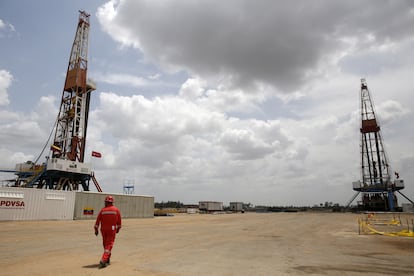
When the oil sanctions arrived in 2019, PDVSA was still producing 1.3 million barrels. Today it produces around one million. “Only 300,000 barrels less than when the oil sanctions began,” explains Monaldi.
“If you look at how much Iran or Russia produce, which have also been under sanctions for a long time, you’ll see they have a powerful oil industry. That’s your best answer,” Pacheco states. According to him, to revive the Venezuelan industry, an investment of “$100 billion over 10 years would be needed to reach 3.5 million barrels per day, plus recovering part of the refining infrastructure, the petrochemical industry, carrying out environmental remediation, and restoring the necessary electricity generation capacity.”
That very figure was recently mentioned by President Trump. Last week, the Republican stated that the world’s largest oil companies had committed to rebuilding Venezuela’s oil industry. “They are going to go in. They are going to rebuild the whole oil infrastructure. They are going to spend at least $100 billion,” he said.
“It’s unrealistic in the short term to think that this money will arrive without very substantial changes to the institutional framework, without political stability, and without a political consensus on opening up the sector,” warns Monaldi. Pacheco, for his part, believes that “under the current regime, it’s not possible to achieve the necessary changes. If you ask me tomorrow if there will be a political change, it might begin, but I don’t see it happening today.”
What could happen in the short term, according to Monaldi, is what he calls “low-hanging fruit.” Chevron, which already has signed projects and its own cash flow, could increase production. Repsol “might too.” And several small Texas producers, the so-called “wildcatters,” could also invest in conventional oil fields “from which PDVSA is barely extracting any barrels.” “The sum of Chevron, Repsol, and these small projects could add a maximum of 400,000 or 500,000 barrels over the next two years,” Monaldi estimates.
Meanwhile, the major Houston oil companies are proceeding cautiously. ExxonMobil and ConocoPhillips, both expropriated by Chávez, are demanding guarantees before returning. “We’ve had our assets seized there twice, and so you can imagine to re-enter a third time would require some pretty significant changes,” Exxon CEO Darren Woods said last Friday.
Chevron, for its part, is the only U.S. oil company that never left the South American nation. Following the arrest of president Nicolás Maduro, the company issued a statement supporting “a peaceful, lawful transition that promotes stability and economic recovery.”
Clear rules, security and transparency
Miguel Morales, a 59-year-old Cuban who has worked in Texas refineries for eight years, says that “the majority of oil workers are Latino. They’re mostly Mexican because of the proximity, but there are also many Cubans and Venezuelans.” Regarding the arrival of the confiscated ships, he says that “it was quite shocking, given the United States’ capacity to carry out operations of that kind and to stop fuel shipments to Cuba and other countries.”
The operations have been methodical. The Skipper was sailing toward Cuba under a false Guyanese flag when the Coast Guard intercepted it off the Venezuelan coast on December 10. Days later, they did the same with the Centuries in the Caribbean, while it was sailing under a Panamanian flag. The Bella 1, which was renamed Marinera under a Russian flag, managed to escape, but was pursued for weeks until its capture. Another vessel, the Sophia, was seized in Caribbean waters last week.
Currently, only Chevron’s ships, which have a special license from Washington, continue to operate normally.
For Venezuelans like Arturo, the situation is emotionally complex. “Seeing those ships arriving here doesn’t evoke any feelings in me,” he says. “I see it as a transition process. There hasn’t been any real change yet. Now, with Maduro’s arrest, we’ll have to see if there’s a real change in how the country is run, from a political and democratic standpoint, in the oil industry, and in other areas.”
Arturo is a member of the Venezuelan American Petroleum Association, an organization with nearly 200 members. “Its goal is to preserve knowledge, maintain professional development, and support Venezuela in rebuilding its industry,” he explains. “Those of us Venezuelans who have been abroad for many years have been preparing to return to the industry if there is a change,” Arturo adds. When asked if he would return to contribute his experience to this effort, he says he is “willing to collaborate, but I don’t see myself returning to Venezuela to work in operations.”
“There are many Venezuelan professionals who are willing and of the right age to go,” Pacheco points out. “But it depends on their age, how well-established their families are, and how attractive the financial opportunity is.”
In that sense, Monaldi believes that with the right conditions, “a good percentage would return temporarily if the opportunity is attractive.” But without conditions, “they wouldn’t even want to leave as expatriates.”
For Miguel, the situation in Venezuela is a mirror of what could happen in Cuba. “With everything that’s happening now and with the expectation of possible change, I’ve considered the idea of moving back to my country,” he says. However, he wouldn’t leave Texas permanently. “I’ll maintain both nationalities as long as possible.”
“The United States has historically bought Venezuelan oil at market price, and I don’t see why it would be any different now,” Arturo says. “It’s a business, after all. It’s not like the oil is just hanging from trees for people to come and take. Foreign companies have to invest money.” For that investment to happen, everyone agrees that “clear rules of the game, legal certainty, and transparency in the processes” are needed.
“I envision a country where there is investment from North American companies and possibly also from Asian companies,” says Arturo. “Oil is a good business as long as it is managed with clear and transparent rules.”
Sign up for our weekly newsletter to get more English-language news coverage from EL PAÍS USA Edition









































