
From safe-haven investment to geostrategic weapon: Who owns the most gold and where are the bars kept?
The war in Ukraine, Trump’s disruptive policies, and his interference with the Federal Reserve have revived countries’ interest in controlling and increasing their reserves of the precious metal
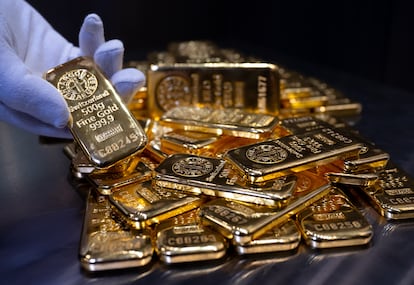

Gold has been a symbol of wealth for thousands of years. While humans have used all sorts of instruments as money (salt, coins, banknotes, or now, algorithms), no asset even comes close to matching its historical significance. And popular culture is also full of references to the precious metal. These include historical references, like the Moscow gold sent by the Spanish Second Republic to the USSR, and television references, such as the success of the series Money Heist.
Even in an age of futuristic mechanisms such as cryptoassets, the precious metal asserts its power — not only as an investment asset capable of providing a safe haven during financial turbulence, but also as a geostrategic weapon. Central banks’ gold purchases, accelerated by the outbreak of the war in Ukraine in 2022, have been a crucial factor in driving its price higher, to the point that ownership of gold bars and the physical location where they are stored is taking on a new significance, shaped in large part by the new global and commercial order imposed by the White House.
The turbulent international policies pursued by U.S. President Donald Trump, in open confrontation with the European Union, have sparked debate this year in countries such as Germany and Italy about the advisability of repatriating their substantial gold reserves held in the U.S. Washington declared a trade war this year, but the White House’s sweeping tariff policies ultimately exempted gold, an asset too sensitive for the world’s largest economy. Still, even the mere threat of levying tariffs helped push up its price and triggered a precautionary movement of bars across the Atlantic, from London’s vaults to New York’s, to avoid potential U.S. tariffs on foreign gold.
China also demonstrates gold’s importance in today’s geopolitics: its central bank is one of the most prominent buyers, in quantities suspected to exceed official declarations. This lack of transparency is typical for assets that take on geostrategic value.
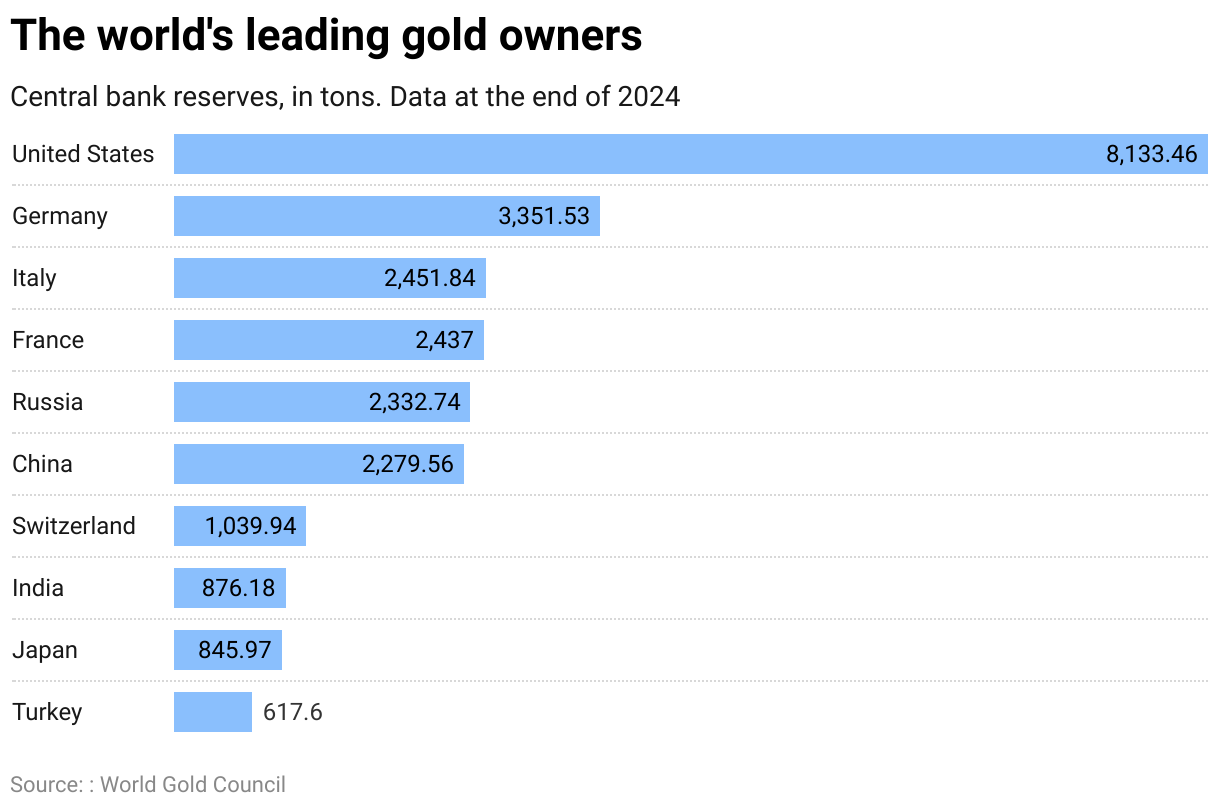
The gold standard as a benchmark for global currencies was abandoned during the Great Depression, and the dollar’s convertibility into gold ended in 1971. Yet central banks around the world still hold vast reserves of the metal, whose value has soared thanks to rising prices. Gold appreciated by 65% in 2025, its best year since 1979, and has risen nearly 140% over the past three years. U.S. reserves — the largest in the world at 8,133 tons — have surpassed $1 trillion for the first time. Central bank purchases have been decisive in the metal’s unstoppable rally, totaling around 32,000 tons globally. They are valued at €3.84 trillion ($4.51 trillion).
The Russian invasion of Ukraine in February 2022 marked a turning point for gold both as a safe-haven asset and as a geopolitical tool. “It brought about a structural change in global gold demand. When the United States froze all Russian dollar-denominated assets, many central banks in emerging markets worried about the possibility of similar measures being taken against them in the event of a conflict,” explains Kerstin Hottner, head of commodities at Vontobel.
As a result, many central banks decided to diversify away from the dollar in their reserves, favoring gold purchases instead. According to Carsten Menke, head of Next Generation Research at Julius Baer, the war in Ukraine is “the main factor that has caused the change in gold’s role as a geostrategic asset. This is a structural change that is unlikely to be reversed, even if a peace agreement is reached.”
But there is another factor that has strengthened gold’s geostrategic profile in recent times: Donald Trump’s return to power. The U.S. president is breaking the status quo of international relations with his continuous attacks on the European Union. He is also undermining the independence of the Federal Reserve, custodian of thousands of tons of gold from European central banks that deposited part of their reserves in the U.S. during World War II and the Cold War. These two factors have recently reignited debates in Germany and Italy — where 37% and 43% of their gold reserves are held at the Federal Reserve in New York, respectively — about repatriating the precious metal. Germany and Italy are, after the U.S., the countries with the largest gold holdings in the world: 3,350.25 tons at the Bundesbank and 2,451.84 tons at the Bank of Italy, according to the World Gold Council.
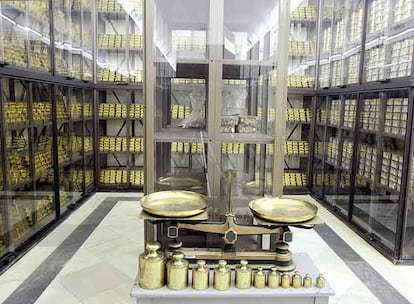
In any case, these two countries store most of their gold in the vaults of their central banks in Frankfurt or Rome, just as the Bank of Spain does in Madrid. The United States protects its own reserves — and those of other countries — across New York and military facilities at West Point and Fort Knox. The Bank of England holds British gold bars, as well as those of other central banks and private investors, who rushed this year to buy the metal as an investment.
“There is a growing movement of repatriation, or at least sovereign relocation, of gold reserves, related less to logistics and more to doubts about the political and legal security of the U.S. as a neutral custodian,” explains Judith Arnal, senior researcher for economics at Spain’s Elcano Royal Institute. “It is not yet a mass exodus from the New York Fed, but it is a structural trend to hold more gold in one’s own country or in jurisdictions that offer full legal guarantees and to reduce the risk that reserves could be caught up in sanctions, political pressure, or interference with the custodian central bank.”
So far, requests to repatriate Italian or German gold have not come from government officials or central banks. In Germany, they have emerged within the far-right party Alternative for Germany (AfD), and in Italy, the idea has been present since 2019 within the Brothers of Italy party, led by Italian Prime Minister Giorgia Meloni. However, her government has taken no steps to repatriate reserves from the U.S. — a move that would be costly logistically and, no doubt, politically as well.
Kerstin Hottner, head of commodities at Vontobel, does not believe that European countries will repatriate their gold held in the U.S. in the near future. “Doing so would represent a significant loss of confidence in the United States. It would also be seen as a clear affront to Trump, and given his personality and track record, he would likely take it personally and retaliate in some way. The political implications of a large-scale repatriation would simply be too great,” she explains.
Italy provides another recent example of this renewed interest in national gold reserves: Meloni’s party has proposed declaring that the country’s gold reserves “belong to the state, on behalf of the Italian people” — a measure that immediately raised concerns at the European Central Bank, which fears that it will undermine the independence of the Bank of Italy and violate European treaties.
Gold and tariffs
Gold, as a geopolitical asset, is a sensitive issue for the U.S., as its tariff policy has shown. Trump’s threat of imposing taxes on the precious metal prompted a precautionary movement of bars from London’s vaults to New York. The Bank of England, whose vaults hold a significant portion of the world’s financial institutions’ gold, recorded strong withdrawal requests in February from traders and banks, who preferred to move it to New York. The impact of the tariff threat on gold peaked in August, when Trump announced a 39% tariff on Switzerland, which also affected the country’s powerful gold refining industry.
Switzerland processes around 70% of the world’s gold, and the U.S. is a major importer of gold bars. In fact, much of Switzerland’s trade surplus with Washington is explained by the precious metal. Trump ultimately decided to exempt gold from tariffs and reduce Switzerland’s rates to 15% in an agreement that included a Swiss investment package of about $200 billion in the U.S., with the gold refining industry as a key beneficiary.
“It appears that the decision to impose a 39% tariff on Switzerland was made without fully considering the country’s role as a global refining hub,” says Hottner. “When the gold market again began to show signs of distortion, U.S. officials were quick to reiterate that gold would not be part of the tariff package.”
Chinese purchases and lack of transparency
Annual gold purchases by monetary authorities averaged around 500 tons between 2009 and 2021, but have multiplied since 2022. China holds the world’s sixth-largest gold reserves, totaling 2,279.56 tons, up from 1,948 tons in 2021, according to the World Gold Council, a leading source of information on global gold ownership. Poland, on high alert since 2022 due to its proximity to Russia, has increased its gold reserves even more sharply, from 230.84 tons in 2019 to 448.23 tons in 2024.
Most countries voluntarily report their gold reserves to the IMF. “That said, beyond these declared reserves, there is also a large amount of undeclared purchases that have begun to emerge since 2022, that is, since the U.S. dollar began to be used as a weapon,” explains Menke, who says China is one of the largest undeclared buyers. According to the expert’s calculations, “its volume of undeclared purchases reached 821 tons between January 2022 and the present. This compares to 357 tons of declared purchases.”
According to Arnal, from the Elcano Royal Institute, “there is considerably less transparency than official data suggests: while statistics for declared reserves are relatively consistent, there are strong indications of unreported purchases and holdings, as well as gray areas in private ownership and opaque sovereign reserves.” In her view, the available data are reasonably reliable for determining which countries hold the most gold, allowing for comparisons between nations, but it is not possible to know in detail all the gold held by states or exactly where it is physically stored.
Sign up for our weekly newsletter to get more English-language news coverage from EL PAÍS USA Edition









































