
Olivier de Schutter: ‘A 2% tax on billionaires would provide social protection for 820 million people in low-income countries’
‘The money is there,’ says the United Nations Special Rapporteur on extreme poverty and human rights. ‘All that is needed is the political will’
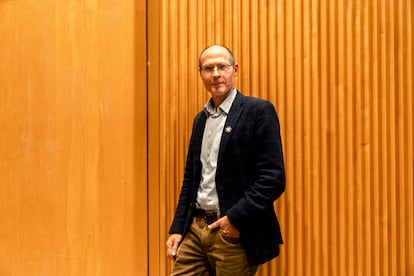

Olivier de Schutter, 57, thinks it possible for the over 800 million people who, according to the United Nations, live on less than $2.15 a day to improve their living conditions. According to the Special Rapporteur on extreme poverty and human rights, it would require the political will to tax billionaires and apply other measures, such as levies on aviation, maritime transportation and financial transactions. “The money is there,” the Belgian lawyer and poverty expert told EL PAÍS during an interview that took place in late September in Madrid, where he participated in the Beyond Growth conference.
Question. In a world with more than 800 million people living in extreme poverty, what is your priority when it comes to addressing poverty and hunger?
Answer. The priority is clearly to allow low-income countries to finance social protection, because they simply do not have enough fiscal leeway to provide their population with economic security against unemployment, disability, sickness, pension payments and so on. It would cost about $308 billion per year to allow the 26 poorest countries on Earth to provide their population with social protection, about twice the level of official development assistance in the year 2019. It is not affordable for low-income countries alone, but it is affordable for the international community. All that is needed is the political will, and it is the best investment we can make.
Question. Many governments are reducing development aid budget. How does that affect the global fight against poverty?
Answer. Well, that’s a disaster, and the figures show that millions of people will be affected by the retreat of USAID. I’d like to commend the fact that the Spanish government has not retreated on its commitments to support development aid. But there are many other tools. In my most recent report to the United Nations, I listed a number of innovative financing mechanisms that could allow us to compensate for this reduction. Those mechanisms include a billionaire’s tax, as proposed by Brazil when it chaired the G20.
Question. How should billionaires be taxed?
Answer. A 2% tax on the wealth of billionaires, about 3,000 people in the world, would be more than enough to provide social protection to all people in low-income countries, 820 million people in the 26 poorest countries. And the billionaires would not even notice it.
Question. What other steps could be taken?
Answer. Solidarity taxes, for example, taxes on aviation, on maritime transportation, taxes on financial transactions. I show in the report that we could, with the necessary political will, mobilize enough resources to support the universalization of social protection across the world. The money is there.
Question. You also propose degrowth as a formula to reduce poverty. Why?
Answer. Degrowth is a strategy of democratic planning of the transition towards a more sustainable model of production and consumption. It is not an economic recession, where consumption and productions are reduced, and which people may be suffering from if it leads to deprivation and to sacrifice. With that understanding, degrowth can be a solution to reducing poverty, because it will mean a more equitable distribution of wealth and income and closing the gaps between the rich and the poor.
Question. Do you think there are certain discourses that lead to aporophobia, hatred of the poor?
Answer. One major reason why people are not able to escape poverty is because they face discrimination. They face negative stereotypes. That is not simply a subjective experience, but an exclusionary one. It is an obstacle to seeking employment, to finding housing, to improving your education or to gaining access to social protection. If you face discrimination from an employer who does not trust you because you have been a long-term unemployed person, or because you don’t have the right accent, or you don´t have the right cultural codes, you will face obstacles accessing jobs. If a landlord does not want to rent an apartment to a person who depends on social assistance or whose income is irregular, then you will find it difficult to rent an apartment. If your child is bullied at school because they are known to come from a low-income household, they will not perform well in class. And finally, if you are humiliated, harassed, shamed when you seek social benefits, then you will not claim your rights. Aporophobia is not simply unfair, it is also an obstacle that people face in order to escape from poverty.
Question. Can this be fought be changing the narrative?
Answer. All too often, politicians implicitly or explicitly blame people in poverty. ‘They should follow training, they should provide a better education for their children, they should keep their appointments,’ and so on… and that is extremely perverse. We should view poverty as the result of a society that is not inclusive enough, not as an individual issue. Paradoxically, the more a society becomes meritocratic, rewarding people based on their talent and effort, the more being poor is shameful. If you don’t succeed in a meritocratic society, it means you do not deserve to succeed, and that is very perverse and dangerous. Those who succeed as meritocrats usually do so because their family is wealthy, they benefited from a good education, and had access to a support networks that allowed them to succeed.
Question. Is aporophobia growing in the Global North?
Answer. Yes, because the welfare system is under pressure and increasingly, people who benefit from social assistance have conditions imposed on them. People in poverty are seen as competitors, as potentially cheaters, as a dangerous class. The rise of the far-right populist parties in Europe and the United States have made people in poverty the scapegoats.
Q. As chair of the International Panel of Experts on Food Systems (IPES-Food), what structural changes are needed to end hunger?
A. The key is to understand that most hungry people are so because they are poor, not because of natural disasters or conflicts. They are poor because wages are too low, because social protection is insufficient, and because small farmers do not receive a fair price for their products. Hunger is not a technical problem; it is a political one, and it can be eradicated.
Q. And in the Gaza Strip, where there are already areas where famine has been officially declared?
A. Gaza is a special case; the famine is due to the blockade of humanitarian aid. But in most countries, there isn’t a lack of food, just a lack of purchasing power.
Q. You have called what is happening in Gaza a genocide.
A. I’m a lawyer. Genocide is defined by two elements. One, policies that can take the form of murder or living conditions that are unsustainable for the people. And the second element is a subjective: the intention to destroy a group defined by its religion, its ethnicity, its nationality, or other characteristics. And what is happening in Gaza is a genocide because the conditions to which the Palestinians are being subjected to increasingly reveal an intention to destroy a particular group defined by its ethnicity and its religion. Genocide can take different forms and the form we are seeing in Gaza is an indiscriminate use of force against defenseless civilian population. At least two-thirds of the 65,000 people who have been killed in Gaza since October 7th, 2023 are women and children. And that goes hand in hand with a growing discourse in Israel that is dehumanizing the Palestinians and that sees all of the Gaza population as complicit in the terrorist attacks of October 7th.
Q. What must the international community do to stop it?
A. For the moment, the measures that have been taken are symbolic. Even the recognition of Palestine [as a state] remains symbolic. The EU would seriously have to say, we are not importing any more goods and services from Israel, because the EU is the primary trading partner of Israel: 32% of the exports of Israel go to the EU, the equivalent of €16 billion per year. That is the only way to put pressure on Israel to stop the genocide. But that would very likely be opposed by Germany and Italy.
Sign up for our weekly newsletter to get more English-language news coverage from EL PAÍS USA Edition









































