
Houston, the city that nearly ended homelessness and now criminalizes it
Despite the success of The Way Home, lack of housing and funding cuts have led to a renewed rise in the city’s homeless population

For years, Houston was one of the U.S. cities with the lowest number of people experiencing homelessness. Between 2011 and 2020, thanks to the regional system The Way Home, the city reduced homelessness by 63%, housed more than 35,000 people, and dismantled 127 street camps. Politicians from Dallas, Pittsburgh, and New Orleans traveled to study the model. The architect of the system, Mandy Chapman-Semple, said the city had essentially created a manual that allowed any other city to replicate it. “We’ve proven that it can be done,” she said. However, five years later, the formula has begun to wear thin.
Earlier this year, 1,282 people were sleeping on the streets of Houston and its surrounding counties. That number was 15.8% higher than in 2024, marking the first sustained increase in more than a decade. In July, the City Council banned sitting, lying down, or storing personal belongings in public spaces downtown. Violations of this rule are considered class C misdemeanors and can carry fines of up to $500. In this way, Houston went from being a model to follow, to criminalizing people who sleep on its streets.
Catherine Villarreal, vice president of the Coalition for the Homeless of Houston/Harris County (CFTH), the organization that coordinates The Way Home, notes that “the success of the model lies in combining housing with supportive services, especially for people with disabilities and chronic conditions.” However, she adds, there is still a challenge to address: “people without shelter often have to wait on the street until a spot in a housing program becomes available.”
“While our system is very effective at stabilizing those who are successfully housed, it struggles to address the needs of those who have not yet been matched with stable housing, especially amid rising housing costs and the complexity of behavioral health issues,” explains Villarreal.
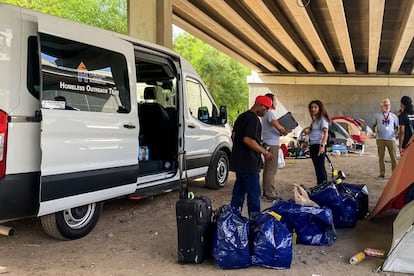
The strategy dates back to 2012, when Houston began implementing a model called Housing First — in other words, housing first, services later. According to this logic, it makes little sense to ask someone sleeping under a bridge to solve their addiction or mental health problems before they have a place to live. First, you have to help them find a place to live, then you help them stabilize their life.
“The initial success was due to bold political leadership, coordinated institutional action, and a shared commitment to prioritizing housing,” explains Villarreal. “The creation of The Way Home united more than 100 partners under a common strategy, supported by data-driven decision-making and centralized access.”
The program’s organizers created a database to record in real-time where each homeless person slept. They also established a coordinated entry system to avoid bureaucratic delays. The city also had something that gave it an advantage over others: a large supply of affordable apartments. By 2020, Houston had reduced its homeless population from 8,500 to around 3,200.
The Beacon
The Beacon is the organization that runs Houston’s largest day center. It’s, they say, “the front door” for homeless people. There they can shower, do laundry, receive mail, eat, and, most importantly, access assessments that determine their priority on housing waiting lists.
Ten years ago, the center served about 660 people a day. Today, it serves just over 200. “The progress of the system is real, and we see it most clearly when people are assigned to housing and move in,” explains Ana Rausch, executive director of The Beacon.
According to Rausch, between 2023 and 2025, the center intensified its outreach efforts. In 2023, they served 80,175 meals, a figure that increased to 97,617 in 2024. So far in 2025, the number has risen to 73,043. While the number of visits to the center is declining, the demand for basic services is increasing dramatically.

“On a daily basis, we serve an increasing mix of people who have recently experienced homelessness and others with greater vulnerability: mental health and substance use issues, complex medical needs, or long periods of homelessness,” Rausch explains. “This means that, while the system is reducing homelessness overall, the work at the front door is more intensive: more coordination with health and behavioral health providers, more time per person, and more support to stabilize them while they wait for housing.”
“Although the numbers have decreased, the people we serve today face greater barriers, and many are considered the hardest to serve,” the director states. Last September, CFTH reported that 56% of Houston’s unsheltered population has mental health issues and 46% has substance abuse disorders. Most say these conditions limit their ability to work or live independently.
Weaknesses of the system
Rausch explains that the system’s collapse is due to a combination of factors. On the one hand, displacement of camps and the lack of beds force many back onto the streets, increasing the need for safety and stabilization at The Beacon. Added to this is the shortage of psychiatric care and transition options. Outpatient connections, Rausch explains, often take weeks.
Rising rent and a lack of available units are exacerbating the situation. Acquiring housing has become complicated due to factors such as perceived risks by landlords and the cost of insurance. Houston built its system with roughly $100 million, primarily from federal COVID-19 emergency funds. That money is now running out, and the city has no way to replace it because Texas limits local governments’ ability to raise taxes. Houston is no longer the cheap city it once was and has lost much of what made the system’s initial success possible.
Rausch also argues that it is difficult to “recruit and retain qualified frontline and clinical staff in a high-cost market.” The legal services of The Beacon Law — which help homeless people, for example, recover IDs and clear outstanding fines — closed 1,905 cases in 2023. But in 2024, the number dropped to 1,691. In the first months of 2025, they reported just over 1,200 — a 34% drop at a time when case complexity is increasing.
To counter these weaknesses, Catherine Villarreal emphasizes that The Way Home has expanded its connections with landlords, launched pilot programs to prevent evictions, and explored new funding sources. She also says they are investing in job training and income supports to help beneficiaries maintain their housing over the long term.
The iron fist as an alternative
The local government has responded by criminalizing the most disadvantaged. The ordinance passed last July was justified on the grounds that enough shelter beds are available and that the rule would only be enforced in areas where alternatives exist.

“Looking ahead, Houston must address the growing complexity of unsheltered homelessness, behavioral health needs, and system sustainability,” Villarreal notes. “Key innovations include a street outreach team, new gateways to streamline access, and expanded partnerships, for example, with health systems. The city is also exploring funding mechanisms to ensure long-term viability.”
Ana Rausch, for her part, believes that “people are returning to the streets” because there aren’t enough options. She also lists alternatives to preserve the progress that has been made. For example, she suggests maintaining centralized funding for programs that sustain the system and avoiding “funding cliffs” that disrupt work and relationships with landlords. She also proposes incorporating local funds to address homelessness and creating flexible resources to cover deposits, fees, household items, and insurance to mitigate landlord risks.
Rausch also believes it is urgent to invest in behavioral health, especially in the rapid provision of psychiatric care. She also highlights the importance of outpatient transitional options, mobile teams, and medical resilience capacity. Moreover, she proposes increasing the production of and access to temporary housing, incentivizing small landlords, and rehabilitating low-cost units. At the same time, she insists on extending stabilization support to the most vulnerable households beyond the timelines of rapid rehousing.
Sign up for our weekly newsletter to get more English-language news coverage from EL PAÍS USA Edition









































