
Abandoned houses for the homeless: Mexico’s plan to make Alejandra a homeowner
The Sheinbaum administration is developing a comprehensive strategy to reverse decades of social decline across more than 800,000 Infonavit homes with years of unpaid debt
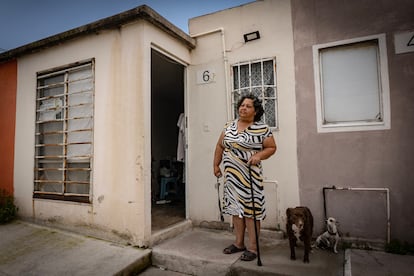

Her house is so small that one short stride from the front door is enough to land you at the next home — identical to hers, but in a different color. Peeking through the frame of that door is Alejandra Gálvez, 45, with her iron cane: foul-mouthed, cheerful, and generous — a force of nature. Life is tough, but I’m tougher, she says with her presence.
Alejandra is from Coatzacoalcos, Veracruz, and crossed half the country before ending up in Huehuetoca, in the densely populated State of Mexico. For 10 years, she’s been living in a house she occupied after renting another one where the landlady would walk in whenever she pleased, without warning.
“I’d see the house, and no one ever came, and one day I said: ‘Screw it, I’m moving in. The rogue way,’” she laughs.
At the time, it was just the bare “shell,” as they’ve come to call the homes that were first abandoned and then stripped: a space three by 10 meters, with a handful of walls and a roof. No doors, no electricity, no water — nothing that might suggest a home. But bit by bit, she turned it into one. Friends pitched in along the way:
— I’ll do the wiring for 200 pesos ($10.60), but where do you live?
— All the way out in El Dorado, Huehuetoca.
— And where the hell is that?
— Just around the corner from hell, dumbass.
Alejandra, who’s been living on a disability pension of 3,200 pesos ($170) every two months since a motorcycle accident, recalls the work, the money, and the sweat poured into every small fix in a house that isn’t hers — but might one day be. The government of President Claudia Sheinbaum has made it a priority to tackle Mexico’s monumental housing crisis, and part of that broader plan — which began modestly under the previous administration — involves granting legal ownership to people like Alejandra who are occupying homes that technically belong to Mexico’s national worker housing fund institute Infonavit, after going unpaid for years.
There are at least 842,000 such properties across the country in irregular situations. All the agency knows is that the original mortgage was never paid off. Whether the homes are currently inhabited, and if so, whether by the original owners or by someone else — or whether they’ve been abandoned, stripped, or taken over by organized crime — remains unknown. The Ministry of Welfare has started a door-to-door survey to find out who’s living in each one and under what conditions.
In reality, behind that dramatic figure lies an even larger one: Mexico’s national statistics agency INEGI estimates that there are more than six million unoccupied homes throughout the country, regardless of whether they were financed by Infonavit or the reasons that led their owners to leave them empty. That amounts to roughly 20% of all the homes built in Mexico — in other words, one in every five. This is in a country with a housing deficit of nine million homes, either because they need to be built or rehabilitated, according to the 2024 housing report from the Secretariat of Territorial Development.
This paradoxical tangle of numbers stems from a disconnect between housing policies and land-use planning. “We are building houses, not cities, and that is one of the causes of the housing problem we face today,” says Fernanda Lonardoni, representative of U.N.-Habitat in Mexico, Cuba, and Central America. In Mexico, this separation occurred mainly between the 1990s and the first decade of the 2000s. Large construction companies built thousands of homes on cheap land far from jobs, public services, and transportation — perfect ground for organized crime, which has taken control of many of these areas.
So much so that in some residential developments, census teams from the Ministry of Welfare have not even been able to enter, according to their own accounts, because the “administrator,” who has effectively taken control of the buildings, has denied them access. “Some authority will have to come in order to finish the job,” admits one of the census takers from Huehuetoca. There are hundreds of homes left unregistered. Of those they managed to visit, they say: “Most are being tricked into paying someone who claims to be the owner but actually isn’t.”
Urban growth unchecked by government planning has led to a grim reality on the ground. The neighborhood where Alejandra Gálvez lives reflects the decades of social decay resulting from bad urban planning, speculative real estate practices, and institutional neglect. The result is vast fields of tiny, uniform houses located “closer to hell” than anywhere else. Traveling to Indios Verdes, north of Mexico City, costs about 50 pesos ($2.70) from these areas — that’s 100 pesos ($5.30) a day for someone who commutes daily to work, while public transportation in the capital costs 10 times less.
Between Huehuetoca and Zumpango, near the Felipe Ángeles Airport (AIFA), lies a large concentration of irregular housing in the State of Mexico, one of the regions where the problem is most acute: 10,600 units in the first municipality and almost 19,000 in the second. El Dorado, Alejandra’s neighborhood, is classified as a “red zone” due to insecurity and the large number of “problematic” housing units.


When the census workers arrived to tell Alejandra about the regularization plan, it felt like the sky opened up for her. “Honestly, I didn’t know whether to believe it, laugh, or cry. I’ve been through so much, and I never thought the day would come when I could actually own this house,” said the Veracruz native, who lost her husband and her son — one murdered, the other killed in an accident — and now lives with two rescued dogs, Catalina and Pulguita.
Alejandra has fought her way through life with resilience and patience. Now, besides collecting her disability pension, she works as a car watcher early in the morning in downtown Huehuetoca for tips. “Before, when I could, I made and sold lollies or coffee. That’s how I survived,” she explains. With that money, she gradually invested in the house and now dreams of building a second floor “to let the air flow through everything,” and so her nephews can come visit. She also wants to pay off her bills. “I prefer to make my payments. If it’s little by little, that’s fine, but to keep paying, because in the end I live in the house, and it’s me who benefits,” she reasons.
The government project that will allow her to carry out these plans has a similar precedent in the previous administration. “We focused on the northern border to recover urban areas. We ran programs in Mexicali, Ciudad Juárez, Reynosa, and also in the State of Mexico,” explains Carlos Martínez, former director of Infonavit. In total, they managed to recover around 25,000 homes, he says, 67% of which were resold to their original buyers who had lost them due to inability to pay the mortgage. Sheinbaum’s ambitious goal is to recover 600,000 homes.
Joaquín Santiago: A legal loan and no one to hold accountable for basic services
In the residential development where Joaquín Santiago lives, in Zumpango, 12 miles from the National Institute of Agricultural Development (AIFA), there are no shortage of unanswered questions. “They told us there would be jobs, what kind of jobs?” “If you have money, you go to the hospital, and if not?” “There were going to be lots of children’s areas, bike paths, a pool... Where are they?” Joaquín, 35, arrived with his mother at the Santa Isabel campus after stumbling across the advertisements displayed by large construction companies in Ecatepec, the most populated municipality in the State of Mexico, where he had moved to work from the Mixteca region of Oaxaca. “I decided on Homex because it offered us many advantages, but none of them came true,” he says.
It was 2013 when he secured his loan through Infonavit, and 2020 when he lost hope that the construction company would ever finish the work. Now, the inhabited houses — like his — stand in the same row as those that have become little more than garbage dumps. Alongside them are all the homes the company left unfinished: uniform concrete shells filled with nothing but air. The infamous husks.
The consequences of abandoning the job halfway are monumental: no local authority recognizes the housing development as part of its municipality, so no one provides public services like water — and there’s no one to hold accountable either. Residents buy water from private tankers: 150 pesos per tank, and it’s not always clean. And what if you can’t afford it that month? More unanswered questions.


The existence of unincorporated housing developments is a particularly widespread problem in this state, explains the former director of Infonavit. “Unlike other countries, where the land is urbanized first and then the companies come in and build the houses, in Mexico during those years it was the construction companies that did everything, because the municipalities didn’t have the resources,” he explains. “The problem was that the mayors’ terms were shorter than the construction timelines, so the person receiving the project wasn’t the one who had approved it — and many times, the developments were never formally accepted, either because the construction company had left the work unfinished, or because the municipality couldn’t commit to maintaining the services,” he concludes. “It became a source of major social frustration, because residents would complain, and each party would pass the blame to the other.”
Joaquín knows this all too well. “No one supports us here — not the municipality, not Homex, which doesn’t even exist anymore. We were just left behind,” he says, defeated. Everyone, that is, except the criminals: by 10 p.m., everyone is inside their homes, and by 11 p.m., they start hearing gunshots. But not a single patrol car is seen on the streets.
Those who, like Joaquín, paid off their loans misled by deceptive advertising now live wall-to-wall with people who occupied their homes, like Alejandra. Two realities that not only intersect in daily life, but also in the impact of the regularization plan. “For me, it would be excellent,” says Joaquín. “It would greatly improve the environment, because we’d all take on more responsibility.”
Those who aren’t legal owners of their homes tend to be more reluctant to chip in when money is needed for repairs — but they benefit from them all the same. Getting them to feel part of the community, he says, would be the best way to get them involved: “For us, it would be the best thing that could happen.”
50 years of flawed housing policies
The enormous problem now facing the government — which has also committed to building one million new homes and expanding access to social rental options, not just home ownership — has been building gradually over the past few decades. In the 1970s, Mexico focused on becoming a nation of homeowners, “to the point that more than 80% of the population came to own their homes,” says Carla Escoffié, a lawyer specializing in housing rights.
But that figure masked serious issues, such as lack of access to basic services and transportation. Even so, she adds, “they kept betting on public loans, which also exclude people working in the informal economy — who make up the majority of the country.”
The result of that approach, explains Alejandro Suárez Pareyón, an architect at UNAM, is “the long record of a major number of administrative errors, a deeply flawed financial system, and the exploitation by housing developers who built those residential complexes.” In short, adds Fernanda Lonardoni of U.N.-Habitat, “housing has gradually become one of the pillars of our financial systems”: “There’s nothing that ties us more to a bank than a home.”
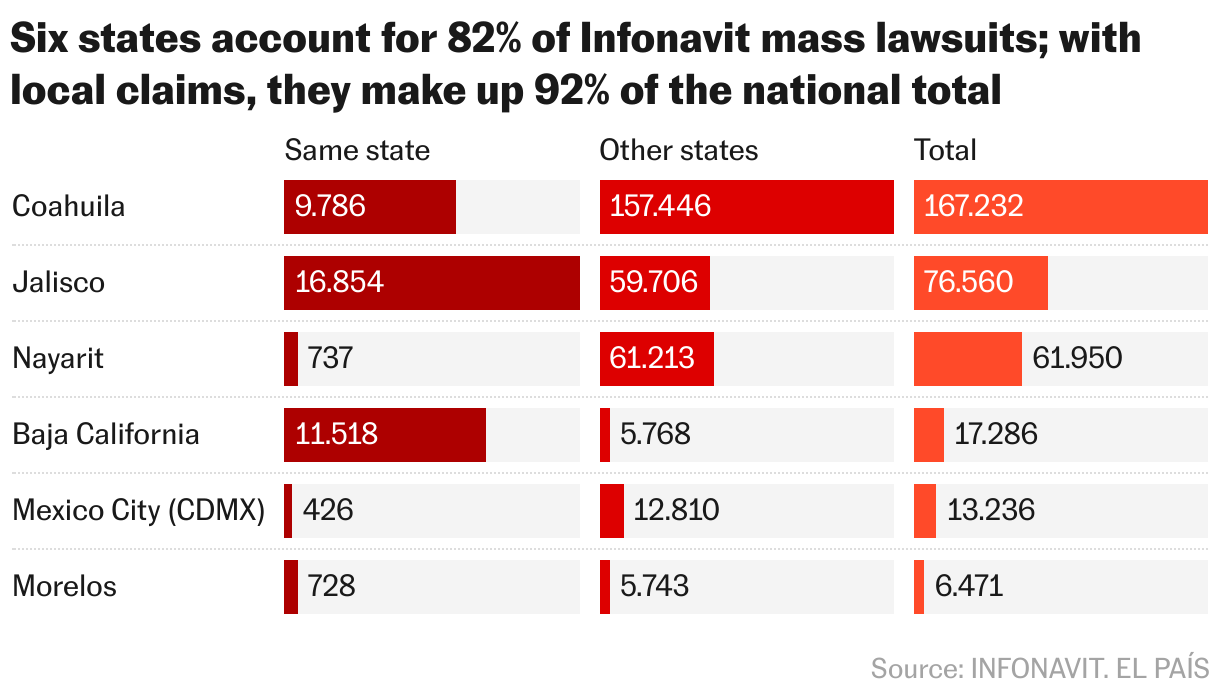
That model collapsed in Mexico: housing developers went bankrupt, leaving behind a trail of abandoned homes — some due to their remote locations, others due to poor conditions — and borrowers who could no longer afford to pay off their loans. When the government first attempted to address the issue in 2014, under president Enrique Peña Nieto, it did so through what became known as Infonavit’s mass trials —legal proceedings involving thousands of cases at once, in which the institute sued borrowers and eventually took ownership of unpaid homes.
“What happened,” explains Carlos Martínez, “was that Infonavit was fighting in a court in Nayarit over a house that had stopped being paid for in Cancún, and the person living in Cancún never even knew the case existed. It was a very perverse strategy.” The current administration estimates that 373,000 people were affected by these mass proceedings.
Although the government has pushed to overturn these highly irregular proceedings, no court has taken this action so far. Many of the homes that became Infonavit property through these means are now part of a plan to return them — through flexible resale options or social rent schemes — to their original borrowers or to others who could make use of them.
The condition of each property varies, and not all will be easy to recover. Homes abandoned 15 years ago due to lack of transportation access, for example, may be easier to rehabilitate if infrastructure has improved since then. Recovering homes left empty due to structural issues will be harder, as they will require greater investment.
In any case, says Fernanda Lonardoni, “there’s also a cost to inaction.” She adds: “In countries where efforts were made to move toward regularization, it didn’t lead to more informality — on the contrary.”
Credits:
Sign up for our weekly newsletter to get more English-language news coverage from EL PAÍS USA Edition