
Bitcoin grows up: From speculative gamble to long-term financial asset
The cryptocurrency is easing its pursuit of new highs in a market increasingly shaped by institutional players
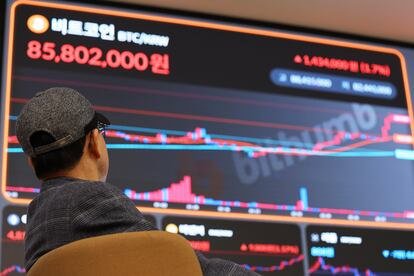
Bitcoin is no longer what it used to be, and the leading cryptocurrency is undergoing its second major transformation. Its original promise of becoming a universal means of payment gave way to a speculative Wild West dominated by a tight-knit community of impulsive investors. Now, it has morphed into a financial asset carving out space in the portfolios of large institutional investors — who set the pace of the market.
After a few tumultuous months marked by investor euphoria (driven by Donald Trump’s return) and panic following the outbreak of the trade war, the cryptocurrency has traded its rollercoaster ride for a steady upward slope. Over the past two months, it has hovered between $93,000 and $111,000 — one of the narrowest ranges in its history — which hasn’t stopped it from hitting all-time highs above $120,000 (it reached a record of $121,207 during Monday’s Asian session). In the past, daily price swings of 5% or 10% — often reversed in the following session — were more the norm than the exception.
This volatility — which had scared off more traditional investors — was actually welcomed in the crypto world, a fertile ecosystem for speculation. Practically since its inception, the space has been dominated not by seasoned financial professionals, but by a legion of retail investors. A self-governed community with its own jargon (“hodling,” “tothemoon”) and promises of quick and easy money from YouTubers. In this world, displays of wealth on social media often took the place of investment analysis or advice — though using the same tools (candlestick charts, Fibonacci extensions) and with even more obsessive market tracking.
Speculators, always eager to catch the next wave, measure their investment horizons not in weeks or months, but in hours or minutes. Now that those sharp movements are softening, those supposed advantages are fading.
The indicators are clear. Bitcoin’s historical volatility (measured over the past 90 days) sits at 73.6 points, down 35% from late May. Implied volatility — which gauges the market’s expectations for fluctuation over the next 30 days — has fallen to its lowest level in two years, 40% below early April when Trump triggered a global trade war, and back to levels last seen in October 2023, when the market was weathering its own dry spell after several high-profile bankruptcies. The crypto market is still more unstable than traditional stock exchanges, but the gap is narrowing. Bitcoin has lost the reckless fervor of its adolescence and is showing the steadiness of early adulthood.
In reality, it’s not the currency that has changed — it’s the user. The ultra-short-term investor, mostly retail, has gradually been replaced by major asset managers like BlackRock and Fidelity, which now offer exchange-traded funds (ETFs) that mirror the cryptocurrency’s movements; by governments, such as El Salvador and several U.S. states, that are adding bitcoin to their reserves; and by companies incorporating it into their treasuries in the hope that it will appreciate.
“As new participants enter the market and regulation becomes clearer, bitcoin’s price becomes more standardized, since these new entities tend to hold for the long term, which reduces the sharp drops that used to fuel volatility,” explains Alberto Goyanes, head of Renta 4 Digital Assets. A key driver of this shift has been the launch of bitcoin ETFs, which have opened the door to institutions whose investment guidelines previously barred direct cryptocurrency purchases.
Javier Molina, an analyst at eToro, believes that bitcoin has shifted from being a speculative gamble to a volatile financial asset that is now more influenced by macroeconomic factors rather than the moods of a very specific community of believers. It responds to variables such as interest rates, inflation, or employment data.
For this reason, the high returns the market has seen in the past are unlikely to be repeated. “Historically, in each cycle, bitcoin has tended to have smaller gains, because a jump from a price of 1 to 10 is significant, but multiplying 100,000 by 10 would mean surpassing the global gold market capitalization, which is unlikely,” notes Goyanes.
In 2017, when bitcoin began to assert itself in the financial scene, it appreciated by 1,375%; last year, by 120%. So far in 2025, it has increased by 25%.
Jaime Muñoz, portfolio manager at Miralta AM, emphasizes that sales from long-term investors and miners who periodically need liquidity have been absorbed by institutional demand. In other words, investors who usually don’t sell at the first price spike to take profits, nor when panic spreads and the price plunges: the bet on bitcoin now is long-term, which helps keep its price more stable. Over the past year, large holders — known in crypto jargon as whales — have sold more than 500,000 bitcoins, equivalent to about €50 billion ($58 billion), according to 10x Research. This outflow has been largely absorbed by new institutional actors.
ETFs and companies that hold bitcoins now control around a quarter of all units in circulation. Companies like Strategy have built a complex financial engineering based on the cryptocurrency’s price movements, becoming the largest holders. However, the low volatility could undermine expectations: “There may come a point when this system no longer works and its stock stops being so attractive,” warns Molina.
Nonetheless, investors remain confident in bitcoin’s long-term growth potential. According to experts, the change is that predicting its future price will be easier, and that short-term corrections will be less severe. For this reason, Goyanes believes that in models like Strategy’s, volatility is beneficial at first because it helps attract capital under favorable conditions. However, in the long term, stability will be more advantageous by providing greater predictability and lowering risks for investors.
Sign up for our weekly newsletter to get more English-language news coverage from EL PAÍS USA Edition









































