
Do Tutankhamun and Nefertiti share a tomb?
Two recent research campaigns have revived the hypothesis that the young king’s tomb is only part of a larger burial complex belonging to the queen

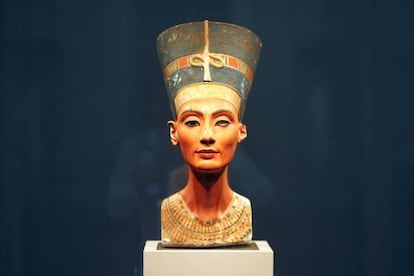
In a development that has revived one of Egyptology’s most intriguing debates, the theory that Tutankhamun and his stepmother Nefertiti, the celebrated chief queen of Akhenaten whose bust is one of the most iconic images of Ancient Egypt, may share the same eternal resting place has returned to the spotlight.
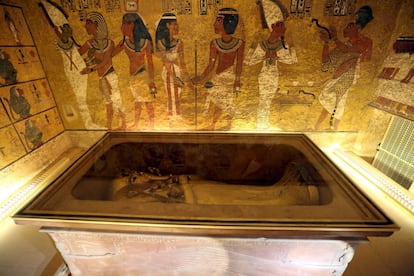
New research has once again revived the remarkable and tantalising hypothesis put forward in 2015 by the prominent British Egyptologist Nicholas Reeves, which sent shockwaves through the field of Egyptology. According to the theory, Tutankhamun’s small tomb in the Valley of the Kings (KV62) contains additional unexplored chambers and is in fact only part of a substantially larger burial complex, hidden behind what appear to be the solid walls of the known tomb.
Reeves has stuck to that view ever since, against all odds. Drawing on a meticulous iconographic analysis of the paintings in the burial chamber and on high-resolution photographs taken by the Spanish company Factum Art while scanning the tomb to produce a replica — photographs that appear to suggest the presence of sealed doorways — he argues that the tomb was originally designed for Nefertiti, with Tutankhamun effectively an interloper, and that the queen’s mummy may still lie within undiscovered chambers.
Eleven years ago, we seemed to stand on the very threshold of a potentially historic discovery. The tests carried out at the time proved inconclusive. We were told that further investigations would be needed. Eyebrows were raised across the Egyptological community. Zahi Hawass, in his characteristically categorical fashion, dismissed the whole idea as nonsense. And there matters were left, mercilessly so, as we continued to wonder, with a mixture of anticipation and scepticism, what secrets and marvels might lie, if any did, beyond Tutankhamun’s burial chamber.
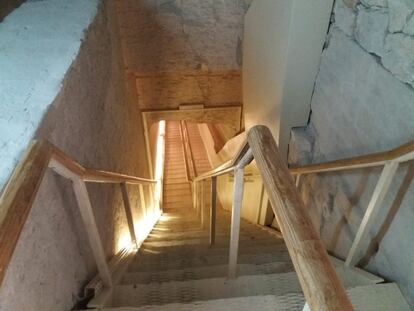
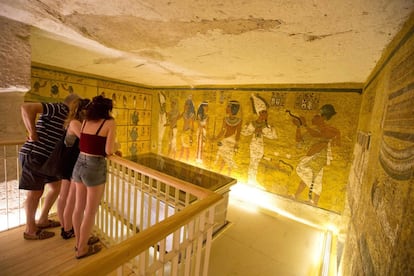
Visiting Tutankhamun’s tomb has never been the same since. A new mystery gnaws at you. Are you standing only in the outer portion of a tomb that extends much farther beyond? With Nicholas Reeves’s theory in mind, you find yourself in the antechamber, looking to the right, unable to shake the thought that something — a passageway, perhaps, or undiscovered rooms — may lie hidden behind the northern wall of the burial chamber, beyond the sarcophagus, where the famous scenes of the young king’s funeral are depicted.
Yet no matter how intently you stare, however hard you try to pierce the wall with your gaze, you see nothing. Nothing except your quickened pulse and a marked tendency to sigh. Nor does Tutankhamun himself offer any clues. Behind you, his mummy seems almost to mock your curiosity with its faint, rabbit-like grin.
Is Tutankhamun merely an intruder, a cuckoo chick in Nefertiti’s nest, as Reeves so poetically suggests? Stranger discoveries have been made in Egypt. One need look no further than neighboring KV5, the tomb of the sons of Ramses II. Excavated in 1825 and long thought to be relatively modest, it was revealed in its full extent by Kent Weeks in 1995: a vast funerary complex comprising 130 chambers linked by a network of corridors.
The obvious question is why no holes are drilled to find out whether anything lies beyond the walls of KV62. So far, the Egyptian authorities, along with most Egyptologists, have not considered the evidence strong enough to justify such invasive tests on one of the most famous monuments in Egypt, and indeed the world. As a result, researchers have had to rely on non-invasive methods, which are rarely capable of providing conclusive answers.
And now Reeves and his supporters are back on the offensive. On September 17, they published a lengthy, detailed and scholarly study, A Review and Archaeo-Geophysical Assessment of the Structure and Morphology of the Tomb of Tutankhamun (KV62), the fourth paper in a series collectively titled The Burial of Nefertiti?, a veritable soap opera by now, some might say.
The 57-page paper, published in the Occasional Papers of the Amarna Royal Tomb Project, directed by Reeves himself, and once again highlighted by Nature, is co-authored by Reeves, former antiquities minister and archaeologist Mamdouh Eldamaty, a firm believer in the extended-tomb theory; geophysicist Abbas Mohamed Abbas; and George Ballard, a specialist in the investigation of historic structures.
The article details two new research campaigns carried out inside and around the tomb under the auspices of Egypt’s Supreme Council of Antiquities (SCA). In their search for evidence of unknown spaces, the researchers deployed an array of technology worthy of the Death Star, including microgravimetry, a non-destructive geophysical technique that measures minute local variations in the Earth’s gravitational field to detect differences in subsurface density.
The authors of the study argue that it can now be said that “the structure of KV62 predates the interment of Tutankhamun and is likely to be more extensive than traditionally understood.” That alone, the possibility that Tutankhamun’s tomb is larger than previously thought, would be a bombshell.
I read the paper with all the excitement you might imagine, an excitement that gradually waned as the text ventured ever deeper into dense scientific terminology that lies well beyond my modest understanding (“this simple program used the Talwani algorithm to calculate the Bouguer anomaly over a polygon”; and they say hieroglyphs are difficult). Still, taken as a whole, it is highly stimulating.
The researchers place themselves under the patronage of Howard Carter, who, they argue, had already suspected that the tomb continued beyond its known limits, although the exploratory trenches he allegedly dug in secret to test the idea were, according to the authors, in the wrong place. He failed to take into account that queens’ tombs turn to the right.
The authors begin by revisiting earlier work and Reeves’s original hypothesis that the layout of KV62 extends beyond what is visible today. They acknowledge that the results of the initial tests carried out between 2015 and 2018 were insufficient to prove anything, but argue that the new approach, combining multiple disciplines in a “holistic” methodology and making use of new technologies such as ground-penetrating radar, electrical resistivity tomography and microgravimetry, places us in a very different position.
In the first part of the paper, Reeves, who has incorporated the theory into the new edition of his reference work The Complete Tutankhamun, revisits the argument that Tutankhamun’s tomb is highly unusual for a royal burial of the 18th Dynasty and that there are two possible explanations.
The first is that it was originally a private tomb that was hastily adapted to house Tutankhamun and his funerary equipment following the young pharaoh’s unexpected death. The second is that KV62 was in fact a queen’s tomb, whose outer sections were repurposed for Tutankhamun’s burial, while the original owner’s interment was left undisturbed in deeper, inaccessible chambers.
According to Reeves, and it is all tremendously exciting, when Tutankhamun died, alterations were made to the front part of that queen’s tomb, namely Nefertiti’s, to accommodate the dead king and his possessions, while the remainder of the funerary complex was sealed off.
The Egyptologist points to modifications in the tomb’s decoration that, he argues, reveal this repurposing. In an initial phase, the central figure in the painted scenes would have been Nefertiti herself, acting as pharaoh after the death of her husband Akhenaten and ruling under the throne name of the enigmatic Smenkhkare, while Tutankhamun was depicted officiating at her funeral rites. In a second phase, the deceased became Tutankhamun and the officiant his successor, Ay.
What is now the burial chamber, the “House of Gold” in Ancient Egyptian terms, would originally have been little more than a passageway leading to the deeper reaches of a much larger tomb where the queen rested, or perhaps still rests. Reeves also identifies a number of apparent anomalies in the walls that, he contends, may indicate the presence of blocked entrances leading to the supposed corridor and to additional storage chambers for funerary goods.
To be precise, and to complicate matters still further, Reeves identifies four phases in the tomb’s development: an initial construction phase for a queen consort; a second modification following Nefertiti’s supposed elevation to co-regent; a third when she assumed the full rank of pharaoh after Akhenaten’s death; and a final phase, a decade later, when Tutankhamun died and the golden boy was put in there.
The second, highly technical section of the paper is authored by George Ballard and focuses on the tomb’s geophysical investigation. He reviews earlier studies, including those by Watanabe and Porcelli, as well as some findings that have not previously been published. None of these, he notes, proved conclusive in determining whether the cavities and voids detected beyond the tomb’s walls were anthropogenic in origin, that is, created by human activity.
Ballard nevertheless concludes that Reeves’s hypothesis has not been definitively disproved. “Geophysical investigation of the area surrounding KV62 has led to the identification of a number of intriguing features that could be passages or chambers,” he writes.
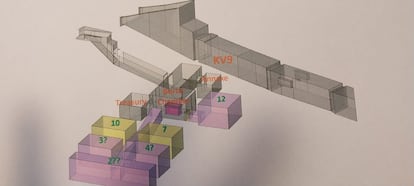
Ballard himself, together with Abbas, authors the paper’s third section, the heart of the matter. They describe the new tests carried out both inside and outside the tomb and emphasize that echoes consistent with rubble have been detected in two areas beyond the northern wall of the burial chamber. These could correspond to the fill customarily used to seal passageways in tombs.
These and other findings, they argue, are consistent with the proposition that chambers and passageways exist beyond the northern and western walls at the far end of Tutankhamun’s tomb. Particularly intriguing are a series of rectangular features on the other side of the northern wall. Equally compelling is the suggestion that readings indicating high-density material in the center of one of these spaces are exactly what one might expect to find “in a well-stocked, undisturbed funerary chamber.”
In their summary, the researchers state that they have identified, “with a high probability,” a funerary complex extending some 20 to 30 meters north of KV62. They add: “Five or six chambers are likely to exist in this space, and there is a clear expectation that the voids detected connect to themselves and to KV62 by passageways deliberately filled with rubble in antiquity.” Access to the complex, they suggest, appears to be “via a corridor whose access is concealed behind a mortared stone wall at the eastern end of the current burial chamber.”
In his conclusion, Mamdouh Eldamaty argues that the evidence strongly suggests ”the existence of at least one further storage chamber" in Tutankhamun’s tomb (which would be located behind the west wall of his burial chamber), as well as a continuation beyond the northern wall in keeping with the layout of royal burials.
“Even if this latter hidden complex does not ultimately prove to be the burial place of Nefertiti herself, the evidence increasingly points towards a connection with the Amarna royal family and the immediate circle of Akhenaten’s court,” he writes.
If the extension of the tomb were to be confirmed, he concludes, “it could potentially rank among the most transformative archaeological discoveries of the modern era, fundamentally reshaping our understanding of the political, religious, and dynastic history of the Amarna Period itself.”
The obvious next step, the researchers stress, now that non-invasive methods have been exhausted, is “direct investigation by finding a means to access directly one of the proposed new chambers and achieve a photographic inspection of its nature.”
For now, all we can do is keep wondering.
Sign up for our weekly newsletter to get more English-language news coverage from EL PAÍS USA Edition









































