
Tom Morello: ‘America is a much more dangerous place today’
Three decades after Rage Against the Machine broke onto the scene, the guitarist maintains that rock has always been political
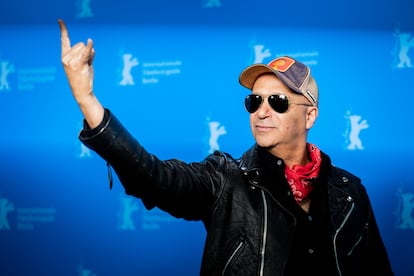
Tom Morello likes to use a word that many musicians stopped uttering long ago: resistance. The 62-year-old singer uses it naturally, the way he would when talking about songs, chords or the road. On June 27, he will perform at the BBK Legends festival in Bilbao, and in a video call interview, he sums up the spirit of the event: “It will be a celebration of the guitar and of resistance.”
More than three decades have passed since Rage Against the Machine, the band with which he rose to fame, made a seismic impact on popular culture, and he still sees no contradiction whatsoever between the two: music and rebellion.
Rock and roll has seemed, since its beginnings, synonymous with fun; while politics is, for many, just the opposite — a drag. The guitarist disagrees: “Rock music has been extremely political from the beginning. The idea of a white artist like Elvis Presley singing with the voice of a Black artist and turning white audiences on to Black music was an incredibly political statement, even if the lyrics were about love. John Coltrane’s music, purely instrumental, challenges the conventions and norms of how you can play an instrument or how you can view jazz, and in the same way, it challenges conventions in society.”
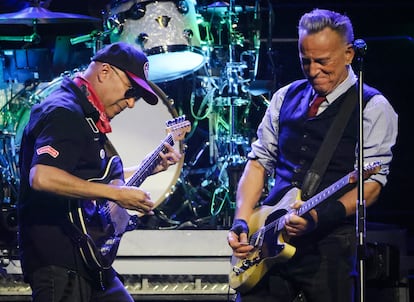
On March 31, Morello joined Bruce Springsteen on a tour of 19 large venues titled Land of Hope and Dreams, driven by that same insurgent instinct. “They were a lot of fun, but also very serious politically, because I believe that as an artist, your responsibility is not to hide who you are in what you do.”
On October 3, he will rejoin Springsteen at the Power to the People concert in Columbia, Maryland, very close to Washington, organized by Morello and also featuring Foo Fighters, Joan Baez, Serj Tankian (System of a Down), Cypress Hill, Dave Matthews, and Jack Black, among others.
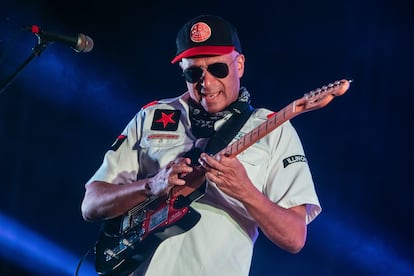
He takes his convictions so far that one starts to wonder whether he sees himself as a musician or as an activist who uses music the way others use a megaphone.
“I didn’t choose to be a guitarist,” he replies. “The guitar chose me. It was a calling, almost religious. But once I had that calling, I had to find a way to bring my convictions into my vocation. I was seized by being a guitarist, but also by having a revolutionary perspective on the world, and I tried to find a way where I could be as effective as possible while playing guitar solos.”
Revolution… Morello gives the solemn word a everyday, almost domestic feel. “It means not accepting things as they are and not allowing unjust human relationships to become normalized. In my view, it’s revolutionary to entertain and to confront an audience with an onslaught of joy and justice.”
He adds: “Most of my biggest influences regarding music and social commitment weren’t musicians but political activists: the Black Panthers, the Weather Underground, anti-colonial movements in the Third World, the Lincoln brigades that fought in Spain against the fascists.”
As for musicians, he cites Woody Guthrie, Public Enemy and System of a Down. “I can’t conceive of music separated from political activism. Life is something you must engage in.”
He’s far from happy with the United States under Trump. “I’m worried about a lot of things; it’s a long list. I think we are facing someone who wants to be the dictator of democracy every day, from his terrible foreign policy to the tactics of pursuing immigrants in their own homes,” he says. “Probably worse than all that is the anti-intellectualism and anti-science stance, which leads to policies that are undoing decades of environmental work and helping push the planet toward destruction. America is a much more dangerous place than it used to be. It’s a very, very dangerous time, and I wish I could retire and sit on a beach, but that’s not going to happen soon. There’s still work to do.”
Over three decades in music, he has repeated that idea in many different ways, but rarely as combatively as now. “If there has been a message throughout my career, it is that the world is not going to change itself,” he says. “It is our responsibility to make it change. History is not something that happens; it is something we make. When the world has changed in progressive, radical or even revolutionary ways, it has been because of people no different from those reading this now. The people who have changed the world don’t have more courage, power, money or intelligence than the readers of this interview.”
Behind that conviction is also a personal experience. Born in New York in 1964, the son of a Kenyan diplomat and a teacher with Italian and Irish roots, Morello grew up in Libertyville, Illinois, in a predominantly white community. “I didn’t have to read political philosophers to learn about human relationships and injustice,” he says. “I encountered them on the playground when I was four or five. The idea that there was hate, ignorance and injustice in the world came to me very early.”
His mother, also an activist, was a key figure in his upbringing (his father returned to Kenya when Tom was still a baby. “She never made me feel inferior in any way, even though the world was trying to tell me I was,” he recalls. “I always had a very strong heart thanks to the support and love of my family.”
Long before becoming one of the most recognizable guitarists in contemporary rock, he was a teenager obsessed with the instrument. For years, he tried to follow the same path as the great virtuosos of the 1980s. “At first I was a very fast guitarist, heavily influenced by Randy Rhoads, Eddie Van Halen and people like that,” he says.
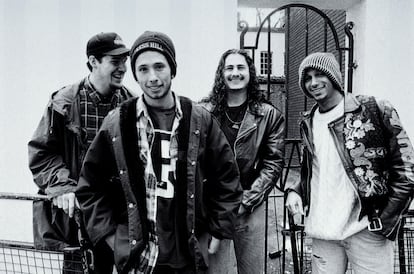
His search changed direction when he stopped trying to sound like others. “It wasn’t until the beginning of Rage Against the Machine that I began to find my own voice on the instrument. I began identifying as the band’s DJ. I diverted my attention from traditional guitarists toward animal or mechanical sounds, trying to recreate the sounds of industry and nature.”
It was a decision that ended up defining his entire career: “That, combined with the big heavy riffs of my favorite bands like Black Sabbath and Led Zeppelin, led me to find an authentic voice on the instrument.”
For Morello, what separates a great guitarist from a merely good one is personality. “One of the things that impresses me most about guitarists is when they have their own voice on the instrument,” he says. “Sometimes that can mean playing many notes very quickly, other times playing with feeling, other times producing otherworldly sounds you’ve never heard before.”
At 62, he continues to seek new challenges. The next will come in the form of a record. “It will be my 22nd album, but the first solo rock album as Tom Morello. I wanted to make an album with all the riffs in the style of Rage Against the Machine and Audioslave [the group he formed after the former’s breakup] and the lyrical depth of Bruce Springsteen, Bob Dylan and Roger Waters. I wanted to take the weight and power of the rock of my whole life and bring it to 2026 to make a modern, heavy album that is as devastating musically as it is politically relevant.” His son Roman, also a guitarist, is part of the project.
When asked to choose a Rage Against the Machine song to explain the present, he doesn’t think twice: “The first that comes to mind is Killing in the Name. Frederick Douglass [a slave and later abolitionist in the mid-19th century] wrote in his autobiography that the day he was freed was not when his chains were removed; it was the day the master said yes and he said no. And that is Killing in the Name: a refusal of illegitimate authority. You don’t need to submit to illegitimate authority. Whether in your home, at your school, your workplace or your country. You can always rise up against it.”
But not everything in Morello’s life has been so serious. In 1986, freshly graduated from Harvard, where he studied social sciences, he worked as a stripper at bachelorette parties in Los Angeles to make some money. “I wanted to sell Iron Maiden T-shirts, and I didn’t even get that job,” he says. “I didn’t pass any audition; I got in through a friend. It’s a job like any other. There’s an old saying: the rent isn’t going to pay itself,” he jokes.
Sign up for our weekly newsletter to get more English-language news coverage from EL PAÍS USA Edition









































