
Salón Tenampa, the emblem of mariachi in Mexico City, celebrates its 100th anniversary
EL PAÍS visited the century-old ‘cantina’ on one of its nights filled with tequila and traditional cuisine. In this place, nestled beside Plaza Garibaldi, the music never stops
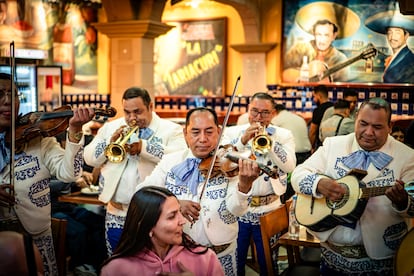

The legend goes that the singer Chavela Vargas and the actor José Alfredo Jiménez locked themselves away for three nights in Salón Tenampa, in northern Mexico City, drinking tequila and singing along to the musicians, who mingled with the patrons of the grand cantina.
Many years later, on the night of Wednesday, November 19, a mariachi band begins to play one of Paquita la del Barrio’s classics: Tres veces te engañé (“I cheated on you three times”).
“You, who left me. I, who waited for you…”
Seated at one of the tables, Daniel Gómez closes his eyes. He clenches his fist and shakes it to the rhythm of the music. He sings with deep feeling: “I, foolishly, was always faithful to you.”
The tables are nearly full. The mariachis stroll about, offering songs to the customers. Waiters attend to the tables with the same undivided attention as musicians in an orchestra. Salón Tenampa, the great emblem of mariachi music in the capital, is celebrating its 100th anniversary.
The mariachi band continues to circle Daniel Gómez’s table. He sways to the sound of the violins. Accompanied by a group of friends, it’s his first time here: he’s from Los Angeles. “The place is super chill. Imagine coming from the other side [of the border] and experiencing this,” he sighs. A large portrait of Pedro Infante and Jorge Negrete hangs in Salón Tenampa, surrounded by pictures of other great musical artists, such as Juan Gabriel and Chavela Vargas. The staff says that, on busy nights, around 800 people can pass through. When things slow down, there are about 200.
Marcos Montes, 57, emphasizes that the music never stops. The Mexico City-born gentleman is wearing a light beige charro suit with gold details. A blue handkerchief hangs from his neck. This is the uniform of Mariachi Guadalajara. He says his father performed at the cantina for 50 years, while he’s been there for 38. “Garibaldi (the plaza that surrounds the place) is full of mariachis… but Tenampa is an emblematic place,” he affirms.
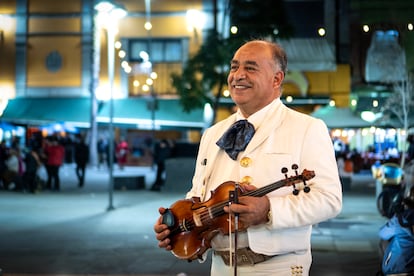
Montes picks up his violin and joins his bandmates. He begins to sing Estos Celos (“These Jealousies”), a song by Vicente Fernández: “I looked at you. You were so beautiful, so sensual…”
Two customers join in the chorus. Mariachi Guadalajara is one of the bands chosen by the World Mariachi Congress agreement to perform at Tenampa. None of the groups that perform in Plaza Garibaldi can enter without being granted permission. Montes says that Garibaldi can accommodate about 2,000 mariachi musicians on weekends, with about seven bands performing at Salón Tenampa. He likes to sing Los Soles Jaliscienses (“The Suns of Jalisco”). “It’s something that represents us,” he points out. But the songs that people request the most are Mujeres Divinas (“Divine Women”), Serenata Huasteca, Estos Celos, or De Qué Manera Te Olvido (“How can I forget you?”).
Early risers and a plate of meat stew
The trumpets play the characteristic melody of the controversial song Mátalas (“Kill Them”), by Alejandro Fernández. The composer of that song and others such as Rata De Dos Patas (“Two-Legged Rat”) is 73-year-old Manuel Eduardo Toscano. He recalls one of the mischievous little anecdotes that happened to him at the cantina in his early years as a songwriter, several decades ago. He was leaving a music studio, Discos Orfeón, with the artistic director Jorge Nájera (now deceased).
“We were up early and we ordered birria (meat stew). They served it to us, but it was already dawn and they had added too much water. So, we didn’t like it,” he remembers. That night, Nájera told him not to worry – “we’re not going to pay for it” – and pulled out a hair from his head. He threw it into the plate of birria and called the waiter over. “There’s a hair in this. We don’t want anything else,” he said.
Toscano, who was born in the state of Veracruz, in a city near the Gulf of Mexico, is cheerful as he affirms that Salón Tenampa has “real” value. “It’s so important that composers like Don Pepe Guízar have written songs about it (such as Mi Tenampa, performed by Pedro Infante). Those songs have traveled the world, making the place famous. Therefore, it remains incredibly important to the history of mariachi,” he explains. He emphasizes that visiting Plaza Garibaldi without heading over to the cantina means that you’re missing out. “Surely,” he continues, “mariachi musicians – because they spend so much time there every day – don’t consider it as important anymore. But for me, as a composer, it’s incredibly important.”
The colorful papel picado, Mexican decorative craft paper, hangs from the ceiling. It announces the centennial: “Tenampa 100.” Fernanda Aguilera, 37, is the great-great-granddaughter of the first owner, Juan I. Hernández. The business has always been in her family. Since she was 22, she has co-managed the place with her mother, after her father’s death. “From a very young age, I didn’t realize the magnitude of what this place was. It was simply a reality for me: family celebrations, baptisms, parties… my mission has always been to maintain the legacy of the family and the place.”
Aguilera is clear about the strengths that have allowed the establishment to endure for 100 years. During her conversation with EL PAÍS, she shares that “Tenampa is living history.” Here, she notes, “you experience this identity of flavors, colors, smells and sounds of a Mexico that seems very old, but which still exists today.”
“It’s international,” she adds, “because it’s positioned as the place where you can hear [formal bands]. Before, the [mariachis only] played in the street.”
José Alfredo Jiménez and a tequila
At the entrance, 23-year-old Saúl Palacios flashes his best smile for the camera. One of the employees, he’s been serving customers since 2022. He believes that Salón Tenampa’s success is due to the renowned people who have visited, but also because of “the preservation of Mexican traditions.”
“I’ve worked here for three years and it’s truly been a very pleasant experience for me. It’s a place that preserves traditions and pampers everyone,” he says.
Palacios tells EL PAÍS that an essential part of the establishment is promoting the heritage of mezcal and tequila, the two most popular drinks. The menu includes cocktails like mezcalitas and margaritas (“traditional drinks that you absolutely must try,” he gushes). But he also highlights the pomegranate punch – a mixture of tequila, pomegranate and pieces of walnut – whose complete recipe is known only to a bartender from Guadalajara named Jerry.
When asked about the most popular dishes served up by the pub, Palacios elaborates: “Our essence is [cuisine from the state of] Jalisco. Some dishes that are always available here include quesabirrias (meat in tortillas with melted cheese), birria, pozole (traditional soup) and torta ahogada (a drowned submarine sandwich). And, of course, the Tenampa platter: a dish made up of street food that puts all of Mexican cuisine on one plate.”
The chronicler also recounts that, 30 years ago, the plaza surrounding Tenampa “was one big party.”
“It was the only place where you could drink in the street, without having to be inside a bar,” he points out. “But as the city changed, it was refined to accommodate more people who come to spend money.”
Palacios explains that the establishment used to just be a bar. It was only later on that the place began to serve food. For Ruvalcaba, this shift shows that the place knew how to read the changing clientele. “Considering that it’s still open, it’s a triumph. If it’s lasted 100 years, that’s a success. The only thing that matters in the life of restaurants is selling and surviving,” he argues.
The chef says that a big change has been noticeable since the early 2000s: “Before, [Garibaldi] was the most trashed plaza in Mexico. Now, it’s like a tourist attraction… which isn’t a bad thing at all.”
“[Being part of that history] is a very beautiful thing. It’s something that’s always been with you. I think I spend more time at Tenampa than at my own house,” says José Luis Hernández, 61, who plays the harp with Mariachi Jarocho. He has been with the group 46 years. “Being part of Tenampa is something indescribable,” he chuckles.
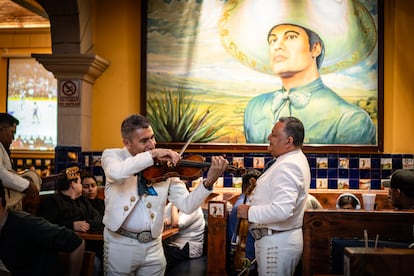
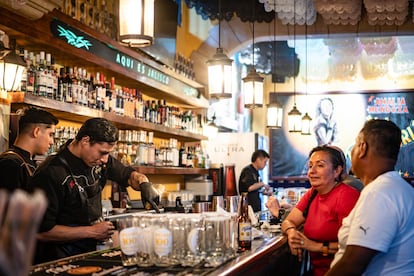
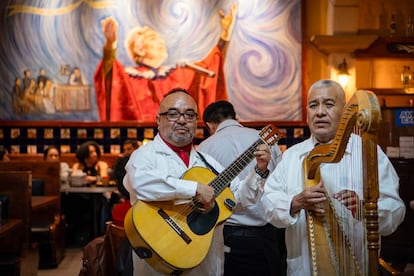
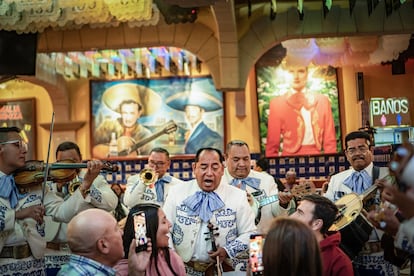
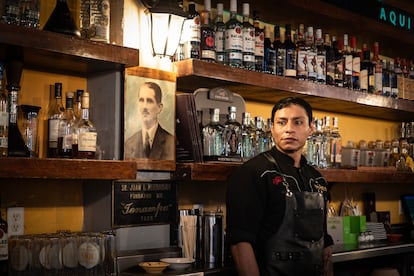
The music has not stopped playing for a single minute throughout Plaza Garibaldi. Something similar is happening inside Tenampa. The scenes divide the place like still shots: Daniel Gómez sings at one of the tables, an Asian couple gets up and starts dancing to the rhythm of the mariachi. In the center of the room, violins begin to accompany the guitars to perform La bikina, a classic Mexican song composed by Rubén Fuentes: “Haughty, beautiful, and proud / She won’t let them comfort her [...]” The night seems endless in here.
Sign up for our weekly newsletter to get more English-language news coverage from EL PAÍS USA Edition









































