
Pablo Escobar’s son publishes a comic book about his childhood: ‘Netflix glorifies the drug world, I raise awareness’
Juan Pablo Escobar seeks to debunk the myth surrounding one of the most notorious drug traffickers of the 20th century
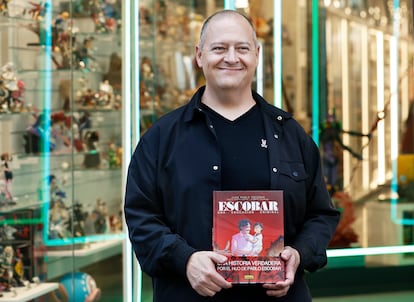

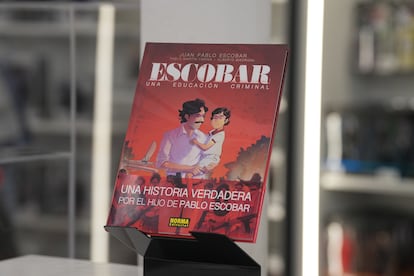
Juan Pablo Escobar, 48, perhaps carries one of the most difficult legacies to confront: that of his father, Pablo Escobar. It’s a legacy marked by violence and the staggering 5,500 deaths recorded during the peak of the Medellín cartel between 1989 and 1993. The weight of the name follows him — in films, TV series, and books. In his effort to confront his past and tell his side of the story, he now turns to comics. Escobar, una educación criminal (in English, Escobar: A Criminal Education), published by the Catalan publisher Norma, explores his childhood in an atmosphere of fear and secrecy. “I aim to dismantle the myth of those who see my father as a successful man, especially young people,” he explained on Wednesday during the book’s launch, alongside Pablo Martín Farina and Alberto Madrigal, responsible for the script and illustrations.
Escobar — an architect, industrial designer, and pacifist — says he chose the comic format as a different way to narrate his past and to connect with young people. “Even though I’m a writer, I had never spoken so much about myself. I had to learn how to write a comic; I didn’t know each scene had its own script,” said the author, who has also produced some of his works under the pseudonym Juan Sebastián Marroquín. The idea, he explained, arose during the COVID-19 pandemic, a time of personal reflection on how to tell his story “with the utmost respect” for the victims and “without glorifying” the world of drugs and violence. “I raise awareness, Netflix glorifies it,” he said.
The comic focuses on his childhood: the years he lived surrounded by hitmen who also acted as babysitters, with various bodyguards and anxiety ever-present in a life surrounded by countless dangers. “There was no room to dream. Life was permanently at risk. I developed a very deep and intense relationship with my caretakers,” he recalled.
For narrative purposes, he explained, he chose to reduce the number of characters involved, while always maintaining the story’s truthfulness. One of those caretakers, he confessed, is still alive and read the comic. “It was interesting to see his reaction. In relation to the world, he’s dead, but he’s still alive,” he noted.
The way his life was shaped by violence is described without explicitly including the character of Pablo Escobar, despite his omnipresence at every moment. He only appears on the cover, showing an embrace between them, and in the last 15 pages. “I didn’t want my father to be the protagonist of this story, because it’s my story,” he insisted. Yet the shadow of the mastermind behind thousands of victims, orphans, widows, and the man who nearly brought the Colombian state to its knees with his war to avoid extradition to the U.S., is always present.
The author acknowledges the contradiction of having grown up amid fear and the privilege that came from the immense wealth generated by drug trafficking. “It didn’t make me happy to be happy with the fortune of a bad life. It didn’t make me proud; it left a mark on me,” he admitted. In recent years, Escobar has publicly apologized to the families of his father’s victims and argues that drug trafficking must be addressed from a different perspective. “Colombia has not been able to overcome this issue at all. It’s a very sad story. It’s a war in which no one has won, and no one ever will. It’s a public health problem, not a security issue. Prohibition isn’t the way either,” he said.
With his book, Escobar’s son seeks to process the impact and contradictions of being who he is. While recognizing the complexity of his father’s character, he remembers him as a present figure even in his absence. He recalls the letters he received weekly from the cartel boss — messages in which his father urged him not to be frightened by explosions and gunfire. “He wrote to me: ‘This week you’re going to hear a lot of explosions, but I’m fine,’” he explained. Ironically, it was one of those attempts at communication that allowed the police to trace his location on December 2, 1993, finally finding him in a house in western Medellín, where he was shot several times while trying to flee.
He also recalls the lesson his father gave him at the age of 12, when he first spoke to him about cocaine addiction. “It’s a paradox: he didn’t set the best example, but he did instill values in me,” he reflected. His intention in writing the comic, he says, is not to reconcile with the myth, but to break it. “I’d rather die than repeat my father’s story,” he concluded.
Sign up for our weekly newsletter to get more English-language news coverage from EL PAÍS USA Edition









































