
Vince Gilligan, creator of ‘Breaking Bad,’ returns to science fiction: ‘I’ve had enough of writing anti-heroes for now’
The screenwriter premieres the series ‘Pluribus’, in which Rhea Seehorn (‘Better Call Saul’) plays a woman who tries to save humanity as we know it

The first episode of Apple TV’s new series Pluribus that was sent to the press included a preliminary message from its creator, Vince Gilligan, asking journalists not to reveal too much about the plot. “We’ve taken great care to keep details under wraps, and we’d like to ask you to do the same,” he said. The new project from the creator of Breaking Bad and Better Call Saul (which premiered on November 7, with new episodes every Friday) is shrouded in mystery. Before its debut, all that was known was that it would be a science fiction story in which “the most miserable person on Earth must save the world from happiness.” And not much else.
So the first question for Gilligan is precisely what can be revealed about the series. “I know it’s tough, and I’m sorry to make your job tougher” he apologizes over a video call. “I usually say it’s about a romance novelist living in Albuquerque, New Mexico, and something very big happens in the first episode, it changes the whole world, and then she tries desperately to save the world after this thing happens, but maybe we’re not so sure the world needs saving.” Cryptic enough to still leave us with little idea of the plot.
Both the audience and the character played by Rhea Seehorn will discover what’s happening at the same time. “That’s the intention. I like shows like that. The thing I’m best at is telling one person’s story,” Gilligan explains. “Some writers are really good at ensemble stories where there are lots of different characters, and you go from one to the other. I’m best at writing one person’s story and seeing it through her eyes or his eyes. Some of my favorite experiences watching movies or TV shows have been when I knew nothing about them. A good example of that’s The X-Files. The first night it went on the air back in 1993 — 32 years ago — I was home alone, bored and flipping around on the TV, and boom, the first X-Files came on. I was hooked within five minutes. I hadn’t read about it, and it made me very happy to discover it that way. I want that for our audience.”
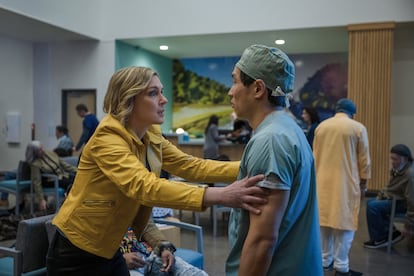
The mention of The X-Files is no coincidence. Before Vince Gilligan became world-famous as the creator of one of the most acclaimed series in television history, Breaking Bad, he had honed his craft writing episodes about Mulder and Scully. Much of that eerie sense of fun that defined The X-Files is also present in Pluribus — a curious turn for a writer and producer who had spent nearly 15 years in the dark, criminal universe of Breaking Bad and Better Call Saul.
Gilligan came up with the idea for Pluribus (a Latin word meaning “many” or “plurality,” also part of one of the earliest U.S. mottos, E pluribus unum — “out of many, one”) about eight or 10 years ago while working on Better Call Saul. Clearing his head with a walk around the neighborhood where the writers’ room was located, he suddenly imagined a man whom everyone treated with extraordinary kindness. But a story about universally happy people didn’t sound especially interesting, so he wondered: why was everyone being so nice to him?
“We’re making Better Call Saul, and all the actors were great, but one actor in particular caught my eye, and it was Rhea Seehorn. She was so good. I have to admit, I didn’t know who she was when we hired her. I got to know her through her work on our series, and I realized how funny she was, and later I found out she had done a lot of comedies, and at the same time, she could be very dramatic. So I said to myself, why does this show have to be about a guy and not a woman? I wound up writing the story specifically for Rhea."
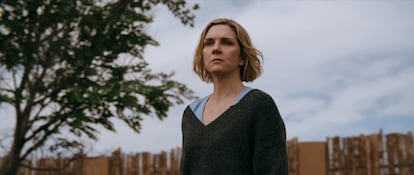
It’s ironic that, just when the real world feels more polarized than ever, Gilligan has chosen a premise that puts kindness — even an unsettling kind of extreme kindness — at its center. Can goodness be seen as something subversive in times like these?
The writer laughs at the question: “I like the way you put that. Kindness can feel subversive, but I don’t think it is. I think most people are good. There are a lot of bad things going on in the world, and there are bad people, you know… running things. There are bad people in the news every day making our lives miserable. America is a country that feels like it’s split right down the middle. I don’t think anyone, on either side, wants to live in a world this chaotic and angry and unhappy. I like to think about what it would be like to live in a world where everyone got along. Although in Pluribus, it’s not always a good thing that everyone is so of one mind. It’s good we have individuality. There’s got to be a happy medium."
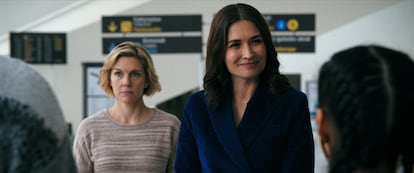
It’s also striking that, after so many years writing stories about antiheroes — where the line between good and evil is so blurred — Gilligan has chosen to tell a story about a kind, happy humanity and a woman who, in her own way, wants to save the world. Has the age of television antiheroes come to an end?
“I wouldn’t say that. I think it’s up to every storyteller to tell their own stories,” says Gilligan. “Personally, it’s like having a really good meal, but at a certain a point, I can’t eat another bite. I’ve had enough of writing anti-heroes for a while. That doesn’t mean I’ll always feel that way. When I created Breaking Bad, it was kind of a reaction to having written heroes for almost 10 years. I wrote for The X-Files, and it was a great job; Mulder and Scully were heroic characters. But I thought, ‘Maybe it would be cool to write about a bad guy.’ And now I miss the good guys, especially in the world we’re living in. There are plenty of good people out there; we just need them to speak up more and be more in charge of things.”
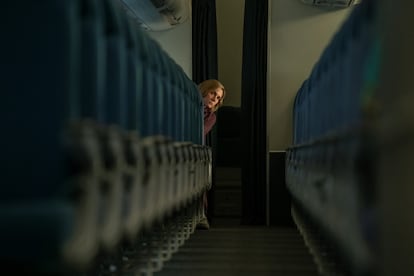
Although Pluribus and the Breaking Bad universe tell completely different stories, they do share certain elements — most notably Seehorn, and the setting of Albuquerque. Does Gilligan find it hard to move on from the world of Walter White and Saul Goodman?
“I know that Breaking Bad is the first thing they’ll put in my obituary when I pass away, hopefully not anytime soon," he says. “But that’ll be no matter what I do. I love Breaking Bad, and I’m proud of it, and I’m grateful, but I was ready to do something new. I love Rhea Seehorn and I love my crew in Albuquerque so much that I set the show back there so I could work with them again. There’s no other reason why Pluribus takes place in Albuquerque. In fact, it makes it harder on me because I have to explain to folks there’s no real Breaking Bad connection that was intentional,” he laughs.
After watching the series (the press has seen seven of the nine episodes in the season), many questions arise: Why is Carol, the main character, different from the rest of humanity? Is there any way to undo what’s happened? And the big one — will there be answers to all these mysteries? Gilligan laughs again.
“I don’t know that I have answers for all the questions. Personally, I don’t care why Carol is different, she just is. I don’t know if all questions will be answered. But hopefully all the questions that need answering will be answered. I want the audience to leave satisfied, just as I wanted them to be satisfied at the end of Breaking Bad and Better Call Saul. But sometimes I think it’s satisfying to leave the audience certainly wanting more, and having certain questions that they get to answer themselves instead of them being told, ‘This is the answer,’” he concludes.
Sign up for our weekly newsletter to get more English-language news coverage from EL PAÍS USA Edition









































