
Munchausen Syndrome: Can imaginary illnesses become real?
Patients with this disorder use a strange way to ask for attention: they pretend to be sick
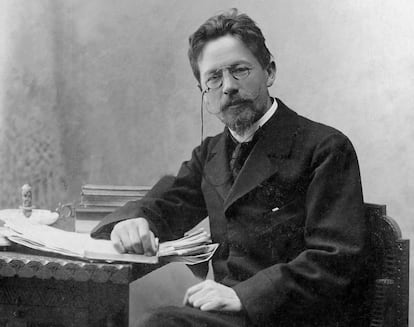

In one of his letters, Anton Chekhov wrote that medicine was his legal wife and literature “his lover.” While working as a rural doctor in the villages of the Moscow Oblast, he created characters, fictional conflicts, and units of action. In this way, he scattered stories and plays along a path that would eventually travel around the world.
Crossing the boundaries of reality, he even invented a disease called “hyperesthesia of the speech center,” which he included in one of his short stories. He uses his medical colleagues to reinforce his lie, claiming that “nine-tenths of women” suffer from this condition. To make the imaginary illness in his story even more credible, he tells us that it was named by Jean-Martin Charcot himself, and that amputation of the tongue is the only way to cure the disease, according to “this illustrious doctor.” In this way, Chekhov uses his medical profession to create a short story that is the closest thing to a prank carried out with the talent of a brilliant author. In this way, an imaginary illness becomes a medical term that passes as real.
But the opposite can also happen: a healthy person imagines themselves ill and cannot live without being surrounded by doctors. It often happens. And to translate this anomaly into the literary dimension, the most significant example is found in Argan, the hypochondriac character in Molière’s The Imaginary Invalid, who decides to marry his daughter to a doctor’s son in order to save money. And to continue on the subject of imaginary illnesses, we cannot fail to mention the man who claimed to have danced on the belly of a whale; we are talking about Karl Friedrich Hieronymus, better known as Baron Munchausen (1720-1797), who will go down in history as a great fabulist, a shameless man capable of recounting incredible adventures in the first person. Baron Munchausen would become a literary myth thanks to the German scientist Rudolf Erich Raspe (1737-1794), who wrote the first version of his adventures. He wrote it in English, and later the German poet Gottfried August Burger was responsible for returning it to its original language.
However, what interests us here regarding this character is that he gave his name to a psychological disorder known as Munchausen syndrome, a disorder in which the patient uses a strange way to ask for help, since he pretends to be ill, even going so far as to self-harm, thus turning the imaginary illness into a potentially real illness.
But returning to the beginning, to Chekhov, suffice it to recall that his death was an example of a life drawn around the thin line that separates art from reality; a brief but intense life where fiction ended up spilling over the glass of champagne he drank on his deathbed in a hotel in the Black Forest, Germany, shortly before dying of tuberculosis at the age of 44, toasting “his lover.”
Sign up for our weekly newsletter to get more English-language news coverage from EL PAÍS USA Edition









































