Andrés ta Chikinib, the teacher who taught ChatGPT Tzotzil: ‘It already speaks like a child of three or four’
The Mexican poet describes the chatbot learning process and defends its use to further develop and promote the language
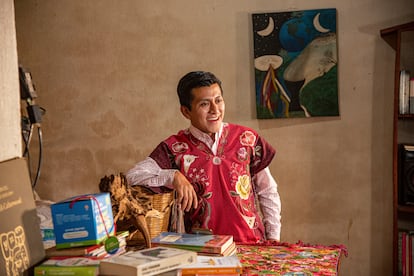
When José Andrés Hernández Pérez began teaching Tzotzil to non-speakers a year ago, he didn’t consider what he eventually ended up doing: teaching a non-human student. The idea of instructing ChatGPT came from one of his students, who suggested that he use it as a platform to help him generate teaching materials. The results of his first class were “a disappointment,” but he admits his fault for having passed on the Tzotzil information without any order. “It seemed like it was stumbling and not understanding much. It could memorize everything, but poorly and not the way it should have,” he summarizes. So he changed strategy. The poet explained to ChatGPT, like any other student, that it had to learn and memorize everything he taught it, and he was clear about the goal: the chatbot had to be able to hold a conversation in Tzotzil with him. “And that’s where the whole thing started,” he says with a smile.
In just three weeks, ChatGPT was able to form its first sentences. “It already speaks like a child of three or four,” says the teacher, winner of the 2020-2021 National Youth Award, who began promoting Tzotzil literacy on social media during the pandemic in 2020. The teacher says that, after his lessons, it has already mastered the alphabet and personal pronouns. “It understands that in Tzotzil, we speak not only of six personal pronouns but of seven, because there are inclusive ones and exclusive ones. It also knows that Tzotzil verbs end in ‘el’ and that nouns end in ‘il,’ but with certain rules,” he explains. Hernández says that his unique student now even refers to the new language he is learning in the same way Tzotzil speakers name it: optike.
Andrés ta Chikinib, as the teacher calls himself and which means “Andrés in oak,” explains that he has only taught the chatbot to write in Tzotzil, but he has been surprised by the progress so far. “You say ‘wow,’ right? A [human] student who works hard can do one exercise on a topic, but this student can do four or five exercises for me.” And although the artificial intelligence is not yet perfect, he doesn’t hide his amazement at the results obtained: “What’s impressive to me is that it beats us in terms of human capacity.” He reveals that a common error ChatGPT makes is when it confuses words from Yucatec Maya or Tseltal with Tzotzil, but he remembers, above all, the first stumbles. “Everything I was teaching it, it wanted to mix with research it found on the internet. It was from the last century, like the first Tzotzil research done by Americans,” he explains.

ChatGPT also knows that there are certain terms in Tzotzil that carry prejudice, for example, regarding the LGBTQ+ community. Its teacher has taken it upon himself to “raise awareness on the platform and provide context” so that it knows that in some places this group is still stigmatized. “I’ve already taught it some terms, but I qualify the information,” he assures. Regarding the criticism from some people who have objected to him teaching Tzotzil to artificial intelligence, the poet is clear that it’s the language that wins. “Then we complain that there’s nowhere to teach Tzotzil. Yes, [ChatGPT] is a for-profit company, but if we see it as a tool, we can take advantage of the platform and use it to help us develop further,” he maintains.
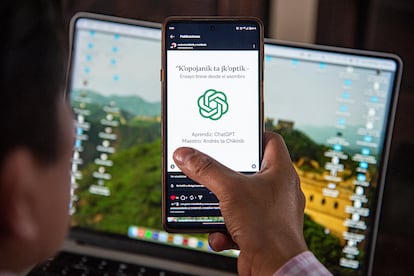
A few weeks ago, Hernández published an essay on his Instagram profile that the chatbot had written about its experience learning a new language, which went viral, according to the Efe news agency. He confesses that he was worried about people’s reactions, but that he didn’t expect the popularity his experiment has achieved: “It was a surprise that, based on a post that I thought was very simple, many media outlets picked up the information and took note of it.” Although he hasn’t yet used materials created by the platform to teach Tzotzil, it has helped him generate scripts for his Facebook videos: “I ask it, for example, to write me a script for a three-minute video that summarizes everything we’ve learned so far.”
The poet jokes when he compares his human students to his new one. “It doesn’t complain,” he says with a laugh. “A friend told me that I was taking it out on ChatGPT, that everything I couldn’t do with my human students, like scolding them, I did to it,” he reveals, but he also acknowledges what the platform has taught him. “As a Tzotzil teacher, it has helped me discover more about the language because, sometimes, humans fail to understand the linguistic universe, no matter how many grammar books we’ve read. There are certain topics that I know how they work because I speak Tzotzil, but that I can’t name in linguistic terms. ChatGPT tells me what they are called and puts them in order,” he explains.
While artificial intelligence can’t teach other users what it has learned from its Tzotzil teacher for privacy reasons, Andrés ta Chikinib isn’t considering approaching OpenAI to change this. “For now, I’m interested in powering [the platform] from my personal account so that it can help me, or be an assistant for me.”
Sign up for our weekly newsletter to get more English-language news coverage from EL PAÍS USA Edition