
Liz Pelly, the journalist who uncovered Spotify’s fake artist farms: ‘In an hour they produce dozens of songs’
On a recent visit to Barcelona, the author discussed how streaming saved the industry from piracy, but not the artists
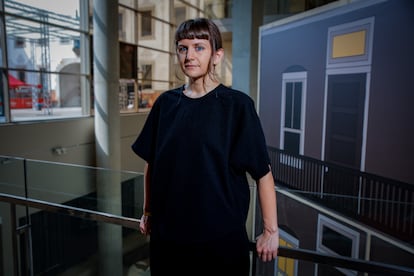

Liz Pelly, 35, had been writing about music for various blogs and media outlets since her teens, until she grew tired of promotional interviews and writing listicle articles summarizing entire albums in five lines. As a true millennial, she knew that little remained of the utopian internet that had democratized music consumption, making it more accessible until piracy became a global problem. The arrival of streaming platforms changed everything, and in 2016, she decided to begin investigating Spotify and its corporate consolidation mechanisms through its playlists.
After almost a decade of work, the adjunct professor at New York University (NYU) has published Mood Machine: The Rise of Spotify and the Costs of the Perfect Playlist (Simon & Schuster), an investigation with more than 100 sources in which she not only uncovers the platform’s extractivist policies but also paints a picture of control over consumers that has flattened musical taste. We met with her at the Centre de Cultura Contemporània de Barcelona (CCCB) shortly before her talk with journalist Shawn Reynaldo about the costs of the perfect playlist, as part of the Primavera Pro program.
Question. One of the playlists Spotify recommends is titled ‘Pilates Posh Princess’. What is the platform trying to tell me?
Answer. Streaming services now categorize music by appealing to emotions, by making you feel like the protagonist. It does so based on vibes and feelings. When they recommend that playlist to you in the main carousel, it’s to make you think: “Oh, yeah, my life is a movie, and today I want to be a ‘Pilates Posh Princess’.”
Q. Isn’t it a bit essentialist to fit me into that group? Is there a Spotify for boys and a Spotify for girls?
A. Streaming has inherited the techniques of personalized marketing. And like the rest of the music industry, it often assumes that people don’t like music or underestimates users’ capacity for engagement and curiosity. If you truly believed your users were serious about music or were fans, you would contextualize them in terms that truly relate to it. Instead of feelings, you could explain music based on musical attributes, record labels, regional scenes, or other aspects that truly help us learn about musical culture.
Q. Are predetermined playlists dumbing us down?
A. When you think about what a playlist is—a way of grouping songs—there are ways of doing it that do relate to music. But streaming services try to package songs in ways that they hope will appeal to a sense of uniqueness or specialness, or simply what users will click on.
Q. In your book, you point out that Spotify seemed like the platform that would save artists from piracy, but that hasn’t been the case.
A. Spotify created a huge opportunity against piracy and was very helpful in making the global music business profitable again. Streaming services transfer 70% of their revenue to rights holders. But because of the pro rata business model, most of that revenue ends up in the hands of the major record labels. We’ve learned that saving the music industry isn’t the same as saving musicians.
Q. Who makes money on Spotify?
A. The model is designed to benefit artists who operate on a large scale, who aspire to be pop artists, and who have strong marketing support. Those who make money on Spotify are those who aspire to massive success or those who create music that gets played repeatedly—music that works well in the background.
Q. What we put on while we do other things.
A. Yes, there’s this boom in what the industry calls functional music. What you listen to in the background while you work, study, or try to sleep. But for artists who make music that’s less commercial or less ideal for those kinds of constant-playing situations, the model doesn’t really work. That doesn’t mean those songs don’t have value, that those artists don’t have value.
Q. Indie artists have lost out to functional music.
A. The paradox of this is that independent music fans are more willing to pay for it than passive listeners or pop fans. The question here is: Did streaming incentivize certain types of fans to stop paying for music, when in reality those fans would be willing to continue paying musicians directly?
Q. In your research, you detected the presence of “fake artists” on Spotify. Who are they?
A. When I published my first article on Spotify in 2017, I was contacted by several people who had worked in the industry alerting me to the same rumor: the existence of fake artists that the platform was putting on its playlists, especially those meant for studying, sleeping, or concentrating. I started with an investigation by journalists from the Swedish newspaper Dagens Nyheter, who had access to copyright documents to show that there were a handful of composers who, under pseudonyms, were responsible for thousands of artist names and thousands of songs on these main playlists. I went to Sweden, met with those journalists, and continued investigating, interviewing dozens of sources.
Q. What did you discover?
A. That Spotify has an internal team specifically responsible for these instrumental playlists and works with a specific group of licensing experts to provide this material. They internally use the term “fit to content.” I also contacted the musicians who had been hired to create this content. They are session musicians or instrumental artists hired en masse to produce music in large quantities. These artists are often assigned pseudonyms that don’t correspond to real artists so you can’t find information about them online.
There are a handful of songwriters who – by using pseudonyms – are responsible for thousands of artist names and thousands of songs on these playlists
Q. How do they work?
A. It all depends on the company. There are several companies, and each one works differently. Some musicians told me they produce a dozen songs in an hour and try to make as many songs as possible in the shortest amount of time.
Q. Yet another content farm.
A. Yes, it reminds me of those journalists who are hired to produce 15 articles a day. It’s all closely related to clickbait culture.
Q. How is this tyranny of the click influencing artists?
A. I think any creative person—be it a musician, writer, or filmmaker—feels pressure from industries that increasingly value these metrics. If you’re a musician, not only does the number of streams determine how much you get paid, but it increasingly influences whether you’re scheduled at a festival or booked for your work. The same goes for friends who make videos: they need a certain number of views for their work to be seen as successful. No one starts in music, journalism, or video because they want people to post emojis on their Instagram reels. It’s a chore to also have to be a full-time social media manager and marketing specialist. Many musicians see themselves that way. And journalism faces similar pressures with the rise of platforms like Substack and newsletters, which are part of the digital economy, subjecting writers to those same metrics and isolating their journalistic work.
Sign up for our weekly newsletter to get more English-language news coverage from EL PAÍS USA Edition









































