
Marina van Zuylen, author: ‘We spend our lives acting for others’
We’re always worried about what others think, but this professor has a remedy: forget these pressures and pay attention to what goes unnoticed
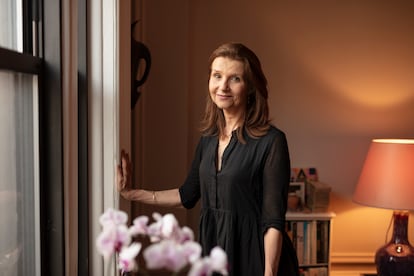
Academic and writer Marina van Zuylen, who holds a PhD in Comparative Literature from Harvard, left Columbia to become a professor at Bard College because she also wanted to devote herself to an unusual project hosted there: the Clemente Course in the Humanities, which offers free humanities courses that can later be converted into college credits. She taught there voluntarily for 25 years, until a philanthropist decided to fund the initiative and turn her commitment into a professorship.
This is a clear example that Van Zuylen’s priority is not personal recognition. In her research, she explores concepts such as fatigue, boredom, distraction, difference, and the golden mean as legitimate forms of knowledge and resistance to the logic of productivity. A refreshing line of thought reflected in her two most recent books: In Favor of Distraction (Elba, 2019) and Elogio de las virtudes minúsculas (In Praise of Minor Virtues, not yet translated into English).
The conversation unfolds over five hours at her home in the heart of the Upper West Side, one of New York’s most intellectual and iconic residential neighborhoods. Van Zuylen touches on philosophical topics and curiosities from her life (despite living in France until age 19, she holds only U.S. citizenship) as well as subjects connected to her latest book. Throughout, she exudes a boundless warmth, which her son refers to as “aggressive hospitality” and which aligns with the reviews of many of her students, who describe her as the best teacher they have ever had.
Question. A recurring theme in your books is the culture of self-demand.
Answer. I decided to write Elogio de las virtudes minúsculas because many of my colleagues, professors at the most important universities in the U.S., remained dissatisfied despite having achieved great things in their careers. It’s a topic that worries me. With that mentality, you never feel like you’re enough, and you live in a constant state of alert.
Q. In the book, you recount how, due to a botched MRI, your neurologist thought you were missing part of your brain. And how that relieved you.
A. I thought I’d achieved a lot without that part of my brain, which made me proud of myself, while at the same time, its absence served to justify my failures. Although another doctor later explained to me that my brain was perfectly normal and the problem had been a poorly done MRI. The experience made me reflect on the expectations we place on ourselves and the tyranny of merit, which can ruin many people’s lives. We spend our lives performing for others.
Q. And yet, according to you, virtue lies in not needing external validation.
A. It’s always nice to be recognized for what we do, but I think what’s valuable is doing something without seeking any credit. My purest interaction with a human being was with a neighbor who suffered from Alzheimer’s. All our conversations were immediately forgotten, but for a moment, while he was talking to me, he would abandon this void in which he didn’t exist. And it’s the perfect example of doing something meaningful without feeling virtuous, because it was merely down to the two of us and the moment in which it happened; then I would disappear. And the philosopher Simone Weil was referring to that disappearing when she went to work at the factory and wanted to exist, without existing. There are moments that have nothing to do with prestige or prejudice. It shouldn’t even be called altruism.
Q. You speak of the importance of listening to the silences, of noticing what usually goes unnoticed.
A. I write about the importance of noticing something. I remember being a little girl, alone in a park, and hearing a mother tell her daughter, “Go play with that little girl who’s all alone.” About the importance of kindness. My reference is Chekhov because almost all of his characters are secondary. One of my favorites is Astrov [the alcoholic doctor in Uncle Vanya], who plants little trees without anyone seeing him “for the future, because at some point they’ll help Russia’s forests.” And for me, he’s a great example of virtue because trees are an investment in a better future, but no one will know who planted them. My book tries to make visible those virtuous people who have felt invisible their entire lives. For example, I mention the maid in Octavio Paz’s The Labyrinth of Solitude, when she knocks on the door and says, “It’s nobody, sir, it’s me.”
Q. You also mention an Emily Dickinson poem, which has the line: “I’m nobody! Who are you? Are you nobody too?”
A. That’s a fantastic poem! I also really like a French philosopher who changed my life: Édouard Glissant, who talks about the right to opacity, that there’s no need to reveal oneself to anyone. You can keep things to yourself, even success, because if you feel the need to share it with everyone, deep down you’re showing that you’ve intensely desired it for a long time.
Q. Your way of achieving success can be considered atypical.
A. I’ve never competed, I never thought I’d get a good job. It’s true that I’ve managed to achieve success in a transversal way. My doctoral thesis, Difficulty as an Aesthetic Principle, focused on 19th-century novels that didn’t aspire to be commercial successes. I’ve written about Melville, Flaubert... writers who didn’t aspire to please the public. I also wrote about monomania, jealousy, hypochondria, and other aspects that have destroyed part of my life and definitely my first marriage. Many people were interested in me talking about my failures instead of boasting about successes, and they invited me to teach at Harvard, Columbia University, and Princeton.
Q. You direct the Clemente Course in the Humanities. Have you been affected by the sociopolitical situation in the U.S.?
A. The political situation has certainly impacted the course, because it’s aimed at students who are in more vulnerable situations, and many are afraid of being arrested and deported. We started the year with 22 enrolled students, and now we only have eight. When I die, I’ll be more proud of having helped them than I was of Obama giving me a hug when he awarded me the National Humanities Medal in 2014.
Q. Besides the threat of political interference in academia, the arrival of new technology is also proving disruptive. How are you addressing this?
A. All teachers who care about our students’ lives try to ensure that assessments are conducted in class and are more interactive. I don’t accept the use of any type of technology; cell phones are prohibited. I assess students through exams and essays that I have them write by hand in class. Before, there was a final project they completed at home, but now I’m suspicious.
Q. Do you have faith in the future of education?
A. Today I read that in France people read five books a year, but in America only one. It’s very sad. Students are increasingly focused on the goal, not the process. Many take Adderall [an amphetamine used to treat ADHD] to concentrate, but they are no longer able to read poetry.
Sign up for our weekly newsletter to get more English-language news coverage from EL PAÍS USA Edition









































