
An evening with Max Richter, the composer whose music for the edge of sleep has millions of streams
The German-British musician celebrates the 10th anniversary of his bestseller ‘Sleep’ with two nighttime performances at London’s Alexandra Palace and the release of a distilled version of the original, adapted to the 90 minutes of the REM phase
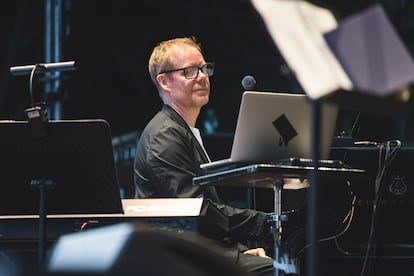
Next to the window of Max Richter’s studio, a telescope points at the bright sky. It’s 3 p.m., but for the German-British composer, it feels like dawn. “I’ve been adjusting my biological clock to the schedule of my upcoming concerts for days,” he says via video conference from the top floor of his house in Oxfordshire. “These controlled jet lag sessions will allow me to come onto the stage refreshed.”
The sessions will take place this Friday and Saturday evening in the central nave of London’s Alexandra Palace, where he will celebrate the 10th anniversary of the release of Sleep, an eight-hour work written for string quartet, piano, organ, voice, and electronics. That album changed his life. “My relationship with the public took an unexpected turn,” he confesses. “I realized that the traditional concert format could be too rigid.”
From there, the post-minimalist style of his early work gradually gained a more mainstream profile through commissions for film — including the highly praised soundtrack of Mary Queen of Scots — television series such as The Leftovers and Black Mirror, and even fashion shows for Fendi and Dior. “I’ve just finished the music for the adaptation of Hamnet [the novel by Maggie O’Farrell] directed by Chloé Zhao,” he confirms. “And next month, Anne-Sophie Mutter will premiere my first Violin Concerto at the Musikverein.”
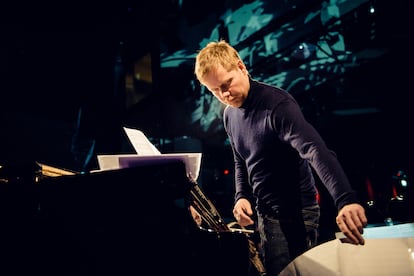
Despite the generous capacity of Alexandra Palace, attendance for the concerts he will perform will be limited to a total of 850 numbered beds (at $300 per ticket, breakfast included), from which the audience will enjoy an immersive experience that has already amassed over two billion streams and has topped the Apple Music Classical charts for months.
“Thinking about those numbers makes me a little dizzy, but it’s beyond my control,” the composer admits. “Sleep was designed to be listened to at night, but I know a lot of people put it on during the day, perhaps as an accompaniment to their workday,” he jokes.
Coinciding with the anniversary of the bestselling Sleep, Richter is now releasing Sleep Circle, a distilled version of his magnum opus. “During the tours for the project, I gathered material for a montage of more active, foregrounded tracks, without the performative component,” he explains. “I decided to record it right here, in my house, in one go and without any editing.” The result is a collection of 24 tracks that guide the listener into a hypnagogic state through a succession of soundscapes that simulate the transition from wakefulness to sleep over the course of 90 minutes. “That’s roughly how long it takes us to reach REM sleep, a liminal zone of great creative potential.”
In fact, the original idea for Sleep arose under the influence of what is known as desynchronized sleep. When Richter was not well-known, his partner and collaborator, visual artist Yulia Mahr, would follow the premieres of his works in other countries via streaming, often at ungodly hours. “After waking up from one of those half-sleeps, she called me enthusiastically to encourage me to compose a piece inspired by the architecture of sleep.”
Since then, his low-frequency sounds have been guided by David Eagleman, neuroscientist and author of Incognito: The Secret Lives of the Brain. “Let’s just say the experiment went better than expected,” he says.
Over the course of this decade, his famous ambient lullaby Sleep has cradled listeners around the world: from the Park Avenue Armory in New York to the Sydney Opera House, and through La Nave, the old Böetticher factory in Madrid, his only stop in Spain. In 2019, Richter and his ensemble performed the same program outdoors along a section of the Great Wall of China in Beijing. “While we were playing, I saw several soldiers patrolling the fortification under the moonlight,” he recalls. “Two hours later, during a coffee break, I found those same men asleep on the ground with their rifles. It was the most surreal sight…”
Equally well-known is Richter’s foray into Baroque repertoire, as recommended by his teacher Luciano Berio, when he was trying to free himself from the “obsession with atonal abstraction brought on by the New Complexity.” In 2012, in an unlikely collaboration with violinist Daniel Hope, he dared to rewrite Vivaldi’s The Four Seasons, which he re-recorded two years ago using period instruments. “The earthy color of the gut strings provides that crunchy flavor that fascinates certain palates,” he says, alluding to the eternal debate between the two varieties of peanut butter. “I’m more crunchy than creamy,” he clarifies.
For Richter, artificial intelligence is not a threat. “Human creativity is extraordinarily complex,” he reflects. “Formulas can be replicated, but music goes beyond words and notes. There’s no way to imitate that magical state of communion between people in the real world.” He then points to the “real elephant” in the room. “The problem lies in the original materials with which these machines are trained. That content, which is protected by copyright licenses, is being used fraudulently. I’m not exaggerating when I say that the music industry has regressed several steps back to the Napster era of illegal downloads.”
None of this, however, robs him of sleep. “I sleep wonderfully, up to 12 hours at a time, which is lucky considering the enormous amount of stimuli we’re exposed to.” Against the ravages of insomnia under the glow of screens, Sleep proclaims its manifesto in favor of rest. “We all want to switch off, but no one is quite sure where the pause button is. Maybe because we think sleeping is a waste of time or a sign of bad manners.” Especially in certain concert halls. “There’s nothing wrong with taking a nap during a [Anton] Bruckner symphony,” he laughs. “I’ve done it, and it feels great.”
Sign up for our weekly newsletter to get more English-language news coverage from EL PAÍS USA Edition









































