
Trump takes aim at Ivy League universities
The president’s threat to withdraw funding from the country’s leading educational institutions is already jeopardizing their research work
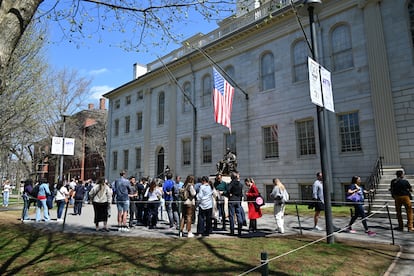

The endowment or reserve fund of each of the eight universities that make up the United States’ prestigious Ivy League would be enough to solve the economic problems of dozens of countries. Harvard University, the richest of them all, has an endowment of $53 billion, the sum of the GDPs of Iceland, Madagascar and Aruba, and more than the GDP of over 120 nations, including Tunisia and Bahrain.
With Yale’s endowment ($41.4 billion), more than 102 homes could be built at an average price of $403,000 in the United States; the University of Pennsylvania, President Donald Trump’s alma mater, has a $22.3 billion endowment, equivalent to 103 times Cristiano Ronaldo’s income in the 2024 season.
The calculations were made by CNN, which recently wondered, like many of its viewers, why, if the eight most prestigious universities in the country have so much money, they depend so much on federal funding (multi-year grants for research programs and contracts).
One answer is that most only spend 5% of their endowment each year, according to CNBC’s calculations based on 2019 data, and invest the rest to further increase the reserve fund, which increases returns for investors, but also for activists.
Last year, pro-Palestinian advocates demanded that Columbia divest from companies with ties to Israel; previously, other institutions were asked to divest from fossil fuel companies or private prisons. In the 2017-2018 academic year, U.S. universities raised $47 billion. That year, Harvard’s equity capital was nearly equal to the entire value of Facebook, or nearly twice that of Coca-Cola.
In fiscal year 2023 alone, the federal government allocated approximately $60 billion to universities in all 50 states, funding research on cancer, Alzheimer’s, and rare isotope beams, among other topics. The funds went to small universities, but also to large public and private research institutions, such as Georgia Tech and Johns Hopkins. Typically, federal research and development funds go to more populated locations that are home to several major universities, such as Chicago, Los Angeles, and major cities on the East Coast.
That’s why the Trump administration’s current threats to universities, which claim they will be deprived of public funding if they don’t comply with the administration’s demands — the eradication of alleged antisemitism on campuses and the cancellation of their diversity and inclusion policies — have sparked a debate about funding, which many mistakenly believe comes primarily from student tuition (up to $80,000 a year). The eight largest U.S. universities are also large corporations, with investments, interests, and assets that their managers — independent of academic leaders — handle based on, for example, the conditions imposed by donors.
The fact that they don’t spend enough of their endowments has put a target on their backs. But while they might spend more, they couldn’t conduct research at the current level — that is, the level they have reached thanks to federal funding — with their endowments alone. Hence, the withdrawal of government funding — $2.2 billion from Harvard, expanded this week by another $450 million, or $400 million from Columbia — represents a serious setback for one of the most important functions of universities: research, including the maintenance of hospitals on which entire cities, like Boston, depend.
Although most Americans believe that expensive tuition is the only source of income for universities, running hospitals and clinics or funding expensive biomedical research programs attracts abundant flows of public money. Endowments are not piggy banks, however. Harvard, which has sued the Trump administration over the funding freeze, estimates that about 80% of its endowment goes to student financial aid, scholarships, professorships and other programs, and the remaining money would not fund even half of its research. Much of the endowment is subject to what are known as donor restrictions, under which donors determine how their money is spent, preventing the diversion of funds to plug loopholes. Very few receive donations without restrictions on their use.
Pressure from Jewish donors, who threatened to withdraw their funding when protests against the Gaza war erupted on campus, led to a wave of resignations among presidents at Pennsylvania State University, Harvard University and Columbia University (two at the latter institution). With Trump in power, pressure has intensified for institutions to capitulate to his demands and to abandon any woke orientation in their programs. The consequences of not doing so include staff cuts, laboratory closures and the suspension of life-saving research programs. Universities may be tempted to pass on the loss of federal funding to tuition, as well as cuts to scholarship programs and financial aid to students.
First cuts
The first cuts have already been made: Johns Hopkins University, which is not an Ivy League member but also boasts great prestige and a significant endowment, has just announced that it will have to cut more than 2,000 jobs due to the withdrawal of federal funding. Columbia announced on Tuesday the layoff of 180 researchers after the government withdrew $400 million in multi-year grants.
Some institutions, especially the wealthiest ones, are exploring alternative plans. Harvard recently began negotiations to sell around $1 billion of its private equity fund stakes. In addition to the Republican administration’s threats to revoke its non-profit tax status, the timing doesn’t seem ideal for the returns on illiquid assets—those that can’t be quickly converted into cash. Its endowment, like that of other prestigious American universities, includes a considerable portion (40%) in venture capital.
Like other universities, the Cambridge-based university faces pressure from investment firms, which are struggling to sell assets and return money to their limited partners, although the effort to sell the secondary portfolio actually began last year, according to Bloomberg, before Trump declared war on universities, which he considers a breeding ground for Democratic elites.
Sign up for our weekly newsletter to get more English-language news coverage from EL PAÍS USA Edition









































