
Elliot & Erick, photographers: ‘We want to talk about Afro-Cuban religions in a more contemporary way’
The Cuban twins behind ‘Time’ magazine’s first Spanish-language cover are premiering their inaugural solo exhibition at the Pérez Art Museum Miami (PAMM)
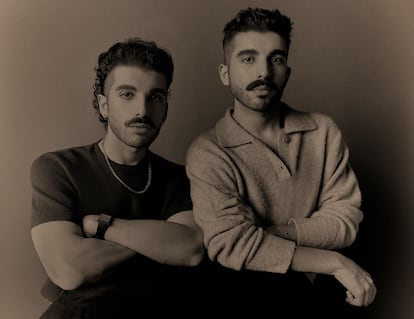

The life of Cuban-born twins Elliot and Erick Jiménez (Miami, 1989) seems like something out of a movie. Self-taught and precocious, they’ve dedicated decades to fashion photography, imbuing it with an artistic aura that plays with syncretism, transculturation and identity. They rose to fame in 2023 when they shot the first Spanish-language cover of Time magazine in its 100-year history. The subject of their photography was Bad Bunny, the king of reggaeton and the current music scene.
The Jiménez brothers are now opening their first institutional solo exhibition, which will be hosted by the Pérez Art Museum Miami (PAMM) from August 28 until February 8, 2026. The exhibition is curated by Maritza Lacayo, who is originally from Nicaragua. It’s entitled El Monte (“The Wilderness”), a reference to the influential work by Cuban ethnologist and writer Lydia Cabrera, who died in 1991. The book, only recently translated into English in 2023, is considered by many to be the bible of Afro-Cuban religions.
Question. You both mainly used to do fashion photography. What inspired you to jump into the art world?
Answer. Erick: We’ve always been interested in art, but starting in 2020, during the pandemic, we began to reflect on our career and interests. And we decided to develop [our craft] further. Clients always emphasized that our work was very artistic.
Creatively, [this shift] has been liberating, because commercial projects always have certain limits. But in visual art, we have complete control to experiment.
Elliot: The art also continues after the photoshoot, because it involves other types of decisions: how we’re going to print the image, what frame we’re going to use, what kind of materials we’re going to use… we also experiment a lot with paint and antique objects.
Q. The exhibition references El Monte (1954), by Lydia Cabrera. What is its relationship to the Lucumí spiritual tradition?
A. Erick: We were raised by our paternal grandmother, who is Afro-Cuban, and she was the one who introduced us to Lucumí, which, incidentally, is very common in Miami. Lydia Cabrera’s book was the first to thoroughly document the beliefs and practices of African American religions on the island. These stories were only passed down orally, so the book became a reference for many artists, like Ana Mendieta, Wilfredo Lam and José Bedia. We wanted to continue that conversation, but in a more contemporary way.
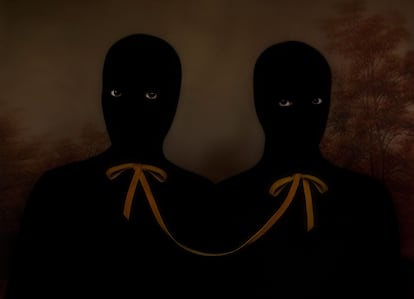
Elliot: Even though we didn’t pay attention as children, from the age of 18 onward, we began to become [interested in learning] more about our identity. In the Yoruba religion, as twins, they call us the Ibeji: spirits that inhabit two bodies and represent duality. It’s interesting because, in West Africa, where the Yoruba community originates, [you can find] one of the largest communities of twins in the world. We looked into Lucumí to better understand our own personal history and found parallels. The Ibeji were abandoned and we grew up with our paternal grandparents.
Q. You were in charge of shooting the first Spanish-language cover of Time magazine, photographing Bad Bunny. How did that work impact your career?
A. Erick: It was a very special moment. Up until that point, our grandparents had never understood what we did. But that day, with the cover and the article in Spanish, they were able to see it.
The entire team was Latino. And Bad Bunny was extremely famous at the time, which gave us the opportunity to represent the importance of Latinx culture in an American publication. Although the fashion world is quite insular, they paid attention to a mainstream magazine to see what we had done.
Elliot: It was the magazine’s editor who became interested in us after seeing our artistic photographs. We thought the fashion industry wouldn’t understand what we were doing… but it was the other way around. It benefited us. From then on, many people who had never paid attention to us before began to take an interest.
Q. New York is a tough city. What was your arrival like?
A. Erick: We taught ourselves to take photos at [the age of] 15. And, by 18, we were already working for modeling agencies. We had built a strong portfolio for that time [period] and for the Miami market, which was very small. That’s when we decided to move to New York, because the opportunities to grow in Miami were very limited. But it was very difficult. We didn’t achieve anything and had to return.
Elliot: Besides discovering that we had to compete with thousands of people in New York — all of them fighting for the same thing — we decided to take in our sister, who was six years old and had moved in with our paternal grandparents. Since they were already too old, we decided to stay in Miami with her. We raised her from 2008 to 2016. It was one of those moments when you have to put your life on hold.
Q. Being twins and photographing together, how do you coexist while still maintaining your individual identity?
A. Erick: We started photography separately. And it was a bit competitive. We realized we had similar interests. So, in 2007, we decided to join forces. It was the best decision, because we did so much better. I can’t imagine doing this without him anymore. I feel so grateful, especially now that I know so many artists and can see how lonely this career is and how depressed they get sometimes. Honestly, I couldn’t say who takes which photo; one of us usually takes photos and the other directs. And then we swap. It’s all very organic.
Elliot: Sometimes, we’re both taking photos at the same time: one with a digital camera and the other with an analog one. It’s about getting the best possible image, no matter who [is taking the picture]. The person I want to impress the most is my brother and vice-versa. And, if we’re both impressed by the work we’ve done, we’re sure it’s good work.
Q. Do you also live together?
A. Elliot: We lived together until 2020, when I moved to Miami with my partner. But in New York — where we spend at least two weeks each month — we still have an apartment together.
Erick: [After he moved out], we also spoke on the phone every day, so although it was a bit difficult for me to adjust at first, it wasn’t that complicated.
Q. And how do you experience your biculturality?
Erick: We speak Spanglish together. And, having grown up in Miami — with such a large Latino community and so many Cubans around — we’ve always identified as Cuban. It was when we arrived in New York that we had the biggest identity crisis, because there were Cubans who told us, “You’re not Cuban, you’re American.” Americans, on the other hand, said, “You’re Cuban, because we don’t [speak like] that.” Even though we were born in the U.S., we realized our English had a Miami accent. It was hard for us to discover our identity, to see what category others put us in. We’ve always lived between two worlds.
Elliot: Duality has always been present in our lives, because in addition to being twins, it’s also present in our own family: white and Black. Our father is of Afro-Cuban origin and our mother is white Cuban, of Spanish descent. And we also straddle the worlds of fashion and art. For us, this exhibition at PAMM doesn’t represent a new category. Rather, it’s a moment to expand our work and our interests.
Sign up for our weekly newsletter to get more English-language news coverage from EL PAÍS USA Edition









































