
Steve McCurry, a great photographer annoyed by certain questions: ‘You are trying to trip me into some bullshit’
Represented by Magnum Photos, he rose to fame for his 1985 portrait of an Afghan girl in a refugee camp — but gets angry when asked about past revelations that some of his images were manipulated


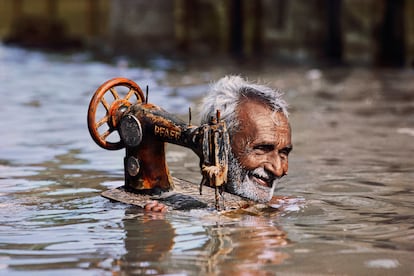
Steve McCurry (Philadelphia, 1950) is a great photographer, but does have a reputation for, at times, being difficult in interviews. His career took off in 1979, when he photographed the civil war in Afghanistan prior to the invasion of the country by the Soviet Union. Later, he covered numerous conflicts, during which he placed special focus on “the human condition,” and specifically, faces. To this end, one of his most important books is Portraits (1999). In it is the shot he took of Afghan girl Sharbat Gula in a Pakistan refugee camp, with her enormous and frightened green eyes. That photograph became the symbol of her people’s plight and made a global impact, thanks to it appearing as the cover of a 1985 issue of National Geographic.
The recipient of numerous awards and subject of many museum exhibitions, the photography of McCurry stands out for its saturated colors and lyrical imagery, even as it explores the lives of the disadvantaged. A member of the Magnum agency since 1985, McCurry has largely focused on Southeast Asia’s “light and color.” However, his reputation was tarnished in 2016 when The New York Times published an article saying he had manipulated some of his images, deleting elements like people and objects that he thought marred photographic composition. At the time, McCurry argued that he was not a photojournalist, but rather, “a visual storyteller.”
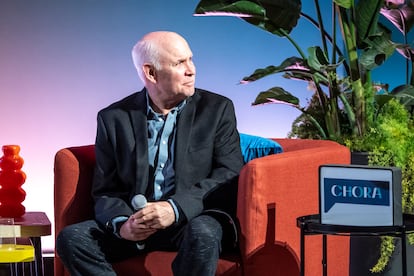
At the end of June, McCurry was one of the star guest photographers featured at the 100th anniversary celebration in Wetzlar, Germany of the first compact camera, the Leica I, an event to which EL PAÍS was invited. The American photographer participated in panels and gave interviews like the one below — though in this case, he ended things abruptly when asked about the controversy of his retouched images.
Question. What are you working on at the moment?
Answer. I have been doing some workshops in Rome, I’m working on a couple of books. That’s about it for now.
Q. We’re at the centennial celebration of the first Leica compact camera. What makes Leica special for you?
A. I like the quality of the lenses, the reliability, the functionality of the camera. It’s really that.
Q. In your photographs there is beauty, a great aesthetic sense, but on occasion, they portray people who are suffering. Why is that?
A. [Ironic laughter] Oh, the subject matter. My God, I think he has me mixed up with somebody else. I don’t always focus on human suffering. Not always. That’s an interesting question, but it’s sort of a trick question.
Q. It’s a trick question? Why?
A. Because in the same sentence, you have the words “aesthetic” and “suffering.” You have tried to manipulate me. Let me say this, you’re a free man, you got your [recorder] on, you can say whatever you want. So we can continue or not, and you can just write whatever you want. But I think that I object to the manipulation of suggesting that somehow I’m trying to beautify human suffering. It’s totally legitimate for an artist or a photographer to document the world as it is, and whatever the human emotion is — joy, happiness, suffering, sadness. I’d stand firmly behind any filmmaker, writer, poet, songwriter that talks about human suffering. That is part of the human story, the human experiment, but this idea that somehow you’re beautifying that, that I’m using it as some aesthetic tool to glorify… I’m not sure about that.
Q. It’s not my opinion. It was just a question.
A. You know, they said the same thing about my late friend, Sebastião Salgado. I don’t think we want to turn away from the less fortunate. I think that we need to care for people, children, poor people. We can’t ignore them. I mean, to say, “you’re profiting off them” — just the contrary, I could have done far better if I had photographed advertising or whatever. I mean, if we don’t know the problem, then how can we solve it?
Q. From when you began as a photographer up until now, what strikes you as the principal difference in people, in humanity? Are we the same? Worse?
A. I don’t think there is any difference, really. Human nature is basically the same. The majority of people are kind and nice, and some people aren’t.
Q. And when you see the wars continue, what’s happening in Palestine, in Ukraine?
A. I have been to Ukraine, I’ve seen it for myself. You have one guy who wants to rebuild the Russian empire. I love traveling to Russia, I have friends there! But what’s happening in Ukraine makes no sense. It never makes sense to kill innocent people — or anybody, for that matter. And then there’s the soldiers, who are given instructions. What are they going to do? It’s their job. I think what’s happening in Gaza is not new, this has been happening for thousands of years. It’s about power and lack of respect, of wanting to discriminate. But anyway, without dwelling too much on politics, we’re talking about human action.
Q. On the other hand, there’s Donald Trump. Do you think his policies could further destabilize the world?
A. Yeah, that too. I think it was a mistake, him being made president. But I don’t want to make this whole thing about Donald Trump. There’s a lot of problems with him, but let’s pick one as an example. The deal breaker for me was questioning Barack Obama’s birthplace and [his] American citizenship. So he has a strange name, OK. He’s a half-Black man, so you attack him because he’s not white? That’s the only thing you need to know about [Trump], that disqualified him right from the beginning. [McCurry opens his arms wide] Forget the list of 900 things, that’s the one thing.
Q. I wanted to ask you about the polemic from a few years ago with some of your photos.
A. This is old news, man. I’m not going to get into that, and I’m disappointed in you. I knew when the Spanish newspaper came in, you were going to go there. And you guys always leave it to the last question. You work for a newspaper? Yeah, this is old news. Thank you, that’s it. [McCurry gets up to leave]
Q. Sorry, but, is this the end of the interview?
A. There’s nothing to be sorry about, it was a pleasure meeting you. Thank you very much. I appreciated our time together and you’ve been very kind with me. I appreciate your time and I appreciate you coming here. You came here as a guest of Leica?
Q. Yes.
A. We both came here as guests, I didn’t come here to discuss — I’m happy to talk to you about politics. If you want to talk about politics, call me in my office. I think we’ve talked enough, OK? You work for a newspaper, man. You need to be more creative, do a bit of research. I know it’s difficult, I know you’re busy. But do some homework. If you took the time — you’re a lazy man. That [other] question was a trick question, but I tried to give you some time. You are trying to trip me into some bullshit. Honestly, I think you should put the whole interview into the trash can and just leave it like that.
Q. I’m sorry, but I’m a journalist. I have the right to ask questions.
A You’re a journalist and I have my right to not waste my time. [McCurry gestures to the phone that is recording the interview] Do have have that fucking thing on? Do you have that fucking thing on?
Sign up for our weekly newsletter to get more English-language news coverage from EL PAÍS USA Edition









































