
Sex, millions of dollars and back-to-back flops: the return of Joe Eszterhas, the best-paid and most-reviled scriptwriter in Hollywood
The announcement that there will be another installation of ‘Basic Instinct’ penned by its original screenwriter raises the question of whether an 80-year-old man who has been largely out of the game for nearly 30 years can still scandalize us
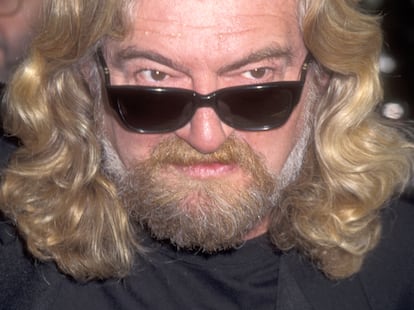

Joe Eszterhas was the most famous screenwriter in the world, and then he disappeared. That brief description, in Hollywood jargon, is what we would call the “idea.” Next would come the twist: this summer, his name returned to the headlines of industry media when it was announced in an exclusive for The Wrap that a reboot is in the works of his best-known film, Basic Instinct, and that he will be writing it. It won’t exactly be a sequel (the world has largely forgotten the one that was released in 2006), but rather, a kind of relaunch that returns to the story from another perspective, maintaining characters and concepts from the original.
In his day, Eszterhas was the closest thing to a rockstar that the world of scriptwriters has ever had. His profession typically sticks to the shadows, with more or less prestige and bigger or smaller paychecks, known somewhat by cinephiles and effectively alien to the wider public. But Eszterhas was a star. After putting out hits in the 1980s like Flashdance, Jagged Edge, Music Box and Betrayed, he became front-page news when his script for Love Hurts sold for the highest price in Hollywood history: $3 million ($7 million in today’s currency). He would go on to become a tireless generator of news items and innovations in the most transformative, convulsive years of the movie industry.
Eszterhas himself soon changed the film’s title, substituting in a moniker that proved much more commercial: Basic Instinct. Unless you live under a rock or are younger than 15 years old, you know what happened from there.
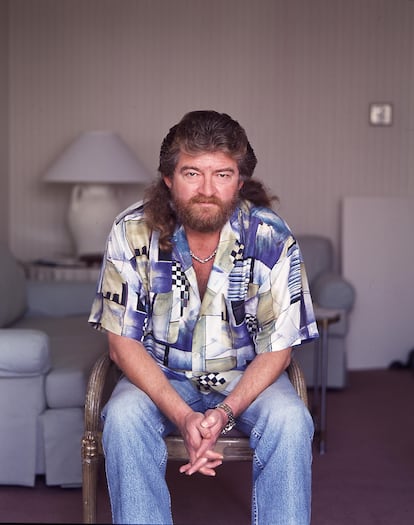
For the first time, a scriptwriter was leading off news programs. Trade paper Variety put him on the cover, a photo of the bearded, hairy man who looked more like a biker, a troublemaker, than a writer alongside the headline: “A New Era Dawns in Hollywood:” $3 million was more than the fee paid to the most famous directors, and the majority of stars. How did it happen? His agent, a man named Guy McElwaine, who had been the first to represent Steven Spielberg, saw that the script possessed just what Hollywood producers were looking for: huge commercial draw. McElwaine put it up to be bid on by the biggest names in the industry. According to Eszterhas in his memoir Hollywood Animal, by noon, the bidding had already reached $2 million and by the afternoon, three.
The film became not only an enormous hit at the box office (it was the fourth-biggest ticket-seller in 1992, a milestone for a film directed at an adult audience), but also a cultural event. Its controversial subject matter provided free publicity even before its release, the elevated doses of violence, sex, and its polemic portrayal of homosexuality — its protagonist is a bisexual woman who is also a ruthless murderer, and her lover Roxy is no upstanding citizen either. Gay and lesbian activists boycotted the film. The critic Roger Ebert commented that, “The movie’s protesters might take note of the fact that this film’s heterosexuals, starting with [Michael] Douglas, are equally offensive.”

Despite all the problematic aspects of Basic Instinct, despite its misogynistic violence, its linkage between sexual dissidence and criminality, the film became a noir classic that stands up to repeated viewings and continues to come across as just as magnetic and daring as it was back in the day. This is in large part thanks to the passionate direction of Paul Verhoeven and the performance of Sharon Stone, who gave it her all at a point in her career in which she had nothing to lose.
From this point on, Eszterhas’s career can be summed up by two key moments that took place just three years apart. In 1992, he was on top of the world with the release of Basic Instinct and in 1995, two of his films debuted just three weeks apart, leading to cataclysmic critical and commercial failure. One was Jade, which has been forgotten. The other was Showgirls, which everyone remembers. The most interesting part of Eszterhas’s life, what makes him such an interesting character, took place during those three years between his rise to glory and his downfall.
From refugee camp to the Hollywood hills
For being a man who basically wound up writing the same script over and over (watch Jagged Edge, Basic Instinct and Jade in a single afternoon and draw your own conclusion), Eszterhaus’s life has more twists and turns than those of 10 other people. He himself, demonstrating the summative ability of a good screenwriter, describes it as follows at the start of his memoir: “I grew up a poor kid in the refugee camps of Austria and on the West Side of Cleveland, Ohio. I worked as a furniture mover, a disc jockey, and a newspaper reporter, but I didn’t like the work. I went out to the American West and became a screenwriter. I sold screenplays in Hollywood for record amounts of money. My agent, Guy McElwaine, referred to these sales as ‘bank heists.’”
His first big hit was Flashdance (1983). Eszterhas’s original script was an ensemble piece that not only included the lead dancer, but also a series of losers, including a comedian who can’t make anyone laugh and a skater who bets everything on a competition but ends up breaking a bone. The film was two hours and 20 minutes long. At the request of Paramount, its production company, it was cut to just over 90 minutes, resulting in the film we know today, comprised of spectacular dance numbers with a few scattered scenes of dialogue and rather sketchy characters. It was a flop on opening weekend, but something happened the second week after its release: theaters reported that people were leaving in tears, singing What a Feeling and, perhaps most strangely, that the popcorn was selling out. “This could be a popcorn movie,” the producer told Eszterhas. At this point, the screenwriter seems to have learned his lesson about what the audience wanted. He would go on to apply what he’d been taught.
All of Eszterhas’s films have emotional twists, magnetic villains and protagonists faced with ambiguous motivations. In Music Box (1989), Jessica Lange’s character must reckon with the love she has for her father and the hard reality of him having been a Nazi collaborator (a product of autobiographical material that Eszterhas explores in detail in his memoir). In Jagged Edge (1985), there is a typewriter missing a key that in the climactic scene leads to Glenn Close realizing that she has fallen in love with a murderer. In Jade (1995), a videotape of Linda Fiorentino having sex with a powerful man winds up being projected in an interrogation room in front of several detectives and her own husband. In his best moments, Eszterhas knew how to manipulate the viewer — with a detail, an object (the Basic Instinct icepick!) — into talking about his films the next day, turning them into his best publicity campaign.
Sharon Stone in Algodonales
When a film becomes a global phenomenon, it’s best to analyze its impact not in the theaters of New York, London, or the planet’s other big cities, but rather in the unexpected corners. Jota Linares is 42 years old, a director, scriptwriter and author, who remembers when he was 10, in his little Spanish town of Algodonales where there was no movie theater, the adults went on excursions to the neighboring village to see Basic Instinct. “I imagine I’m a walking cliché, but the first time I watched it in secret in my bedroom, I was fascinated. Not so much for the sex scenes, although, those too. As the years passed, I’ve realized that it was because of the script, which is perfect. A classic noir story, but unlike any that had been told before.” It’s likely that an entire generation, all over the world, has a Basic Instinct story. Perhaps because it was the last time they were an innocent audience. But for Eszterhaus, that death of innocence would turn out to be a disaster.
Sliver (1993) was released to great fanfare, with the promising reunion of the star and screenwriter of Basic Instinct. In Eszterhas’s memoir, the screenwriter recalls how Stone’s initial response to the offer to make the movie was: “I’m not showing my pussy for Joe Eszterhas anymore.” She didn’t, but it wouldn’t have saved a film that wound up being mutilated by the studio, which didn’t approve the original ending (now viewable on YouTube — basically, the bad guy wins and marries the girl) and hurriedly filmed an incomprehensible alternative. See the succinct review published by EL PAÍS at the time: “Sharon Stone shows her charms; also, William Baldwin.”
It seemed that the magic of Eszterhas was sputtering out, but it was during this era that he signed up for what would be perhaps his easiest and most profitable job. This wasn’t a script, but a simple story treatment, four pages total, for which he received $4 million when the movie was released. The film wound up being called One Night Stand (1997) and after director Mike Figgis made changes that Eszterhas did not approve, he amicably withdrew from the project and removed his name from its credits. Even so, he set a record that has yet to be bested to this day: a historic $1 million fee per page.
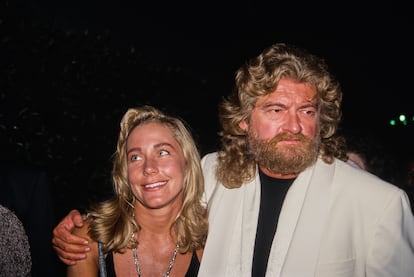
And so we arrive at Showgirls and Jade, both of which debuted in the United States at the end of 1995. This was a test of fire. Hollywood and the press had already taken a dislike for Eszterhas, a guy who earned millions, acted like a movie star, and had yet to prove that his talent was on par with his astronomical paychecks. There was a strong desire to see him bite the dust. And indeed, the dismal critical and box office performance of Showgirls and Jade sank him. Eszterhas maintains in his memoir that both films were ruined by their directors (who were no slouches: Paul Verhoeven and William Friedkin). In the case of Showgirls, Eszterhas says he named the protagonist Nomi using his wife Naomi’s childhood nickname, and wanted Drew Barrymore to play the role. But Verhoeven gave the part to Elizabeth Berkley, a woman with an extremely sexual and aggressive physique whose performance still fascinates and horrifies in equal measures, 20 years later. “The movie came out and disastered and turned my true love’s childhood nickname into a national joke,” lamented Eszterhas. The gesture betrays the seriousness with which he took the story, despite the world’s reaction to it.
The publicity campaign for Showgirls was intense, promising to show things that had never been seen in a commercial film. Linares was among those who were intrigued. “I was obsessed with seeing it. I was 13 years old when it was released and I have never watched it ironically. I’ve always thought it was good, given that it is crude, sleazy and vulgar, because it portrays a crude, sleazy and vulgar environment.”
With the passage of time, Showgirls has become a cult film, almost an auteur project, but for Eszterhas, it was the final nail in the coffin. From his later career, the tender and semi-autobiographical Telling Lies in America (1997) is worth watching. After the comedy Burn Hollywood Burn (1997), another critical and box office flop, he has yet to have another script produced by Hollywood.
Eszterhas would go on to beat throat cancer, though it cost him a tracheotomy and profound regret for having glorified tobacco in his scripts (few people have smoked as well as Stone in Basic Instinct). He would score some subsequent wins, but they were relatively subdued, and took place in bookstores. His memoir Hollywood Animal received good reviews in 2004 and his take on Monica Lewinsky, American Rhapsody, and on Mel Gibson’s poor character in Heaven and Mel are at least, very fun books. In the 21st century, after being Hollywood’s most precocious screenwriter, he returned to embracing religion, and wrote another book about that.
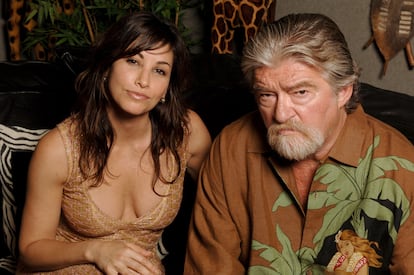
“Eszterhas made very bad movies and he is not a genius. No one remembers Sliver, for example. But when he hit the right keys, he hit them in an extraordinary manner,” says Linares. “The impact that Showgirls has had on cinema is undeniable. Films like Anora, The Neon Demon and The Substance are clearly and recognizably influenced by Showgirls. You don’t get to have that impact without being talented. And his profile in Hollywood, with all its excesses and addictions, makes him even more intriguing. Give me 20 Eszterhases and you can have all these current screenwriters who don’t say too much in case their dialogue is seen as having some controversial political subtext.”
In this area, Eszterhas has no problems whatsoever. He’s promised that the new Basic Instinct will be “anti woke.” He has not volunteered any more details, though it should surprise no one if the film is in the spirit of the original, the least politically correct movie of recent decades. “The only thing I can say in defense of all this is, for people who are concerned about my age, I’m a huge Mark Twain fan. And then I’m going to paraphrase Twain and say that the rumors about my cinematic impotence are exaggerated and ageist,” he told The Wrap. “And I have a co-writer who is a twisted little man who lives somewhere deep inside me — I won’t name where — who’s 29. He was born 29. He will die 29. He wrote much of the first Basic and he tells me that he is quote ‘up to write this’ and that he will give everyone a wild and cinematic ride.” Eszterhas will be paid $2 million for the script, a maximum $4 million if the movie winds up getting made. Can he still scandalize the cynical, apathetic and jaded public of 2025, the way Basic Instinct did in 1992? We are, at least, intrigued.
Sign up for our weekly newsletter to get more English-language news coverage from EL PAÍS USA Edition









































