
United States hampers UN desertification summit with veto of ‘Voldemort words’
The Trump administration’s delegation refused to use terms such as ‘gender’ and ‘Indigenous peoples’ at a conference where governments, development banks and companies unveiled a $1.3 billion financing package for grassland restoration and drought resilience
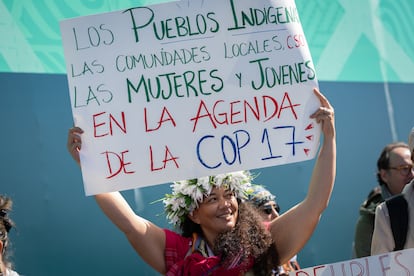

The question is: why does the United States refuse to attend the U.N. climate summit but shows up at the one on land degradation and drought? “I’m not authorized to answer that question,” a Trump administration delegate said mechanically during COP17, convened by the U.N. Convention to Combat Desertification (UNCCD) and held over 11 days through Saturday in Ulaanbaatar, Mongolia.
Delegates from other countries have their own theories: business interests. The conference deals with agriculture and land management. By taking part, the United States can follow closed-door discussions and influence them. And it has done exactly that.
A global drought agreement was expected to be approved at this summit, but the 196 countries and the European Union that must sign off on it once again postponed a decision until COP18 in 2028, in Egypt. And the United States championed the toughest position.
At one end of the negotiations were African countries, which account for just 4% of the world’s carbon dioxide emissions yet bear some of the most severe consequences of climate change they did little to cause. Their delegates have been pushing for a protocol that would commit other nations to helping finance drought management efforts in their territories.
At the opposite end stood the United States, the largest historical emitter of greenhouse gases, which firmly rejected the African bloc’s key demands. The European Union was also unwilling to commit to funding obligations and instead proposed alternative approaches that received little discussion.
What negotiators did manage to secure was a guarantee that droughts will remain a standalone item on the agenda, ensuring the issue continues to receive dedicated attention in future talks. But time is running out.
“It is astonishing that governments have once again failed to reach this agreement. Europe has endured a historic drought, while water levels in the Colorado River in the United States have fallen to record lows. And the strength of El Niño could intensify devastating droughts from southern Africa to the Amazon,” said Wetlands International in criticism of the outcome.
The data suggest that without decisive action, the situation will only worsen. Droughts have increased by 29% since 2000. They are deadly for both people and ecosystems and cause losses of at least €260 billion ($300 billion) a year. They also reduce agricultural productivity, disrupt river transport, affect energy generation, drive migration, fuel wildfires and floods, and trigger conflicts.
Part of the solution to drought lies in restoring degraded land, and according to the United Nations, 40% of the planet’s land surface has already been degraded. COP17 focused on involving all stakeholders in those restoration efforts, but the United States blocked the inclusion on the agenda of previously agreed issues such as gender, civil society participation, and synergies among land, biodiversity and climate change, which reflect the three conventions adopted at the 1992 Earth Summit in Rio de Janeiro.
Those negotiations have now been postponed until COP18. The United States also objected to specific language, much as Argentina and Paraguay did at the 2025 climate summit in Belém. For example, the resolution postponing the drought agreement makes no mention of gender, civil society or Indigenous peoples.
Other delegations were forced to change terminology in order to secure approval of the resolutions. Some attendees jokingly began referring to them as the “Voldemort words,” a reference to the villain in the Harry Potter series, known as “He Who Must Not Be Named.” It was a choice between accepting the condition and seeing the talks collapse. And that has largely been the approach throughout the summit.
“We adopted these decisions to protect multilateralism and safeguard the convention. But we will work to ensure this does not happen again,” said Indigenous leader Hindou Ibrahim, who led a protest inside the COP against the U.S. veto.
In order to keep negotiations moving, delegates have resorted to linguistic workarounds. Indigenous peoples and civil society groups have been relabeled as “all people.” To secure approval of an agreement on land tenure, the word “gender” was replaced with the phrase “women and girls.” Gender is particularly relevant in this area. According to the United Nations, women own less than 15% of the world’s agricultural land despite making up nearly half of the agricultural workforce.
“What is especially disappointing is that we were unable to make progress on key issues such as the gender perspective, the synergies among the three Rio conventions and the participation of civil society,” María Jesús Rodríguez, Spain’s director-general for biodiversity at the Ministry for Ecological Transition, said from Ulaanbaatar.
Among the most important texts, the one on migration was also postponed. Delegates did, however, approve agreements on sand and dust storms, private-sector engagement and grasslands.
The grasslands agreement was particularly significant at this year’s conference, which was dedicated to pastoralists and the ecosystems on which they depend. Grasslands cover 54% of the Earth’s land surface and absorb about 30% of global carbon dioxide emissions.
According to the UNCCD, they remain largely overlooked in both public policy and investment. “Grasslands contain roughly one-third of the world’s Key Biodiversity Areas, but they are included in the national climate plans of only 24 countries, compared with 181 that include forests,” the organization noted.
Activity beyond the negotiations
Beyond the political agreements, and mindful that multilateralism is going through a crisis, the convention sought to strengthen the work being carried out outside the often-contentious negotiations. One of the summit’s flagship announcements was a $1.3 billion financing package from governments, development banks, investment funds and companies to support land restoration and drought resilience projects in 23 countries.
“We leave with more political decisions, a stronger scientific foundation, innovative financing mechanisms, investment pathways and partnerships that can help scale up solutions,” Yasmine Fouad, the convention’s executive secretary, said at the close of the summit.
Among other commitments, Brazil pledged to restore more than 63,000 square miles of degraded land as part of its voluntary target of achieving land degradation neutrality by 2030.
Also widely welcomed was the launch of the Drought Resilience Investment Fund, the first catalytic fund of its kind, which will use public money to attract private investment for drought resilience projects. The initiative aims to mobilize up to €345 million ($400 million). The fund is a joint effort of the UNCCD, the government of Luxembourg and the International Drought Resilience Alliance (IDRA), an initiative launched by the governments of Spain and Senegal in 2022. During this COP, Spain pledged an additional €5 million ($5.8 million) to the alliance, matching the amount it contributed in 2022.
IDRA’s observatory also showcased progress on the world’s first drought resilience index, a tool designed to help governments identify vulnerabilities and prioritize action.
The summit also included hundreds of meetings, conferences, side events and initiatives involving roughly 30,000 participants, including government officials, civil society organizations, private-sector representatives and Indigenous communities.
“It is remarkable how much momentum now exists at these COPs outside the formal negotiations,” said João Campari, WWF’s global food and agriculture practice leader, who has attended about 15 U.N. summits over the past decade. “The role that grasslands and nature-positive agriculture have taken on at this COP has already given new hope to billions of people.”
“When governments neglect their responsibilities, a strong civil society, NGOs and the private sector can continue advancing this work,” Andrea Meza, deputy executive secretary of the UNCCD, said during the conference.
One phrase captures the mood of many participants. Given the current geopolitical climate, some viewed simply preserving what already existed as an achievement. This may well be remembered as the COP where, at the very least, something was preserved.
Sign up for our weekly newsletter to get more English-language news coverage from EL PAÍS USA Edition









































