Hurricane Melissa batters Cuba: ‘The night lasted too long’
Miguel Díaz-Canel said the cyclone had caused ‘extensive damage.’ Jamaica remains in darkness as it waits to assess its losses. The storm’s passage through the Caribbean has left at least 49 people dead
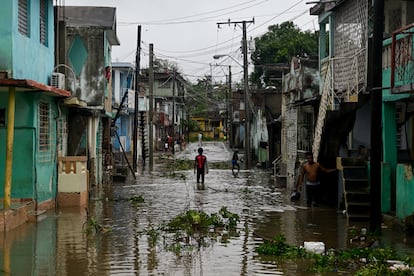
Cubans in the eastern part of the island experienced the longest night they can remember between late Tuesday and early Wednesday morning, when Hurricane Melissa battered their already strained lives, marked by an ongoing economic, energy, and health crisis. The storm hit hardest in the provinces of Santiago de Cuba, Granma, Camagüey, Las Tunas, Guantánamo, and Holguín. These six territories bore the brunt of the Category 4 hurricane (on a scale of 5) on the Saffir-Simpson scale, which struck the island around 3:00 a.m. with sustained winds of 195 kilometers per hour (120 mph). After enduring the onslaught for hours, Cubans began assessing the damage and calculating its bitter consequences in the morning.
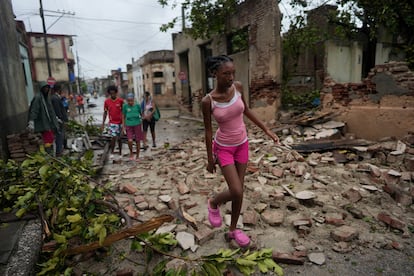
“The night lasted too long,” says Beatriz Vaillant, a 31-year-old journalist from Santiago de Cuba. She says that around 9:00 p.m. on Tuesday, with the rains at their peak, she heard her neighbors on the floor above her screaming because they were trapped in the water. But the night was just beginning. Hours later, strong winds began. “It felt like a lion roaring,” she says. “We wanted it to be 2:00 a.m., the expected time for the center of the hurricane to make landfall, and for it to pass quickly. But no, it made us suffer more than expected.” The next thing she remembers witnessing were roofs flying off, walls collapsing, trees creaking, and sandbags, traditionally used to secure roofs, flying through the air.
The eye of Hurricane Melissa made landfall in Cuba, according to the Forecast Center of the Institute of Meteorology, at a point on the southern coast of Santiago de Cuba, located in Chivirico, a town belonging to the municipality of Guamá. Interaction with the mountainous terrain, especially the Sierra Maestra range, caused the winds to weaken to 165 kilometers per hour. The hurricane exited Cuba through the municipality of Banes, as a Category 2 on the Saffir-Simpson scale, around 10:30 a.m. local time.
At least 40 dead in Haiti and Jamaica remains in darkness
Hurricane Melissa’s passage through the Caribbean has left at least 49 people dead so far, the BBC reported, citing AP. Haiti suffered the worst consequences, with 40 deaths and 10 people missing, while in Jamaica — where Melissa became the worst storm in 174 years — the death toll reached eight. In the Dominican Republic, one death and one missing person were reported.
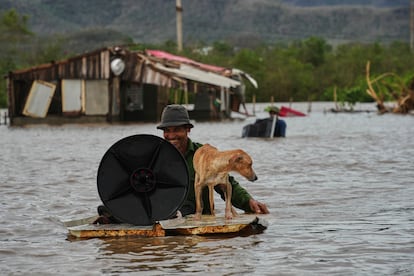
The storm caused flooding, burst river banks, and landslides in the eastern part of the island. In the south, a group of 17 families, including children and the elderly, had to be rescued, according to authorities. Cuban President Miguel Díaz-Canel has confirmed that there is extensive damage. While the full extent of the disaster is still unclear, it is known that approximately 735,000 people were evacuated ahead of the cyclone, which also caused severe flooding and damage to infrastructure such as homes, roads, hospitals, and businesses in Jamaica, an island from which information is trickling out due to the lack of electricity.
“Early indications are that Hurricane Melissa was a disaster of unprecedented catastrophe for the island,” said Alexander Pendry, British Red Cross global response manager, in an official statement. “News is already coming through that whole communities are underwater and that the damage left by the strong winds has been devastating. The immediate priorities are search and rescue and ensuring people have access to healthcare, safe shelter, clean water, food and other essential supplies.”
In eastern Cuba, the images are heartbreaking. From early morning, social media users and local journalists shared videos and photographs showing the magnitude of the disaster: from floods in Granma, caused by overflowing rivers that have submerged several houses, to the uprooting of centuries-old ceiba trees in Holguín.
Cuban authorities reported similar incidents in all eastern provinces: destroyed homes, public institutions, and private businesses; blocked mountain roads; and houses that lost their roofs. Particularly devastating was the damage inflicted by the hurricane on the facilities of the University of Oriente and the Juan Bruno Zayas Clinical Hospital in Santiago de Cuba.
Regarding the electricity service, according to information released on Wednesday by the Unión Eléctrica, the planned shutdown of the thermoelectric plants in the eastern zone affected the total availability of the National Electric Power System, a fact that conditioned the generation capacity for the rest of the country during Wednesday.
The extent of the damage depends on many variables. Whether someone was evacuated or rode out the storm at home; whether their roof was made of concrete or zinc tiles; whether they lived on high or low ground; whether they had trees adjacent to their house or not. The situation was especially precarious for the residents of Cayo Granma, a small islet located at the entrance to Santiago de Cuba Bay, where a sizable community lives. Lisette Murguía, a 55-year-old Havana resident, was there with a film crew working on an audiovisual project when they were surprised by the announcement of Hurricane Melissa’s arrival. Their return tickets to the capital were for October 29, and with all transportation suspended, they decided to ride out the hurricane on the islet, a mound of land connected to the city of Santiago only by sea.
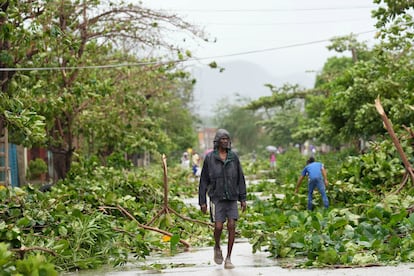
They weren’t alone there. Alongside them were dozens of families who had decided to stay on the cayo to keep an eye on what remained of their homes and belongings, fearing that upon their return, someone might steal what little they had left. The following morning, Lisette sent a few text messages, despite persistent connectivity problems, explaining that the house where she and her team were staying — on the higher ground of the cayo — ended up being used to shelter more people from other, more vulnerable homes. Everyone was expecting a disaster. “The tide came in quite high. We can see many fallen zinc roofs, downed trees, and power lines,” she described.
In Havana, Lisette’s 75-year-old mother received the message with relief. On Tuesday morning, she bought 10 lilies — which cost her 1,000 CUP ($40), almost half a Cuban pension — to make an offering to all the saints of the Yoruba pantheon, to her deceased relatives, and to the Seven African Powers, so that her daughter and all those affected by the hurricane would emerge unharmed. Many Cubans turned to their faith as a last resort to cope with the hours when Melissa battered eastern Cuba and further endangered the lives of its inhabitants.
Sign up for our weekly newsletter to get more English-language news coverage from EL PAÍS USA Edition