
Rebeca Grynspan: ‘The UN must sit at the most important negotiating tables in the world’
The Costa Rican economist and politician is launching her campaign for the United Nations secretary-general position
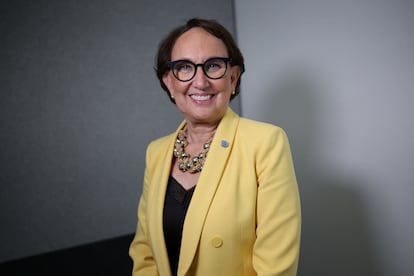

Sometimes the most revolutionary thing is to return to basic principles. Costa Rica’s Rebeca Grynspan is now the official candidate nominated by her country’s government to be the new United Nations secretary-general, a position currently held by Portugal’s António Guterres, who will vacate it in December of next year. Grynspan, who is the current secretary-general of United Nations Trade and Development (UNCTAD), faces a long and intense campaign that will take her around the world for months.
In a London hotel café, surrounded by papers and sitting in front of her laptop, while bland, unsolicited music plays in the background — typical of a Sunday afternoon — she speaks to EL PAÍS. She has come to the British capital to present the annual report of the institution she has led until now. Her political and diplomatic career boasts a track record that is hard to beat. She has served as vice president of Costa Rica and headed the Ibero-American General Secretariat.
“If you were to ask me what my campaign slogan is, I would tell you it’s Article 1 of the U.N. Charter. It says it all, and we should be true to those values,” she argues. “But at the same time, we have to be much more agile and flexible, more innovative in the proposals the U.N. presents to the world. And for that, we have to take risks.”
“To maintain international peace and security; [...] to develop friendly relations among nations; [...] to achieve international cooperation in solving international problems; to be a center for harmonizing the actions of nations in the attainment of these common ends,” reads the first article of the U.N. Charter. Quite a mission. The Costa Rican economist is committed to restoring the organization to its central role. “The organization was originally founded by 50 countries. Today it comprises 193. We can say, then, that in a sense, there are 143 countries that did not participate in its creation. This reality requires inclusion,” she explains. “I know the United Nations well, enough to defend it and to reform it.”
Any attempt to reaffirm the value of the quintessential multilateral institution must take into account the constant disregard for its authority — and even its legitimacy — shown by U.S. governments like that of Donald Trump, who is intent on dismantling the world order that has governed the last few decades. “We are seeing how the United States is beginning to use the United Nations again. Its questioning of the institution is undeniable, but at the same time, it decided to bring its peace plan for Gaza all the way to the Security Council. Trump’s statement in his address to the General Assembly, when he said that the U.N. has great potential, must be taken seriously. […] The United Nations must be able to sit at the most important negotiating tables in the world, and assume that role with firmness and determination,” argues Grynspan.
Other candidates being mentioned for the position of U.N. secretary-general include Michelle Bachelet, former president of Chile; Jacinda Ardern, former prime minister of New Zealand; Mexian Environment Minister Alicia Bárcena; and Mia Mottley, prime minister of Barbados.
Has the time come for a woman to lead the organization? “I know them all, and they all have impeccable resumes. They don’t need any special treatment. They all have the merits for the position, including me. We’re not asking for special treatment, but rather for there to be no discrimination. Because if we’re going to compete on a level playing field, any one of us has every chance of winning,” she argues.
Authoritarianism and immigration
Grynspan knows there’s no room for missteps in such a high-stakes campaign. Her answers always smooth over any rough edges, maintaining a friendly and diplomatic tone. But that doesn’t mean they lack substance. She has a clear diagnosis when it comes to phenomena such as the rise of authoritarianism in the world. “Democracy is being questioned today because it cannot be limited to enabling the capacity for a change of government. Its legitimacy also lies in the search for solutions to the problems of the majority of the population,” argues Grynspan, a politician with deep social democratic convictions.
“When I was at the United Nations Development Programme, we produced a very famous report that talked about democracy in Latin America, and we stated that we had to prevent the current discontent ‘in’ democracy from turning into discontent ‘with’ democracy,” she recalls.
The major issue fragmenting Western societies today is irregular immigration, and Grynspan understands how it can trigger instability. But she notes that, as with everything, perspective is crucial: “The greatest migration happens in the South,” she says, referring to the term “Global South,” which is used to highlight that the world expands beyond the West. “The largest concentrations are in countries that belong to the South, such as Turkey, Lebanon, or South Sudan,” she says. “The ultimate goal should be that only those who want to migrate do so, not those who are forced to. That is why we must focus on addressing the structural causes that drive it, such as the development of many of these countries or climate change.”
Sign up for our weekly newsletter to get more English-language news coverage from EL PAÍS USA Edition









































