
Hurricane Melissa wreaks havoc across Haiti, Cuba and Jamaica
At least 25 people have died in southern Haiti, while Havana has placed six provinces on alert and evacuated 735,000 people
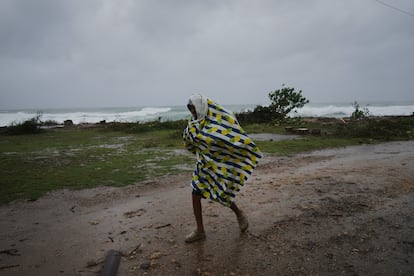
At least 25 people have died and several are trapped under the rubble of buildings that collapsed in southern Haiti after a river overflowed during the passage of Melissa, according to The Guardian, citing the AP news agency.
Hurricane Melissa made landfall in Cuba on Wednesday morning as a Category 4 storm (on a scale of five) with sustained winds of over 200 kilometers per hour (125 mph). Upon reaching land, it weakened to a Category 3 storm. The hurricane made landfall in the south of the island, about 90 kilometers (55 miles) west of Santiago de Cuba.
Its passage has caused flooding, river swelling, and landslides in the eastern part of the island. In the south, a group of 17 family members, including “children and the elderly,” had to be rescued, according to authorities. Cuban President Miguel Díaz-Canel reported “considerable damage.” Around 735,000 people were evacuated, and six provinces (Granma, Santiago de Cuba, Guantánamo, Holguín, Las Tunas, and Camagüey) were placed on alert.
In Jamaica, Melissa caused severe flooding, according to initial reports, which are being published with difficulty due to widespread power outages across the country. Jamaican Prime Minister Andrew Holness told CNN that no fatalities have been confirmed yet, but given the storm’s strength, he expects there will be. The hurricane has caused damage to hospitals and roads, as well as significant destruction to homes and commercial establishments.
The U.S. National Hurricane Center has warned that the danger of flash floods and landslides remains extreme in Jamaica, Haiti, the Dominican Republic, and Cuba. The hurricane is expected to head next toward the Bahamas, where it is expected to arrive on Thursday.
Residents of eastern Cuba were on tenterhooks as Melissa approached the country’s coast. After making landfall Tuesday morning in Jamaica, with sustained winds of over 280 kilometers per hour (174 mph), the hurricane, which is the most powerful so far of this year’s Atlantic season and has been dubbed “the storm of the century” by the World Meteorological Organization (WMO), was expected to batter the island for between six and eight hours, when forecasts estimate Melissa will move out to sea via the northeastern municipality of Banes, although its effects will continue to be felt in Cuba for another eight to ten hours.
Civil Defense on the Caribbean island declared a hurricane alert on Monday morning for the provinces of Guantánamo, Santiago de Cuba, Holguín, Granma, Las Tunas, and Camagüey. Cuban state media has not downplayed the seriousness of the phenomenon and emphasized the high risk that a Category 5 hurricane (its strength on its approach) poses to the entire country. In an appearance on the state-run television program “Mesa Redonda,” the deputy director of the Institute of Meteorology, Yinelys Bermúdez, categorically described Melissa as “a significant danger” to the country.
The Cuban Ministry of Education canceled classes in the provinces that will be directly affected by the hurricane, and all transport services to and from the East were suspended.
Dr. José Rubiera, a hurricane specialist at the National Forecast Center of the Institute of Meteorology of Cuba and vice-chairman of the WMO Hurricane Committee for the region, described the atmospheric phenomenon as “monstrous” on his YouTube channel.
In provinces like Santiago de Cuba, over which the eye of Melissa is expected to pass, there was fear of reliving the traumatic experience of Sandy in 2012, a Category 3 hurricane that devastated the city, as Amanda Meléndez, a 24-year-old dentist, recalls.
“The city was left in ruins, and people are scared because the memory of Sandy is still fresh,” Meléndez said via WhatsApp from her home in downtown Santiago de Cuba, where she lives with her mother and five-year-old daughter. “There are still people who haven’t received the subsidy to buy construction materials to rebuild their homes damaged by that hurricane. Add to that the whole crisis we’re living through: everything has come together, and on top of that, this hurricane. I don’t know what state we’re going to be in after this.”
To make matters worse, Meléndez points out, the city’s tanks and cisterns hadn’t received any water for two months. “It wasn’t even due to be turned on yet, but they had to because people started complaining: if strong winds came and there was no water in the tanks, they were going to be blown away. They had to turn on the water, but it’s not clean because with the heavy rains in September, all the dams overflowed and the water is pure mud.”
Like her, many residents of Santiago were busy on Monday protecting their homes or heading to an evacuation center for shelter. According to residents, many spent the day perched on rooftops, bringing in antennas, securing water tanks, nailing boards to windows, or securing roof tiles with sandbags.
Karina González, 25, a former English teacher who switched to working in the private sector a few years ago, lives in the village of El Caney, about 30 minutes from downtown Santiago. “This is going to be serious,” says González, who, despite her fear of the cyclone, emphasizes the solidarity that has emerged among her neighbors, who are helping each other to secure their homes as best they can.
Melissa will arrive in a city that, according to González, is going through “a terrible health crisis. I just recovered from chikungunya and my family has experienced the symptoms of different viruses; the lack of food causes anguish,” the young woman says, while showing pictures on her phone of a crowd in Santiago de Cuba on Monday looting a truck that was transporting boxes filled with packages of ground meat.
On the other hand, concerns about the electricity supply persist. “We have power now because the Electric Union was kind enough to prioritize us with service before the hurricane hit the eastern provinces. Here, blackouts usually last 12 hours, alternating with three hours of electricity. Sometimes, they don’t stick to the schedule, and we can be without power for more than 12 hours. With all this on our shoulders, it’s understandable that Hurricane Melissa caught us feeling discouraged, because not everyone has the money to weather the storm, to get back on their feet. For many, Hurricane Melissa will catch them with nothing in their refrigerators,” González explains.
Despite her fears, she tries to remain calm so as not to upset her grandparents and her mother, “and thus remain composed for what’s to come.” “The people of Santiago are better prepared now than when Sandy came, but fear and uncertainty still exist,” she says.
“I feel hopeless and worried,” says Meléndez. “I’m afraid because I don’t know the magnitude of the disaster that is coming, nor do I know how the government will manage it so that everyone can receive the necessary care. Many people will be left in a much worse situation.”
Sign up for our weekly newsletter to get more English-language news coverage from EL PAÍS USA Edition









































