
The mountain that swallowed a village in Switzerland: ‘There were nine million tons of rocks, too much for the glacier’
Glaciologist Olivier Gagliardini says that while it is too early to know whether climate change was behind this avalanche, global warming is contributing to destabilizing the mountains and we could see more events of this nature in future
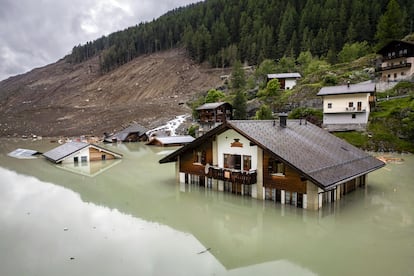

A few days before the collapse of the Birch Glacier engulfed much of the village of Blatten (population 300) in the Swiss Alps in a matter of seconds on May 28, the team led by the glaciologist Olivier Gagliardini, a professor at the University of Grenoble Alpes in France, was asked by his Swiss colleagues if they thought the mountain would hold. “This was on Monday, and the response was that the glacier was going to collapse. We weren’t far off; it collapsed on Wednesday,” the scientist says in a telephone interview. This was an expected disaster, which is why the village was evacuated ahead of time. However, Gagliardini assures that since the brutal avalanche, his research team has been talking about nothing else, as he considers this to be “an exceptional phenomenon in Europe.”
As this Alpine glacier specialist explains, “these disasters are cascading phenomena.” In the case of this avalanche, the peak of the Petit Nesthorn had been slowly collapsing, in a process that began several decades earlier. “On this mountain, there was a tendency for regular rockfalls, and they had accelerated in the days leading up to the disaster. The fall was almost continuous, and all those stones kept piling up on the glacier until it could no longer support them, and the enormous avalanche occurred.” The professor provides some figures: “The volume was similar: three million cubic meters of stones on three million cubic meters of glacier ice. But stones weigh three times more than ice. This was nine million tons of stones on three million tons of ice — too much for the glacier,” he concludes.
To what extent is this catastrophe related to global warming? For the glaciologist, it’s not easy to establish the link between the avalanche and rising temperatures, although he also has no doubt that climate change is affecting the stability of mountain peaks. Geology played a major role in the Petit Nesthorn catastrophe, as this mountain is quite heterogeneous and has suffered rockfalls for years. But not everything is due to global warming: “Mountains have always collapsed throughout the centuries and millennia, due to erosion and alternating frost,” Gagliardini emphasizes. “Even so, this doesn’t take away from the fact that climate change is also contributing to accelerating these phenomena, especially on slopes with permafrost walls, with a mixture of pebbles and ice.” As the professor emphasizes, “it’s still too early to answer this question, but clearly, global warming is accelerating everything.”
Recently, the World Meteorological Organization warned that the rapid melting of glaciers risks unleashing “an avalanche of cascading impacts on economies, ecosystems, and communities, not only in mountain regions, but globally.” Aside from flooding, the loss of water supplies, and rising sea levels, another effect of melting ice is increased mountain instability. “As glaciers melt, they decompress the surrounding walls, which can contribute to the destabilization of slopes, especially if they are weak mountains,” says Gagliardini. “When a glacier retreats, the mountains decompress because that weight is removed, and suddenly, they can become destabilized.”
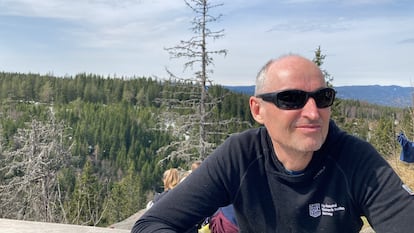
“The scientists who work on this haven’t been talking about anything else for a week,” says Gagliardini. “This is exceptional in Europe; there aren’t many examples of glaciers wiping out a village,” he says. However, he also warns that this doesn’t mean it won’t happen again. In fact, on a smaller scale, in June of last year, a torrent of mud and rocks wiped out an iconic village in the French Alps, Bérarde, in the Écrins massif. “This could happen again,” he warns.
Generally, the focus is on the particular impact that melting glaciers will have on the Asian continent, due to the scale of the ice masses and the enormous population in the mountains and on the coasts (affected by rising sea levels). In the case of landslides like that of the Birch Glacier in Switzerland, Gagliardini emphasizes the danger in this European mountain range. “For there to be danger, there must be a phenomenon in the mountains, such as a glacier collapse, a rockfall, or the emptying of a lake, and at the same time something at stake in the valley; that is, homes, infrastructure, roads, railways, inhabitants…” the glaciologist notes. “In the Alps, glaciers are smaller than in the Andes or the Himalayas, but what’s at stake is often closer, as the mountain range is closer to the people who live in the valleys. The risk is not necessarily lower in the Alps, although in those other mountains, events can be on a larger scale.” Furthermore, these disasters are also more difficult to prevent in those mountain ranges. As Gagliardini points out, “our colleagues in the Andes and the Himalayas have many more glaciers to monitor, in much larger areas, with much more complicated access, so prevention is much more difficult.”
Although much of Blatten has been destroyed, in this case the emergency was well-managed and the village was evacuated several days in advance, preventing casualties. What happened in Switzerland is being held up as an example of good preparedness and adaptation to the risks that can arise from melting ice in the mountains. In this regard, for the Grenoble Alpes University professor, “we must identify which glaciers need to be monitored to avoid these disasters.” In his opinion, “the only solution with the Birch Glacier was to evacuate the village.”
An international study published in February in Nature, in which 35 different research groups participated, estimated that the world’s glaciers have lost an average of 273 billion tons of ice annually since 2000, the equivalent of three Olympic swimming pools per second. Although some areas in the Alps have begun to be covered with enormous white tarps to protect the ice masses, for this glaciologist the only solution to prevent their loss is to reduce greenhouse gas emissions. “Let’s not fool ourselves, covering them with white tarps causes more harm than good, as it means generating more emissions to manufacture these materials. These types of measures can only be used occasionally in some ski resorts to maintain the snow a little longer,” says Gagliardini, who points out that this is the International Year for Glacier Preservation. “Let’s be clear, there is only one solution: stop emissions.”
Sign up for our weekly newsletter to get more English-language news coverage from EL PAÍS USA Edition









































