
The Perito Moreno Glacier is suffering an ‘irreversible’ retreat after losing nearly 2,000 meters in seven years
Scientists warn that climate change is the main cause of the loss of mass in South America’s most famous glacier
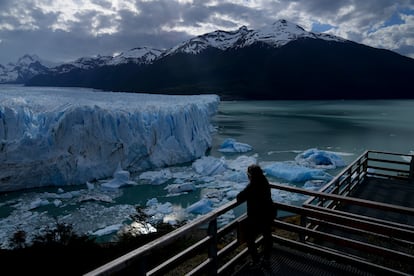

In southern Argentina, bordering Chile, lies South America’s most famous glacier: Perito Moreno. In 2024, nearly 700,000 people gazed out from the walkways of Los Glaciares National Park, from where they could glimpse the end of this imposing 260-square-kilometer (100 square miles) ice giant. This year, visitors were surprised by the collapse of larger-than-usual ice sheets, which even temporarily blocked the dock from which boats depart. These are one sign, but not the only one, of the progressive loss of mass that Perito Moreno has been experiencing since 2018, when it ceased to be in equilibrium and began a retreat that scientists consider “irreversible.” In the last seven years, its margins have shrunk by almost 2,000 meters, and the walls are losing height at an ever-increasing rate.
One of the first people to sound the alarm was 81-year-old geodetic-geophysical engineer Pedro Skvarca, who has been monitoring the evolution of this natural monument for more than three decades. “There is a noticeable and accelerated retreat of the glacier,” Skvarca said during a public talk last week. The scientist noted that rising temperatures caused by climate change have been decisive in the reduction of the ice mass. “The climate is warmer, there is more melting and more water at the base. As a result, the glacier is accelerating and thinning,” he noted.
Glacier geologist Lucas Ruiz confirms that Perito Moreno has broken the exceptional balance it maintained for at least a century, which differentiated it from the general trend affecting other glaciers such as Upsala and Viedma. This means that the amount of ice it accumulates annually at its sources is now less than the amount it loses.
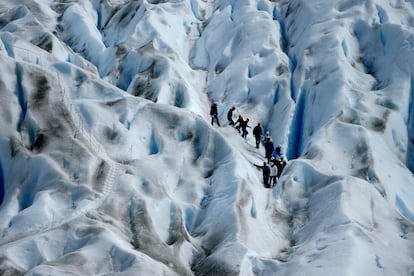
The Perito Moreno Icefield starts from the Southern Patagonian Ice Field and advances, like a conveyor belt, at a speed of about two meters per day in its central area toward Lake Argentino.
According to Ruiz, the loss of mass began between 2017 and 2018 and is increasingly rapid. “At the front, the obvious signs began a little later, starting in 2020,” says the National Scientific and Technical Research Council researcher and consultant for Geo Estudios, referring to the five-kilometer-long wall that rises more than 60 meters above the waters of the lake, where tourists can admire it.
Breakups increasingly unlikely
One of those signs is the thunderous breakup of the Perito Moreno Glacier, which used to occur every two or three years. The glacier advanced toward the peninsula and completely closed off one of the lake’s branches, turning it into a natural dam. The water level began to rise and exerted increasing pressure on the mass of ice. After several weeks, the water managed to bore a tunnel through, and as erosion progressed, it eventually collapsed the ice dome.
“The last major closure was in 2018, when the water level of the Brazo Rico River rose nine meters,” Ruiz notes. In 2022, there was a small closure lasting just one week. “It’s unlikely to happen again. We can maintain a little hope until contact with the peninsula is completely lost, because other processes are influencing it, and the closure is occurring in a small area. But the probability is increasingly lower,” he warns.
The temperature increase caused by climate change is behind the retreat of Perito Moreno and much of the over 16,000 ice bodies surveyed in Argentina. However, those that end in bodies of water like Perito Moreno have a particular behavior, determined by a ratio between the thickness of the ice and the depth of the lake. “When this value exceeds a certain threshold, the only thing it can do is retreat. Perito Moreno has already crossed it in some places, but not in others,” Ruiz points out. On average, the total surface melts one meter of water equivalent per year, but at the front, the thinning is about eight meters.
“We say that the decline is irreversible because the moment it begins, it doesn’t slow down. That doesn’t mean it will never slow down, but rather that it will lose the position of balance it held and seek another,” Ruiz clarifies.
This glaciologist laments that the budget cuts imposed by Javier Milei’s government on Argentine science since the end of 2023 have slowed data collection, even on this iconic glacier, and caused a new brain drain. Perito Moreno’s retreat is now visible to the naked eye, although its enormous size continues to astound tourists who see it for the first time. If things continue on this path, they will be seeing it from further and further away.
Sign up for our weekly newsletter to get more English-language news coverage from EL PAÍS USA Edition









































