US voters head to the polls: Corruption emerges as late-breaking top concern in midterms
Nine in 10 Americans say lack of integrity in government is a very serious problem on the eve of the midterm elections

Barack Obama has just taken the podium. Around 10,000 voters in this pavilion in Morrow, on the outskirts of Atlanta, await his remarks. He is the main attraction at this rally to mobilize voters and back Jon Ossoff’s bid to hold his Senate seat and Keisha Lance Bottoms’ run for governor of Georgia in Tuesday’s midterm elections. He will speak about what has become his favorite theme of this campaign: Donald Trump’s corruption.
“We’ve lost count of all the deals he and his family have done, from meme coins to taxpayer-funded contracts for his kids’ companies. This is someone who has become billions of dollars wealthier while in office,” the former Democratic president roars. “And not a single Republican in Congress has done anything to stop it.” The ovation is deafening.
The economy and the cost of living — especially high fuel prices but also food, housing, and health insurance — have been the leitmotif of this election campaign, in which control of the U.S. House and Senate is at stake, and with it the ability to curb or advance Trump’s legislative agenda, as well as governorships and state legislatures. But in the final stretch another issue has also taken hold of voters’ minds: corruption.
“It’s completely un-American. We want to set limits, reclaim our values and our integrity, go back to what I think most people believe,” says Kay McKenna, a retired resident of Macon, Georgia, who says she voted for the party now in power in the past. “This time, no,” she says flatly.
Constant references to corruption
Democratic candidates repeatedly invoke corruption in their speeches. And the message has stuck. If it barely featured on lists of voter concerns a few months ago, in October a poll by the conservative TV network Fox News found that 88% of the electorate said they were “extremely” or “very” worried about corruption in government.
A separate Harris poll for The Guardian shows similar figures: nine in 10 Americans see corruption as a problem, and 76% say government officials care more about getting rich than improving citizens’ lives. Corruption ranks above immigration, healthcare, or artificial intelligence as a voting priority and is second only to the cost of living in perceived severity.
Criticism centers on the surge in Trump’s personal wealth, as Obama mentioned in his Morrow speech: since his return to the White House the president has earned more than $2.2 billion, largely from cryptocurrency deals — an amount unprecedented by far in any other presidential term.
Members of the business community close to the Republican and his family have landed lucrative deals; the colossal ballroom the former real estate magnate is building on the East Wing of the presidential residence has attracted private donations exceeding $300 million, including $25 million commitments each from tech companies Apple and Nvidia. Trump openly boasts of the many millions the energy sector has made from current wars.
The shadow of suspicion does not fall only on financial matters. It also covers issues such as the lack of transparency around the files of Jeffrey Epstein.
“Just six months ago, corruption was not a top voter concern. Days before the midterms it has absolutely become one of voters’ issues. And the reason is a growing sense that ‘others get ahead while I fall behind,’ and people don’t believe the system works. They think the system has been rigged, perverted, and used improperly, and that breeds a resentment that will be felt on Election Day,” says pollster and political analyst Frank Luntz.
A string of campaigns has raised questions about candidates’ ethics, from the Texas Senate contest, where Republican Ken Paxton’s integrity has been called into question, to the Ohio governor’s race, where an ad run by Republican Vivek Ramaswamy’s campaign against Democratic hopeful Amy Acton was immediately engulfed in a sexual abuse scandal.
In Kansas, Democrat Adam Hamilton accuses his opponent, Senator Roger Marshall, of actually residing in Florida, where he owned a mansion (sold in October), rather than spending time in the state he represents.
“This election is not about left versus right,” Texas Democratic Senate candidate James Talarico said of the corruption allegations surrounding Paxton, the state’s attorney general who faced impeachment proceedings from his own party. “This election is about whether you want a senator who puts money in your pocket — or puts money in his own.”
The issue does not affect only Republican candidates. In Minnesota, the Democratic Senate candidate faces allegations of fraud in social benefit programs. In Alaska, the governor has ordered an investigation into claims that Mary Peltola’s Senate campaign recruited a candidate with a name similar to Republican rival Dan Sullivan’s to confuse voters.
A study by the Brennan Center for Justice, a nonprofit that defends voting integrity, finds that references to government ethics in this campaign’s TV ads surged to the highest levels in 14 years. Nearly 24% of House campaign ads and 16% of Senate ads mentioned government ethics — an issue that was barely present in 2024 presidential advertising.
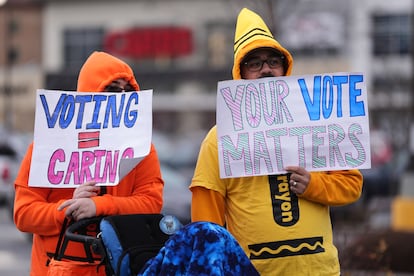
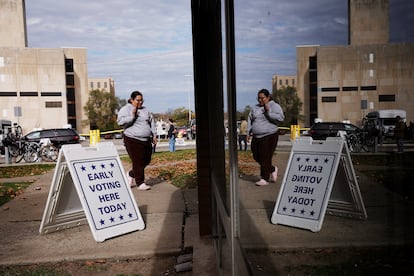
The campaign is drawing to a close. The deadline for in-person early voting has already passed in several states, while candidates are making a final push at rallies and campaign events to mobilize late voters and try to convince the last undecided voters. Although initial turnout figures point to enormous voter interest in this election — far greater than what midterms typically generate — more than 51 million citizens have already cast their ballots, either in person or by mail, which is 25% more than in the 2022 midterm elections.
Polls point to a Democratic victory, driven by dissatisfaction with the economy and corruption and by Trump’s deep unpopularity: 59.9% of voters disapprove of his handling of the cost of living, the war with Iran, or tariffs, among other issues.
Poll aggregators give the opposition an advantage of more than eight percentage points to retake the 435-seat House of Representatives; they need to pick up just four seats from the 214 they hold now.
Those polls also suggest they could control the 100-seat Senate, a prospect that seemed impossible earlier this year. Democrats, with 47 seats, must gain at least four more. Polls show tight races in at least seven states: Michigan, Alaska, Maine, Iowa, Ohio, Kansas, and Texas. Only Michigan’s seat is currently held by a Democrat.
The president closed his campaign Sunday with two rallies, one in Iowa and the other in Kansas, after initially canceling them because, he said, both states were in “good shape” for Republicans.
Sign up for our weekly newsletter to get more English-language news coverage from EL PAÍS USA Edition