
‘Professors fear they could get in trouble for what they teach’: State laws bring censorship to US universities
Nearly half of college students attend institutions in states with at least one law or restriction governing what topics can be discussed in the classroom
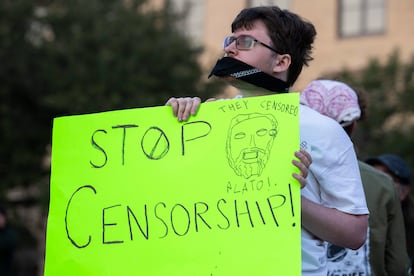

Teaching Plato’s Symposium under Texas education rules cost Dr. Martin Peterson his position as a philosophy professor at Texas A&M University. The dialogue, which discusses love in its various forms and a third gender, was among the readings the university told him to remove from his course syllabus earlier this year. He was informed that any material dealing with race or gender had to be dropped from the curriculum or he would have to teach a different course. He chose to resign.
At the University of North Florida, education professor John W. White was likewise asked to remove the terms “diversity,” “equity,” “inclusion,” and “culture” from his syllabus in order to comply with state regulations. “They’re only three or four words. It’s the law, and we have to follow the law,” White recalls university administrators telling him in December 2025.
The growing number of state laws that directly and indirectly regulate academic life has created a climate of censorship across U.S. colleges and universities. “There is a chilling effect,” says Neal Hutchens, a professor in the Department of Educational Policy Studies and Evaluation at the University of Kentucky’s College of Education, in an interview with EL PAÍS. “[Professors] fear they could get into trouble for what they teach in the classroom. There is concern that, even when they believe they have a sound pedagogical reason and are not breaking any rule, they cannot be certain they will have the support of institutional leaders if an incident goes viral.”
Hutchens researches academic freedom and free speech in the context of public policy, higher-education practice, and the law. Much of his recent work has focused on state legislative efforts to ban the teaching of concepts associated with Critical Race Theory (CRT) in public colleges and universities. “I have the privilege of holding tenure in the United States, which has traditionally provided a degree of economic and professional security. However, compared with, say, five years ago, I know that when I write and speak about these issues, I cannot assume that the systems and safeguards that once existed will provide me with the same level of protection,” he says.
According to PEN America, a nonprofit organization that works to protect freedom of expression in the United States and around the world and has tracked the spread of this kind of legislation since 2021, nearly half of all students attend school in states where at least one law or restriction limits what can be taught in the classroom about race, gender and sexuality — which are now treated as taboo topics. Texas and Florida are among the most restrictive states.
“Students are in a climate of fear, where professors fear losing their jobs; and in fact there are cases where that happens,” says Laura Benitez, senior manager for state policy in PEN America’s Free Expression Programs, where she oversees state-level legislation and policy trends that threaten free speech. “When students arrive on campus and do not have the full and free attention of faculty to debate academic topics, nor support systems, it creates an environment in which often no one is certain what is allowed and what is not. That can affect the learning environment and their ability to do what they are there for: learn,” Benitez adds.
Better not to talk about race and sex
This wave of academic censorship emerged toward the end of Donald Trump’s first presidency (2017-2021), when he issued an executive order prohibiting government agencies from providing training on what his administration described as “divisive concepts” related to race and sex. The order was rescinded after president Joe Biden took office, but it evolved into a state-level movement, first aimed at banning the teaching of certain ideas and later at regulating internal decision-making processes, such as curriculum design and tenure protections.
During Trump’s second administration, the federal government has pressured colleges and universities to support its “priorities” in exchange for funding and approval of visas for foreign students and faculty. Although the United States does not have a federal university system, but rather a dual system of public and private institutions, many universities rely heavily on grants and funding from federal agencies, including the Department of Defense, the Department of Agriculture, the National Science Foundation and the National Institutes of Health.
In October 2025, the Department of Education sent a compact to nine universities outlining a series of demands they would have to meet in order to maintain cooperation with the government. These included adopting the administration’s definitions of sex, limiting the enrollment of international students, implementing “institutional neutrality” policies, and eliminating academic departments, centers or offices that, in the government’s view, “purposefully punish, belittle, and even spark violence against conservative ideas.”
In early August, Education Secretary Linda McMahon sent another open letter to the presidents and governing boards of colleges and universities, asking them to explain how they would address seven areas of interest to the Trump administration. These included merit-based admissions, “free speech,” and “advancing the U.S. national interests.” The department has also announced fees of more than $100,000 for issuing H-1B visas to foreign researchers and professors working in the United States, as well as limits on how long international students may remain in the country.
Although the letter was not addressed to state governments, Florida was the first to respond to the Department of Education, submitting a 30-page document outlining policies the state has already implemented in support of Trump’s agenda and others that are planned. Among them are Florida’s existing bans on diversity statements and on the use of public funds for political or social activism, as well as restrictions on the enrollment of undocumented students beginning in 2027.
Florida’s State University System (SUSFL) comprises 12 universities and is the second-largest public university system in the United States. The state’s college system, meanwhile, consists of 28 colleges. Together, the two systems serve more than 1.1 million students.
University autonomy, along party lines
Universities’ responses to these policies have been mixed, depending on the state in which they are located and whether the state government supports or opposes Trump’s agenda.
In blue states, governed by Democrats, the view that professors should enjoy broad academic freedom in making classroom decisions has largely held firm, despite mounting pressure.
In red, or conservative, states governed by Republicans, legislatures have generally backed the White House’s higher-education priorities. Private universities have also responded in different ways. Harvard University, for example, has remained locked in a legal battle with the Trump administration over several of its measures, while institutions such as Columbia and Brown have sought agreements with the federal government, likely motivated by concerns about the financial consequences of a confrontation.
For Professor Hutchens, it has been surprising to see how quickly Trump’s agenda has taken hold in higher-education institutions that were traditionally considered independent of the federal government.
“Many of us were naive about how fragile some of the systems supporting academic freedom, free thought and freedom of expression at our universities were,” Hutchens reflects. “We were also naive about what the federal government could do with respect to those institutions, because it is implementing policies that could harm their research productivity for years.”
Sign up for our weekly newsletter to get more English-language news coverage from EL PAÍS USA Edition









































