
Darializa Ávila Chevalier, the Afro-Latina socialist with one foot in Congress: ‘We need an economic system that gives people dignity’
Backed by Mamdani, the Dominican American candidate stunned New York’s political establishment with an upset victory in the Democratic primary
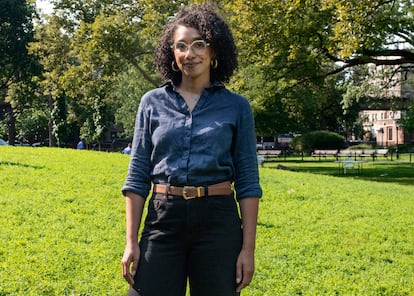

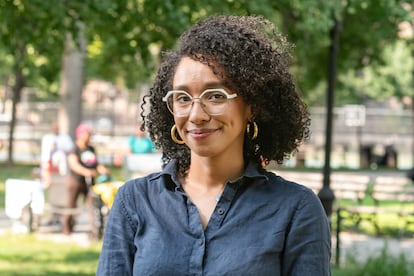
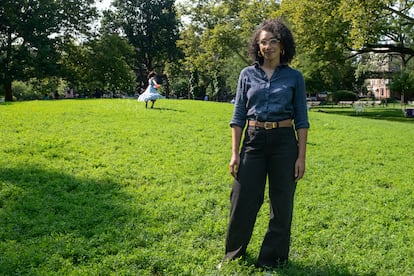
She is slender, dressed in a blue linen shirt, high-waisted jeans and Veja sneakers. Her curls are neatly arranged, she wears white-framed glasses and a nose piercing. But none of these things define Darializa Ávila Chevalier quite as much as the way her calm face changes when confronted with an injustice. She describes it as a “visceral reaction.” The moment she says it, her expression shifts, and the 32-year-old graduate student from Upper Manhattan begins to resemble the politician she has become: the first person of Dominican descent who could make it to Washington as a member of Congress.
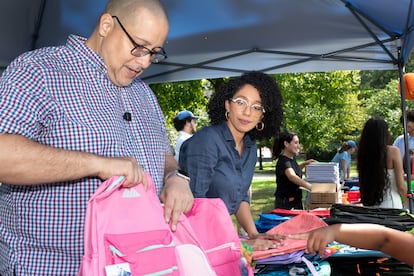
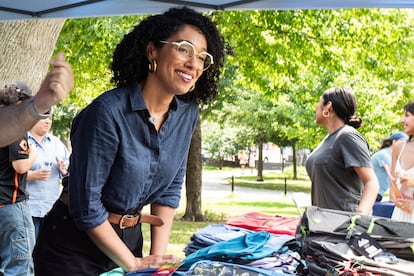
One afternoon during the second week of August, as students across New York headed back to school, Chevalier could be seen in St. James Park in the northeast Bronx handing out backpacks and school supplies to children and parents from the neighborhood lined up in an endless queue. One by one, they approached her, and she let them choose between a pink backpack, a gray one, one with blue flowers and a green one. Chevalier smiled shyly. “Hi, how are you? What’s your name?” she greeted them, in English or Spanish.
At her side stood Gustavo Rivera, a Democratic New York State senator from Puerto Rico who has represented the Bronx’s 33rd Senate District for the past 16 years. As Darializa handed out the gifts, Rivera stepped forward: “Do you know who she is? This is Darializa Ávila Chevalier. She’s going to be your next congresswoman,” he told the crowd.
The children and their parents looked at her, nodded, took their backpacks and moved on. Rivera knows exactly what he is doing: the veteran politician is introducing his community to a new generation of leadership, offering the trust and political capital he has spent more than a decade building in the neighborhood.
“A lot of people still don’t know her, and I’m telling them: trust me. She’s going to do the job she’s supposed to do. She puts the interests of the working class at the center of her political plan,” Rivera says.
Today her face appears in some of the city’s most prominent magazines and television programs, but until a few months ago Chevalier was virtually unknown, someone who had spent the previous 14 years as a community organizer, work that, in her words, “nobody thanks you for and that goes largely unnoticed.”
In fact, when veteran Congressman Adriano Espaillat, 71, faced her in the June 23, 2026 Democratic primary for New York’s 13th Congressional District, which includes Upper Manhattan neighborhoods such as Harlem and Washington Heights as well as part of the Bronx, he repeatedly reminded voters that she had never held elected office. Another line of attack was to portray her as an outsider, emphasizing that she was originally from Florida and even suggesting at one point that people like her should be sent “back home.”
Espaillat arrived as a child from the Dominican Republic, lived as an undocumented immigrant and was one of the first migrants to enter Congress, a seat he has held since he succeeded Charles B. Rangel 10 years ago. New York made him a New Yorker, just as it had done for Chevalier after she moved to the city at 18 to attend Columbia University.
“I love this city; it made me the woman I am,” Chevalier says. If you ask her for a recommendation on a place to party or eat in Miami, where she was born in 1993, she wouldn’t know what to tell you. But if you ask about a spot in Harlem or Washington Heights, she’ll quickly name Harlem’s Hub, Barawine, or Papasito on Dyckman Street. “I used to go there with my friends, but it closed during the pandemic; we miss it a lot,” she says.
At some point, Chevalier stopped being a long-shot challenger and became a serious threat to Espaillat. It happened when voters began looking beyond establishment-backed candidates and placing their faith in someone different. Chevalier herself had to be persuaded to run.
“It wasn’t something I had aspired to,” she admits. But friends and neighbors were deeply dissatisfied with the state of the city and the country. “All the suffering in our community is a political decision made without our consent. We have seen politicians who, after they win a seat, all that remains is their name, and we don’t see them again until the next election, without building a movement that truly allows people to participate in their own government.”
That kind of movement, she says, was made possible by Zohran, as those who know him or admire him call the mayor of New York. The former hip-hop artist arrived from Uganda at age seven and built a political identity as a Muslim, community organizer and outspoken socialist. Within months, the city would come to know him by his surname, Mamdani, after he shook up New York politics with an army of more than 100,000 volunteers who knocked on doors across all five boroughs and helped propel him to the mayor’s office.
“If Zohran hadn’t done it the way he did, I wouldn’t have had an example that it’s possible to build a campaign focused on the process of organizing, to include the community in that victory and to have a political project that gives power to people,” Chevalier says.
A year after that campaign, it was Chevalier who was shaking up part of New York after being recruited to run for Congress by Justice Democrats, the same group that backed Alexandria Ocasio-Cortez a decade earlier. She was an Afro-Latina, young, bilingual, openly pro-Palestinian, a member of the Democratic Socialists of America (DSA) and an Ivy League graduate who, beyond the backing of her parents, a truck driver and a nonprofit social worker, had never been handed anything.
The day Mamdani withdrew his support for Espaillat and endorsed Chevalier, a race that was already fiercely contested became even more bitter. By then, Chevalier had become a candidate to be reckoned with, and she was attacked with all the fury that comes from seeing one’s power threatened.
An unshakable social conscience forged in childhood
Her parents had arrived from the Dominican Republic in the early 1990s and settled in Miami. Chevalier was born there; they returned to the island and she spent her first year and a half of life there. When they moved back to Miami, things were not easy. Her parents separated when she was three, leaving her mother to raise her on her own.
“My mom fought hard to make her paycheck cover the rent,” Chevalier says. They moved apartments often. “Every time the rent went up, we would move. There were times in my life when we had to travel more than an hour to get to school. I lived with that constant feeling of always being in a rush.”
On one occasion, Chevalier was driving to school with her mother when they had to stop at a gas station. “There wasn’t enough money for gas and my mom told me: ‘Bend down and look for coins.’ With what I found, it wasn’t even enough for a dollar. I went into the gas station, a man looked at me, looked at my mom, and said: ‘Tell her I put $5 in.’” Without realizing it at the time, that was the moment Chevalier became a political being. “It was the first time I understood economic class, or that I was part of a poor economic class. And the fact that someone who didn’t know us wanted to make sure we were okay was important to me and stayed with me my whole life.”
Politics was not a regular topic of conversation in her family, but the realities of everyday life were. “At parties or at the dinner table we talked about who was going to lose benefits, how much it cost to change immigration status, if a neighbor was having trouble with immigration enforcement. That’s how politics was discussed in my house.”
More recently, however, she spoke with her grandmother about her grandfather, who fought against the dictatorships of Rafael Leónidas Trujillo and Joaquín Balaguer in the Dominican Republic. He was labeled with many of the same terms now used against her: radical, communist. “But the reality is he couldn’t stand to see people suffer,” Chevalier says. “I always ask myself, when I see some kind of injustice, what can I do to alleviate that suffering? Sometimes, unfortunately, the answer is nothing; I don’t have the power to change those circumstances. But when it’s possible, I see it as necessary.”
At 18, Chevalier, who had regularly visited family in New York, was accepted to Columbia University. “For my parents, education was always about dignity,” she says. In the summer of 2014, she embarked on a trip that would prove transformative. She spent two months as an intern at a center run by the organization Tomorrow’s Youth in Nablus, one of the largest cities in the occupied West Bank. “It was the first time I was in an area of such conflict, under military occupation,” she says.
At one point, while working with four- and five-year-olds, she noticed that most of them were crying. “They had seen a raid in one of the nearby refugee camps, and the families of several students had been detained by the Israeli army, without cause. I, at 20, didn’t have the words to process that. There are so many situations I saw on that trip that transformed me and changed how I understand the role of the state. Not just there, but here as well.”
Back in New York, she joined the campus chapter of Students for Justice in Palestine. And when the world learned of Hamas’s October 7 attacks in Israel, she took to the streets the following day wearing her keffiyeh and demonstrating beneath the neon lights of Times Square, at a rally that Governor Kathy Hochul described as “abhorrent and morally repugnant.”
Nearly three years later, in the Democratic primary contest in Upper Manhattan, Espaillat and his supporters believed the pro-Palestinian cause could be the ace up their sleeve in their effort to bring down Chevalier. They pointed to that symbolic march in the heart of the city, accused her of celebrating the deaths of Israeli civilians, branded her a pro-Palestine extremist, and claimed she wanted to turn Washington Heights, New York’s quintessential Dominican neighborhood, into “a stronghold of the Haitian and Muslim community.”
But the rules of the political game were changing. They had already begun to shift when support for the Palestinian cause failed to prevent Mamdani from winning over New York voters. While others chose to remain silent to protect their jobs or paychecks, Democratic Socialists were openly talking about the genocide in Gaza. Chevalier repeatedly criticized Espaillat for never taking a clear position on the war in Gaza and for failing to support Palestinian student Mahmoud Khalil, while he was being detained by Immigration and Customs Enforcement (ICE), the agency she plans to try to abolish if she reaches Congress.
“For me, a fair immigration system that gives dignity to migrants is not only necessary, it’s possible,” says Chevalier, who is pursuing a Ph.D. in sociology at the CUNY Graduate Center, where she is writing a doctoral thesis on migrant deportations. “What we are seeing is an enormous risk to the safety of our community. People are being killed in the streets, children are being separated from their families, incarcerated and disappearing in detention centers,” she says.
Like other DSA members, Chevalier made one of her main targets the thousands of dollars in campaign contributions Espaillat received from the American Israel Public Affairs Committee (AIPAC), the pro-Israel lobby that spent $650,000 through a Super PAC last May in an effort to defeat her. One of her central campaign slogans became almost a rallying cry: “Babies, not bombs.”
Espaillat, however, did not stand idly by. He and his supporters accused her of disrespecting the Dominican flag, falsely claimed, in an openly racist tactic, that she was Haitian rather than Dominican, and resurfaced old tweets in which Chevalier wrote, “Fuck Kamala Harris,” and another in which she said of Joe Biden: “I’m never giving my vote to a rapist.” Chevalier later apologized for the posts.
Even so, nothing stopped her from capturing more than 49% of the vote in Upper Manhattan on June 23. She was one of three Democratic candidates backed by Mamdani to win their races, vindicating what many had considered a risky political bet and demonstrating the strength of the support that New York voters had given both the mayor and the DSA. The celebrations continued at Sofrito, a Puerto Rican restaurant in West Harlem, in a gathering that was not only about defeating Espaillat, but also about another DSA victory over an entire economic and political class in the era of Donald Trump.
Chevalier never worried that her campaign would suffer because opponents used “socialist” as a slur or labeled her a communist. An entire generation of politicians is reclaiming those terms.
“To me, socialism has always been the idea that this country’s working people deserve to benefit from the wealth they produce,” she says. “It makes no sense that in the richest city of the richest country in the history of the world, we have two of the poorest congressional districts, including mine. We need an economic system that gives people dignity, that lets them decide how the taxes they pay are used. That’s a democratic process. What we have now is a system where corporations, and certain people, are buying our elections. In my district, 26% of people live in poverty, and 40% of our children live in poverty. That is a broken system.”
When asked if socialism is possible in a country like the United States, the mecca of capitalism, and in a city like New York, the cradle of Wall Street, Chevalier replies: “Not only is it possible, it’s been done. The most popular policies in this country’s history are socialist policies. A modern example is Social Security and Medicare; they are so popular that we are always fighting to prevent cuts. And we deserve a system that recognizes that.”
During the victory celebration at Sofrito, as supporters chanted and danced, Mamdani took the microphone and said there was “no one better than a person with clarity, conscience and conviction” to become the district’s next representative, in a constituency largely made up of the city’s working-class Black and Hispanic communities.
“It means so much to me. Not only would I be the first Dominican, but the first woman in this district, and I would be one of the few people in Congress who can speak directly in Spanish with the Latino community,” Chevalier says. “It’s a huge responsibility to take this position; it’s a responsibility to a community that has felt abandoned.”
If she wins the November 3, 2026 election for a seat in the House of Representatives, as she is widely expected to do in a deeply Democratic district, she already knows what her priorities will be on her first day in Congress. “There are two things I’m going to focus on: that we have affordable, dignified housing for everyone, and that we eradicate child poverty. That should shame the entire country, and we know what the solutions are, because we’ve already implemented them, but we currently lack the political will to advance them.”
If all goes as expected, Darializa will be headed to Washington next year.
Sign up for our weekly newsletter to get more English-language news coverage from EL PAÍS USA Edition









































