
The cost of basic groceries, measured in wages: 1.2 hours of work in Ireland and a month in the Central African Republic
A World Vision report assesses the impact of rising prices on affordability and estimates the global average at 4.3 workdays needed to afford a food basket
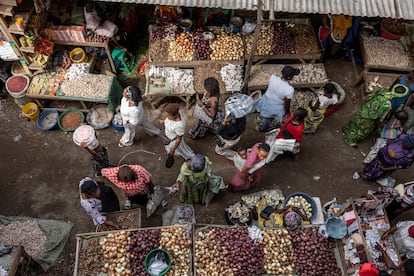

How many days of work does it take to earn enough to buy a basic food basket of 10 items? If we ask that question in Ireland, the answer is just 1.2 hours of work. The picture changes dramatically in the Central African Republic, where a worker needs about 30 days to purchase the same basic basket. In Finland, a person can pay for a week’s groceries with only 1.7 hours of work, compared with the 20.4 days required for someone living in Malawi.
These stark disparities are among the findings of World Vision’s Price Shocks 2026 report, which for the fifth consecutive year compares the cost of a basic basket of 10 common food items with average wages across 62 countries.
“We chose this indicator because it turns food affordability into something people can understand,” Paul Kinuthia, senior director of Food, Cash and Markets at World Vision International, explains by email. “Inflation percentages can seem abstract, but everyone understands what it means to work a full day, or even several days, just to afford a basic, nutritious diet.”

The research highlights deep global inequalities and the devastating impact of rising food prices on households and children. It also echoes other recent warnings about the state of global food security. The 2026 Global Hunger Index, published on Wednesday, warns that after nearly two decades of progress, hunger is once again increasing worldwide, with 44 countries registering serious or alarming levels of hunger and 32 worse off than in 2018.
Based on an eight-hour working day, the average amount of work needed to afford a basic food basket in the countries surveyed in 2026 was 34.3 hours, or about 4.3 working days, down from 4.9 working days in 2024. However, World Vision cautions that this overall improvement does not tell the whole story.
“Hunger has continued to worsen in some regions, especially in fragile settings vulnerable to climate shocks. Also, some countries, including Burundi and Niger, where hunger is particularly acute, were not included in this year’s analysis,” says the report.
“Millions of families are working harder than ever and still cannot afford a nutritious diet,” Kinuthia stresses. “For example, a market vendor, an agricultural worker or a casual laborer may be employed and yet be forced to choose between buying nutritious food, paying school fees or covering healthcare costs,” he adds, explaining that this “puts an entire generation of children at risk of hunger, malnutrition and lost opportunities to develop.”

Of the 62 countries covered by the study, only 56 were included in the main analysis of working hours and days required to afford a basic food basket. Two countries, Japan and Mauritania, were excluded because their food baskets were incomplete due to the absence of maize data, while four others, Afghanistan, South Sudan, Venezuela and Syria, were omitted because data on their gross national income (GNI) were unavailable.
For Kinuthia, the absence of official statistics is itself a sign of extreme crisis. “It is deeply concerning because the children facing the greatest risks of hunger and malnutrition may also be the least visible. Without functioning data systems, crises can be underreported, needs underestimated, and responses delayed,” he adds.
While workers in high-income countries need little more than an hour’s wages to buy a basic food basket, in the 11 countries where food is least affordable the cost exceeds a full week’s work. Nine of those countries are in sub-Saharan Africa, a region that is home to nearly half of the world’s most fragile and conflict-affected states. In places such as Sudan, conflict has disrupted markets and livelihoods, while in countries like Somalia, recurrent droughts have reduced food production and driven up prices.
The rise in food prices has serious consequences for families. Many are eating fewer meals a day, others are reducing portion sizes, and some are switching to cheaper, less nutritious foods to stretch limited resources as far as possible. Families are also borrowing money, depleting their savings, buying food on credit, or selling assets. As the crisis deepens, some cut spending on healthcare and education or take on additional work simply to put food on the table.
Marisol, a woman from Guatemala whose story is featured in the report, feels the impact of rising food prices in her daily life. “We’ve consumed most of [the foods], it’s just that there is a little less now,” she says. Meat is the most expensive item, she says, and the price of chicken can vary from week to week. “Sometimes we eat meat every eight days, every 15 days or even once a month,” she says.
“There are days when my children eat rice with only oil and salt,” says Khin, a mother of eight from Myanmar. “This is no longer occasional; it has become a daily reality,” she adds. Her twins start the day with rice porridge and, at lunchtime, rice porridge is all they have again. With so little nutritious food in their diet, they are beginning to suffer from malnutrition and digestive problems.
Severe price increases
The report also tracks changes in the cost of the food basket between 2024 and 2026. In 33 of the 47 countries for which comparable data were available, the cost of the basket increased, with an average rise of 28.3%, far outweighing the declines recorded elsewhere. The steepest increases were seen in Zimbabwe (+123%), Malawi (+112%), China (+79%), Zambia (+61%) and Ukraine (+52%).
These price hikes have been driven by a combination of factors, including armed conflicts, climate shocks such as El Niño-induced droughts, currency devaluations, inflation and broader economic fragility. Added to these are geopolitical risks, including tensions surrounding the Strait of Hormuz, a critical route for global energy trade. Disruptions there have directly affected fertilizer prices, placing additional upward pressure on food costs.
Sudan recorded a 36% decrease in the cost of the basic basket, the largest reduction measured, but the report warns that this figure reflects the instability of a war context rather than a real improvement, as the country suffers alarming food insecurity and famine conditions.

World Vision fears the situation could worsen in coming years. “The combination of conflicts, climate impacts, disruptions to food supply and cuts to development and humanitarian financing threatens to make nutritious food even less affordable for millions of families,” Kinuthia explains. “The report The State of Food Security and Nutrition in the World (SOFI) already shows that rising food prices are linked to higher levels of food insecurity and child malnutrition.”
The report concludes that while emergency interventions save lives, they do not address the root causes of hunger. It therefore calls for longer-term solutions, such as support for climate-smart agriculture, stronger local food systems and markets, expanded cash-transfer and livelihood-support programs, improved access to nutrition services, and greater investment in school meals and social protection programs.
Sign up for our weekly newsletter to get more English-language news coverage from EL PAÍS USA Edition









































