
RUTF, the miracle food against malnutrition blocked by the USAID debacle
The lives of millions of children hang in the balance if they lose access to this compound. The UN and NGOs are seeking solutions to produce it locally and distribute the US stockpile
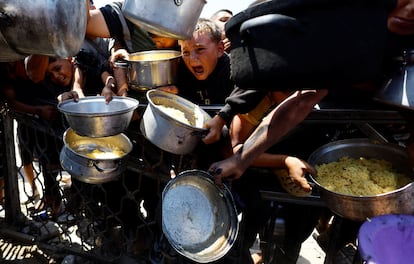

When it comes to hunger, Gaza is currently at the top of the pyramid: the UN has confirmed that half a million people are on the brink of death from starvation, something that has only happened three times in the last two decades and never for reasons strictly linked to political decisions. Beyond the horror provoked by witnessing the famine caused by the Israeli blockade of food supplies, 295 million people worldwide are threatened by hunger. Of this total, 37 million are children with acute malnutrition or wasting (low weight for their age), of whom 10.2 million suffer from severe acute malnutrition, according to data from the Global Report on Food Crisis 2025, prepared by UN agencies.
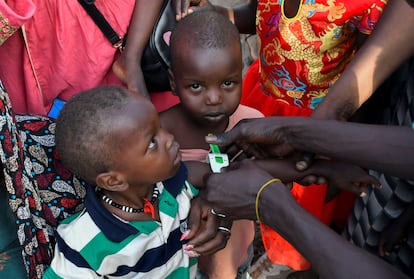
Wasting is the leading cause of death among children aged under five, primarily due to complications such as diarrhea and infections. According to the Institute for Health Metrics and Evaluation at Washington University School of Medicine, in 1990, 6.6 million children died from causes related to malnutrition, but progress in recent decades had reduced that figure to 2.4 million in 2021. These advances were directly linked to a product that changed the global landscape in the 1990s: Ready-to-Use Therapeutic Food (RUTF). These simple yet miraculous sachets contain a combination of peanut paste, oil, milk, vitamins, and essential minerals to combat the most severe cases of childhood malnutrition. For just $45, a six- to eight-week treatment can be completed that can save a child’s life. “RUTF has undoubtedly changed the course of malnutrition treatments because it can be distributed like medicine, patients can take it home, and it doesn’t require water, which was a serious problem with previous treatments,” Luis González, technical director of the NGO Action Against Hunger, told EL PAIS.
However, the situation has changed radically in 2025. “The disappearance of USAID has disrupted the entire RUTF distribution chain because USAID financed most of these products,” González explains.
The entire system comes to a standstill because even if there are products in clinics and warehouses, it’s not enough, and USAID’s cuts have also affected the personnel who distribute themLuis González, Action Against Hunger
In 2024, UNICEF was able to treat more than nine million children with severe acute malnutrition using RUTF. Lara Contreras, Director of Influence, Programs, and Partnerships at UNICEF Spain, confirms: “UNICEF acquires and distributes approximately 75% to 80% of the global supply of RUTF. Once the products arrive on the ground, local partners are responsible for transporting them to their final destination: community health programs,” she explains. According to the official, USAID has often funded these purchases — $200 million for UNICEF alone in 2024 — “although it also purchased RUTF directly and then distributed it with the support of NGOs or UNICEF itself.”
A paralyzed system
What happened when USAID suddenly stopped purchasing RUTF? González is blunt: “The entire system comes to a standstill because even if there are products in clinics and warehouses, it’s not enough, and USAID’s cuts have also affected the personnel who distribute them.”
Studies published since the USAID debacle began, with the paralysis of all its programs in February and the definitive closure of the agency in July, offer concrete figures: 369,000 children could die this year due to lack of access to treatments for malnutrition, according to the journal Nature, which published an analysis authored by the Standing Together Nutrition Consortium, an international network of experts in nutrition and development. But it may have been an underestimate: according to the data visualization platform Impact Counter, the number of children who have died up to August due to USAID cuts has already reached 300,000, of which 90,000 are directly due to malnutrition and the rest due to preventable diseases.
According to The Lancet, the U.S. agency prevented the deaths of 90 million people over the past two decades, including 30 million children. The publication predicts that between four and five million children could die by 2030 due to the disappearance of USAID.
“The abrupt withdrawal of donor support is leaving millions of already seriously ill children without access to these life-saving programs and is weakening the institutional capacity, expertise, and infrastructure needed to deliver essential nutrition services,” explained Saskia Osendarp, executive director of the Micronutrient Forum, a platform of experts focused on improving the health of the most vulnerable communities through micronutrients.
From UNICEF, Lara Contreras explains it in concrete terms: “Due to these cuts, children will die from entirely preventable causes, not only from malnutrition, but also from a lack of safe drinking water, safe sanitation, and essential health services.” The expert cites that in Lebanon, nutrition services for some 55,000 children were reduced overnight; in Bangladesh, critical nutrition, hygiene, vaccination, and education services were reduced or suspended altogether. In Haiti, where 3.3 million children need urgent assistance in the face of violence and shortages, dependence on a single donor threatens the ability to meet even the most basic needs. “We’re talking about 15 million children and mothers whose access to nutritional support could be interrupted,” she insists.
Due to these cuts, children will die from entirely preventable causes, not only from malnutrition, but also from a lack of safe drinking water, safe sanitation, and essential health servicesLara Contreras, Unicef
The problem is not limited to USAID alone. Donald Trump’s pressure on Europe to increase NATO military spending has also had a devastating effect on cooperation. The United Kingdom, France, the Netherlands, and Belgium, for example, have announced cuts of between 25% and 40% over the next three to five years. These measures represent a 44% reduction compared to the $1.6 billion allocated in 2022 to alleviate malnutrition globally, according to calculations by the Standing Together Nutrition Consortium published in Nature. This amount includes RUTF treatments and other complementary programs such as fortified biscuits and cereals, supplements for pregnant and malnourished women, and simply healthcare personnel to manage the programs.
“We’ve looked for alternatives to continue providing support. In many cases, the first step has been to reduce rations,” explains Gonzalez. Furthermore, the situation has revived the long-held idea of producing RUTF locally. “We’ve seen that relying solely on American producers and a single buyer can be very problematic, so the humanitarian community is working to create alternative production chains, but of course, that will take time,” says this aid worker. And time, in this case, costs lives.
Tons of expired supplements
The dismantling of USAID, which invested some $43 billion annually, and the chaos it has wreaked on many humanitarian organizations that relied on its support, is also leading to the waste of tons of products used in nutrition programs. In July, the State Department ordered the destruction of 500 tons of fortified biscuits it had stored in Dubai because they had expired, while Reuters reported in May that more than 60,000 tons of food and nutritional supplements were languishing in U.S. warehouses around the world.
This summer, Democratic Senator Jeanne Shaheen complained about the situation: “If the State Department doesn’t have the officials to distribute it, let’s give it to other aid organizations so that they can distribute it, so it’s not going to waste and that people are getting the benefit of not only what American taxpayers pay for, but the people who are truly desperate.” However, the State Department, questioned at a press conference on the issue in August, has been unable to provide a concrete answer about its distribution plan for the stalled orders.
At Edesia’s warehouses, one of the two largest U.S. producers of RUTF, the situation is not easy. “Luckily, no product has expired, but we have 185,000 boxes of RUTF worth $7.5 million in our warehouses. They’ve been paid for and undistributed,” Navyn Salem, founder of Edesia, explained via email to EL PAÍS. “We’ve spent much of this year raising funds to maintain our production chain and forging alliances with NGOs working on the ground, but there will be a lot of pressure to make up for the eight months of lost time,” she added.
UNICEF initially confirmed on August 11 that the State Department had awarded it $93 million to purchase RUTF to treat one million malnourished children in 13 countries. These treatments will have to be sourced from the Edesia factory or Mana Nutrition, the other U.S. producer of RUTF. However, UNICEF also explained that it takes two to three months from the time an order is placed to the time it arrives at its destination, a critical delay given the current circumstances.
Curiously, Edesia is still awaiting an order whose scale will undoubtedly require its factory to participate. “We keep hearing news, they say there will be imminent instructions, but so far, no one has contacted us,” Salem stated on August 27. The situation is such that its factory has had to juggle multiple tasks to fulfill its contracts with American farmers who supply its raw materials. “We’ve had to make many difficult decisions without information to guide us,” Salem concludes.
Meanwhile, in August, the World Food Programme (WFP) closed 150 clinics in Nigeria, a country facing alarming levels of malnutrition and where the WFP was assisting 300,000 malnourished children. “We are witnessing massive budget cuts, particularly from the United States, the United Kingdom, and other European countries, which are having a real impact on the treatment of malnourished children,” confirmed Ahmed Aldikhari, Doctors Without Borders (MSF) representative in Nigeria.
In Afghanistan, child malnutrition has reached unprecedented levels, leading UNICEF and the WFP to forge an alliance to combat it. But there too, funding is lacking, and only aid from the European Union is saving the day. Action Against Hunger has also had to close nutrition programs in countries like Sudan, where famine has already been declared. “And in other countries, we’ve managed to maintain our operations because ECHO (the European agency for humanitarian operations) has helped fill the gaps left by USAID, but the situation is very complicated,” concludes González.
Sign up for our weekly newsletter to get more English-language news coverage from EL PAÍS USA Edition









































