
Trump’s restrictions on mail-in voting stall in the courts
A new court ruling has put the decree, which would benefit the president in the midterms, on hold for two weeks
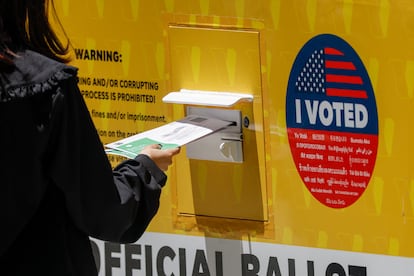

The judicial back-and-forth over mail-in voting shows no sign of abating in the United States. Just a day after a judge removed the last obstacle preventing President Donald Trump from restricting absentee voting, the same magistrate has blocked it again. The presidential decree signed in March that sets strict requirements for exercising the right to vote by mail has, in a matter of days, been paused by two court rulings, revived by the Supreme Court, pushed again in the lower courts and, once more, halted. The cascade of decisions overturning one another threatens to confuse voters with just over two months to go before the midterm elections.
U.S. District Judge Indira Talwani in Boston again suspended the plan for 14 days after a fresh wave of lawsuits filed just days before mail ballots begin to be sent out for the midterms. “Most Plaintiff States have already ordered their mail ballots, and some are required by state law to send them to eligible voters as early as next week,” she noted.
The legal battle the administration is waging against Democratic states and other organizations has major implications for the elections that will choose all 435 members of the House of Representatives, one-third of the Senate, and the governors of 39 states and territories. Nearly a third of Americans vote by mail, and election officials say there is not enough time to change their systems and comply with the U.S. Postal Service’s (USPS) new guidelines.
The new rules, published last Friday, require special envelopes with traceable bar codes for sending mail ballots. States would also be required to provide the USPS with a list of eligible absentee voters, among other requirements. The aim is to reduce the number of people who use mail voting to participate in the democratic process. Trump has repeatedly — without evidence — claimed that absentee voting is fraudulent and that it caused the Republican to lose the 2020 presidential election to Democrat Joe Biden, a claim that has already been debunked. A Brookings Institution report published in 2025 found that fraud in mail voting occurred in only about four cases per 10 million votes cast by that method.
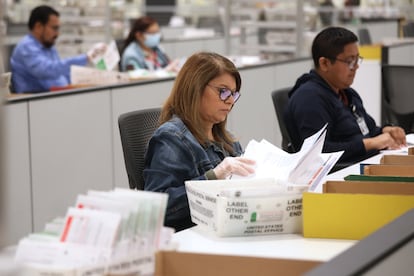
“[The plaintiff states] have neither time nor funds to design new mail ballots, seek approval of the new designs, order production of mail ballots, update their own election management systems, train election officials to use the USPS portal, and upload citizen data to the portal, all before the midterms,” Talwani wrote on Thursday. The judge justified her new ruling by saying the most recent lawsuit arose in a different context than the earlier ones, since it was filed after the administration defined the new rules last Friday.
The case could return to the Supreme Court, which ruled in Trump’s favor earlier this week. The highest court did not rule on the legality of the presidential decree; it determined that Talwani’s injunction was premature. The Supreme Court, where six of the nine justices are conservatives, has sided with the Republican in numerous cases. The three progressive justices — Sonia Sotomayor, Elena Kagan, and Ketanji Brown Jackson — dissented.
In her Thursday decision, Talwani addressed a suit brought by two dozen Democratic states, which argued that “the Rule will frustrate or outright prevent Plaintiff States from administering their mail voting programs in November and foreseeably disenfranchise voters who vote by mail.” The attorneys general who signed the filing noted that “Indeed, this seems to be what the President prefers.”
Trump issued the executive order targeting mail voting in March. Lawsuits followed quickly, but the administration argued the claims were premature because the rules detailing how the order would be implemented had not yet been established. The government won an initial case in Washington, D.C., on that basis. However, Judge Talwani issued preliminary injunctions to block the order’s application to the midterm elections in two separate cases she oversaw in Boston. The Supreme Court overturned one of those injunctions, and the magistrate withdrew the other order last Wednesday.
The Hispanic civil-rights group UnidosUS criticized the Supreme Court’s decision, saying it affects millions of Latinos who, because they cannot miss work, rely on mail voting. “Members of our Armed Forces serving overseas depend on mail voting to participate in our democracy. The same is true for Latino working-class voters who cannot miss work, who lack reliable transportation, or who have health problems that make in-person voting difficult. For all of them, access to mail ballots is not a mere convenience; it is essential,” it said.
Sign up for our weekly newsletter to get more English-language news coverage from EL PAÍS USA Edition









































