
Helena Moreno, mayor of New Orleans: ‘Being Latina and bilingual allows me to defend my community’
Speaking at the National Association of Hispanic Journalists, the former reporter — who is the first Latina to hold the city’s top position — outlines the challenges of standing up to Trump’s immigration policy
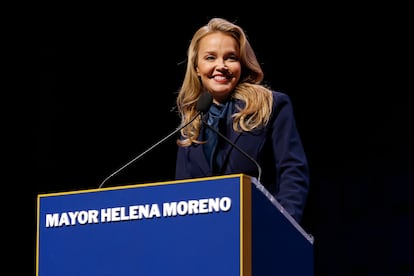

When Helena Moreno, 48, took office as mayor of New Orleans, the city was under threat from Donald Trump’s anti-immigrant machinery. Late last year, the Republican administration set its sights on this southern city — known as the birthplace of jazz — and launched in the state of Louisiana what it called Operation Catahoula Crunch, a name inspired by “the tenacity and grit” of the Catahoula, a dog breed native to the region. It was in this context that Moreno became the first Latina mayor of a city where the immigrant community is relatively small but significant.
“When we were targeted by the so-called Operation Catahoula Crunch, I gathered with our business community, along with our faith-based community, to say: ‘Why is thisreally goodfor anyone?’” Moreno recalls during the interview. “Because, ultimately, what was happening was leading to economic consequences for the city of New Orleans. It was also creating public safety situations, since many people were concerned about whether or not they should call police when they’re injured or a victim of crime.”
The immigration operation carried out in New Orleans by the Trump administration between December 2025 and February of this year was part of a strategy the president pursued in his first year in office, sending thousands of federal agents to cities governed by Democrats to track down, arrest and deport migrants.
The Louisiana operation unfolded around the same time as a deployment in Minnesota, where immigration agents shot and killed two U.S. citizens amid mass protests against Trump’s immigration policies. Following the two deaths that shocked the nation, Minneapolis was the last city targeted by the president, marking a shift in strategy from high-profile urban crackdowns to less conspicuous, more targeted operations.
But while all eyes were on the Midwestern city, New Orleans, on the banks of the mighty Mississippi, was dealing with the fallout from an operation that, although it ended with far fewer arrests than initially expected — fewer than 600 people, compared with the announced goal of 5,000 — spread fear throughout the local immigrant community.
Many of New Orleans’s most frequented restaurants and other businesses closed for weeks out of fear. Sectors that rely on immigrant labor, such as construction and services, were immediately affected as terrified workers stayed away. Migrants make up roughly 9% of the city’s population and play an important role in supporting its tourism industry. Hondurans have historically been the largest immigrant group, although there are also sizeable Mexican and Nicaraguan communities. Many arrived after Hurricane Katrina devastated the city in 2005, drawn by reconstruction work in the storm’s aftermath.
During Operation Catahoula Crunch, which was praised by the state’s Republican Governor Jeff Landry, Moreno demanded transparency and denounced that migrants’ arrests in the city were motivated by racial discrimination. “I support taking murderers, shooters, rapists and violent offenders off our streets,” said Moreno in late January. “But [...] it became very clear from the start of Catahoula Crunch that the mode of operation was for agents to find and target groups of predominantly Hispanic individuals.”
A bilingual, Latina ‘star’
“These are really trying times. I see it and feel it constantly in the way that people want to silence people. There’s certain folks that want to bully certain communities. And my job as mayor is to do all that I can to defend and protect them,” the mayor now reflects.
After her first six months in office, the Democrat says her identity has allowed her to connect with a community that for a long time had no one in power with whom it could identify. “As a Latina and someone who is bilingual, I am able to go into the community and have a real dialogue with them so that they can understand what’s really happening,” she says. “Because there’s so much misinformation that’s out there. I can come in and say: ‘Wait, this is not the truth,’ ‘You can’t do this,’ or ‘Be careful of this,’ due to the fact that I can communicate with them in their language and that they trust me also as a Latina.”
Moreno spoke with EL PAÍS at the annual conference of the National Association of Hispanic Journalists (NAHJ), which took place last week in New Orleans, and where she took part in an awards ceremony. In her opening remarks, the mayor recalled that she was a journalist before entering politics.
Born in the Mexican state of Veracruz, Moreno is not part of Louisiana’s power circles or the families that have long dominated local politics. She is the daughter of a Mexican businessman and a U.S. poet, and as a child she was nicknamed “güerita” because of her fair skin and blond hair. When she was eight, her family moved from Mexico to Texas, where she later trained as a journalist. She came to New Orleans to work as a reporter for the city’s NBC affiliate, and a few years later she won an Emmy for her coverage of Hurricane Katrina.
In 2008 she decided to leave journalism for politics, a move she now recalls was far from easy, particularly in a conservative state like Louisiana, although New Orleans is a Democratic stronghold. Two years later she was elected to the Louisiana House of Representatives for District 93, and in 2017 she won a seat on the City Council.
Moreno launched her mayoral campaign for New Orleans one month before Trump won the 2024 general election. After the Republican’s landslide victory, her campaign — along with several other Democratic campaigns around the country, such as that of now–New York City mayor Zohran Mamdani — gained special attention as a response to the magnate’s return to power. Before the November 2025 elections, former vice president and one-time Democratic presidential candidate Kamala Harris called Moreno a “star.” In January 2026, Harris administered Moreno’s oath of office as mayor.
Six months later, Moreno enjoys an approval rating of 78.6%, according to a poll published in mid-July by her campaign. From City Hall, Moreno has repeatedly clashed with Republican governor Jeff Landry, an ally of Trump — in May he was his special envoy to Greenland, the Arctic island the president has long coveted — and with the state’s Republican attorney general, Liz Murrill, over issues including local governance, immigration and New Orleans’ authority. Those disputes have become a defining feature of her administration.
She has stood firm in her convictions in the face of state and federal pressure. “That will always be my duty and my stance: to protect and defend the people who live in the city of New Orleans,” the mayor says. In her speech at the NAHJ conference, Moreno noted that she originally went into journalism because she wanted to make a difference in people’s lives. Over time, that same motivation led her to leave the newsroom for local politics.
Sign up for our weekly newsletter to get more English-language news coverage from EL PAÍS USA Edition









































