
New York’s response to throwaway culture
In East Harlem, residents meet at Repair Café to fix household appliances and share knowledge
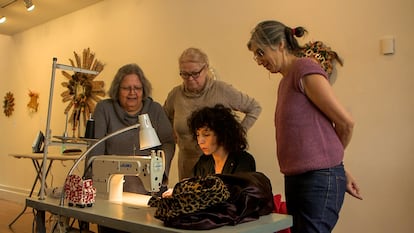
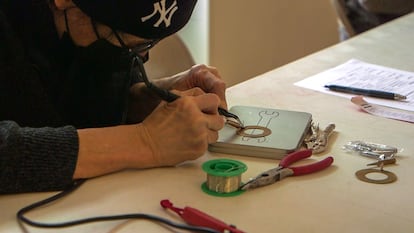
In East Harlem one Sunday out of every month, a group of people meet with the intention of bringing objects back to life. In El Barrio Artspace PS109, a project has transformed an abandoned school into an art center in which several tables have been set up in a simulation of an operating room. Only here, the surgeons are repair experts. Jorge Ramírez and his daughter Jorgette Mariñez come one day in March in the hopes of fixing an electric kettle that has simply decided to stop working.
“I bought it five years ago and everyone tells me that I should just buy another, that it’s easier,” says Mariñez. “But why not try to fix it first?” She and her father are Harlem residents. They heard about Repair Café on social media and were intrigued by the community event with a mission to repair objects.
Rocío Salceda, 48, a Spanish artist and language teacher, founded the collective in New York City in 2022, inspired by a model first born in 2009 in Amsterdam. She says the project started with five people and clothing repair lessons on her sewing machine.
“I went around New York and saw the number of things that are thrown out, but are new: televisions, washing machines, all kinds of things,” she recalls.
According to the United Nations, we are increasingly producing and replacing more objects instead of repairing them. In New York City alone, according to the company Recycle Track Systems, more than 14 million tons of waste are generated every year. Electrical devices, from cell phones to household appliances, represent one of the quickest-growing categories of waste. In 2022, more than 60 million tons were produced worldwide, the weight equivalent of nearly 6,000 Eiffel Towers.
An act of rebellion
New York City promotes obligatory recycling and compost, which requires that food and organic waste be separated for collection. Even so, a large part of electrical appliances wind up in the garbage when they stop working. For example, an exercise carried out by E-Waste Statistics calculated that in the United States alone, a person can generate 46 pounds of electronic waste every year.
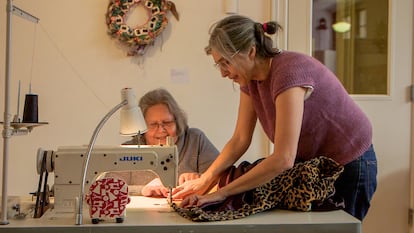
Cuauhtémoc Romero, one of Repair Café’s collaborators, explains that repair has to do with the mentality one learns while young. “Growing up in Mexico, I knew that what I had, if it broke, wasn’t so easily replaced with something new.”
One of the things on which he has worked is an iPod Classic, a music player that Apple stopped manufacturing in 2014. Though for Romero, many repairs involve a “trial and error” process, he says that technology lends a hand. “It would be almost impossible if I didn’t get my phone out and look for a YouTube tutorial,” he says.
As these community networks grow, the debate over supporting repairs has also arrived at the state legislature. In 2022, the state of New York approved the Digital Fair Repair Act, a law tied to the Right to Repair movement that looks to require electronic device manufacturers to offer access to parts, tools, and information on how to repair their products.
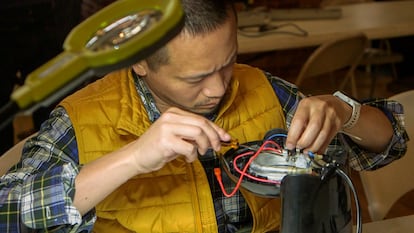
But even with legal changes, for many New Yorkers, repair continues to take place principally in informal and community spaces. Initiatives like the Repair Cafés — meeting spaces where volunteers provide free help in fixing household objects — have arisen to fill that need. Here, neighbors bring lamps, clothes and small household appliances, working with people with technical expertise on trying to fix them.
For Romero, the solution to the throwaway culture is in the hands of public policy. “You’ve got to address the problem more systematically. It should be something that has a place in the governmental programs, where repairing something would be easier.”
Sign up for our weekly newsletter to get more English-language news coverage from EL PAÍS USA Edition









































