
US library hands out potatoes and rice as SNAP cuts leave families hungry
The changes the Trump administration made to the program leave more than 3.5 million families without help to buy food
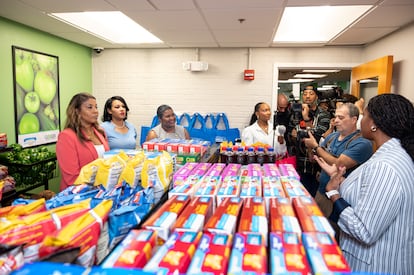

Since May 28, dozens of people have been coming to the Fairmount Heights Library in Prince George’s County, Maryland, looking for more than books. Bread, vegetables, fruit, cereal: the facilities built to feed minds will now also feed stomachs thanks to an initiative by the county’s District 5, which has installed a free grocery store inside the local library. The idea was born to help the neediest families, whose finances have suffered in recent months. In addition to inflation — which has driven gasoline prices to new highs because of the closure of the Strait of Hormuz, and raised the cost of basic goods — the loss of SNAP benefits (Supplemental Nutrition Assistance Program), pared back under the Trump administration, has hit low-income households hard.
“Many people have been laid off or are living with insecurity in so many ways; people who never imagined they would reach this point and need to go to a food pantry,” says Shayla Adams-Stafford, a County Council member representing District 5, and the person who came up with the idea.
On its first day, about 10 families made the inaugural purchases at the Fairmount Five Market. In a small space behind the rows of hundreds of books, there are baskets of oranges, potatoes and peppers and shelves stocked with canned goods, drinks, pasta and rice. At the back, two industrial refrigerators store chilled items. With a $200,000 budget, the program, which has partnered with the organization Goodr, plans to provide food to 175 families a month. One meat item, two dairy items, two potatoes, one loaf of bread… supplies are rationed so there is enough for everyone.
So far, 147 people have used the market and there is a waiting list of about 40. Most are Latino and African American, the two largest demographic groups in the county. Older adults and single-parent families are the primary target of the program. The waiting list is expected to keep growing because prospects for an improved economic situation under an administration that is cutting public assistance and with inflation rising due to the war in Iran are not good.
“There is more hunger now than during the COVID pandemic. There are fewer jobs, food costs more, everyone is feeling it,” says Gina Plata-Nino, director of SNAP Policy and Advocacy at the Food Research & Action Center (FRAC).
According to data from the Center on Budget and Policy Priorities, more than 3.5 million people have lost benefits they received through SNAP since changes were announced last summer. The federal budget law —dubbed by President Donald Trump the Big Beautiful Bill and passed by Congress in July 2025 — includes $187 billion in SNAP savings for the federal coffers over the next 10 years. Created in the 1960s, SNAP distributed more than $90 billion a year, equivalent to 9% of the nation’s food spending, according to Department of Agriculture estimates. About 42 million people received SNAP benefits in fiscal year 2025 (October 1, 2024–September 30, 2025), representing one in eight Americans. Nine out of every 50 Hispanic households use it, five out of every 50 Asian households, and 20 out of every 50 Black households. According to the Department of Agriculture, SNAP covered on average 63% of participants’ groceries.
The Trump administration has attacked the program on several fronts. One measure eliminated nutrition education that helped people choose a balanced diet. It also removed the ability to include online payments in the income-and-expense balance used to determine benefit eligibility. The poorest people who already received assistance for electricity and other services will no longer automatically qualify for SNAP as they did before.
But possibly the most impactful change is the expansion of the work requirement to 20 hours a week. It previously applied to people aged 18 to 54, but the new law raises the age limit to 64 and includes parents of children older than 14. Exemptions that applied to veterans, people experiencing homelessness and those who had been in foster care have been eliminated. Asylum seekers and refugees will also lose eligibility for SNAP benefits if they have not obtained permanent residence (the green card), a process that can take years because of the backlog. Single-parent families are among the hardest hit. If they must combine work with childcare and cannot meet the 20-hour weekly requirement, they lose the benefit.
The maximum monthly SNAP benefit is $298 per household, though few receive this amount. “Most people who get it work. They earn about $1,117 a month, which is nothing. Those $200 or $100 you get for food help a lot,” Plata-Nino said.
Last year the Congressional Budget Office estimated that, on average, nearly 3.2 million people could fall off SNAP rolls each month once the new work requirements take effect.
Experts say the worst is yet to come. Federal savings will be achieved in part at the expense of state budgets. Until now, the federal government and the states split the program’s administrative costs 50–50. Starting in October of this year, states will have to pay 75% and, beginning in October 2027, will also shoulder part of the benefits that until now were covered by federal funds. Most state budgets focus on health and education, but they will now have to divert some of that money to SNAP.
Prince George’s County plans to open another free grocery store in District 7. The initiative is seen as relief for many families’ finances, but it does not replace SNAP. For every meal a food pantry can provide, SNAP would cover nine. “It helps, but it is not the solution. Also, we know that when people have adequate resources and access to SNAP they can support their local economy. These small pantries cannot help everyone in need,” Plata-Nino said.
Sign up for our weekly newsletter to get more English-language news coverage from EL PAÍS USA Edition









































