Martin Baron, winner of the 2026 Ortega y Gasset Journalism Prize: ‘I believe in citizens’ obligation to be informed and discern the truth’
The legendary newspaper editor reflects on his career, freedom of speech under Trump, and the challenge for the media posed by AI
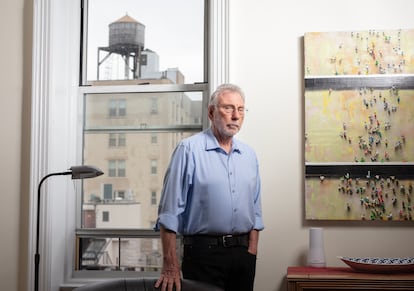

Martin Baron, 71, retired from his position as editor of The Washington Post five years ago, but he still speaks about journalism in the first person plural with phrases like “we must do our job” or “this or that is our responsibility.”
“I still feel like I’m part of the profession,” he explains during an interview in New York. “I still have an obligation to reflect on what I believe our standards should be, and to speak out about freedom of speech. We’ve been wrong to insist on distinguishing between the rights of the press and the rights of citizens to express themselves and be informed freely. They are part of the same thing.”
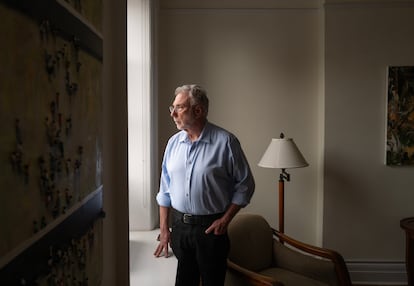
The meeting took place last Tuesday in his small Manhattan apartment, in a living room without a television set and dominated by one of Juan Genovés’ paintings of crowds. This is where he spends his time when he’s not at his home in the middle of nowhere in Massachusetts, or traveling. For example to Spain, where this Monday, on the 50th anniversary of EL PAÍS, he is scheduled to accept the Ortega y Gasset Journalism Prize (and deliver an acceptance speech in Spanish, a language he speaks fluently), along with Belarusian reporter Svetlana Alexievich and Nicaraguan writer Sergio Ramírez.
The award recognizes his entire career, one of the most brilliant in American journalism, during which he directed The Miami Herald (2000-2001), The Boston Globe (2001-2013), and The Washington Post (2013-2021). Under his leadership, those three newspapers went on to win 18 Pulitzer Prizes; he still found time to make film history as Liev Schreiber in the Oscar-winning Spotlight (2015), about the investigation that uncovered the sexual abuse scandals in the Archdiocese of Boston when Baron was at the helm of the Globe.
It was inevitable that Donald Trump should dominate much of the long conversation. Not only because Baron confronted the president during his first term at the Post, which he took over nine months before Jeff Bezos’ purchase of the newspaper — Bezos having just laid off hundreds of employees and put its opinion pages at the service of Trump’s agenda — but also because the U.S. president literally intruded on the conversation in the way he constantly does in the lives of hundreds, perhaps billions, of people: with one of those cellphone alerts demanding immediate attention to his latest pronouncements. In this case, it was a post from his media office with a picture of himself alongside Prince Charles and the caption “Two kings.”
“He’s just trying to provoke the media; to outrage us so he can accuse us of exaggerating something that was just a joke,” says Baron, a shy man with a mischievous smile. “The press is a convenient target. Trump always needs an enemy, and journalists are always available. It’s the hallmark of authoritarians: they don’t like independent arbiters of the facts.”
Question. In the 2024 campaign, there was a recurring question: Had journalism learned how to cover Trump? Fifteen months into his second term, I ask it of you.
Answer. I’m not sure, but I think so. Our job is to give the public the information it needs and to hold those in power accountable. James Madison, author of the First Amendment, had that in mind when he wrote it. It speaks of freely scrutinizing public figures and holding accountable the policies that affect our lives. It is our duty and our responsibility, no matter what pressures we face. It’s important that we continue our work because what Trump fears the most are facts. Opinions are cheap.
Q. One must acknowledge his success in undermining the “facts.”
A. He has succeeded in making the public question whether it is even possible to determine what is true. And he has undermined trust in the press. It’s not that we were entirely popular before he came along. Trust in the media in the United States reached its peak after the Watergate scandal [the series of reports by the Post and others that forced Nixon’s resignation]. From the mid-1970s onward, it was declining. Trump attacks the media every day, and his supporters believe him, whether what he says is true or not.
Q. In view of the constant bombardment: is ignoring him an option?
A. It’s very difficult. I don’t think it’s viable for the press, because he’s the president, and he has a tremendous impact on the world…
Q. If the press doesn’t... do you understand why there are citizens who choose to tune out?
A. I believe in citizens’ obligation to be informed and discern the truth. To do their homework. If that includes turning off Trump from time to time, that’s fine. In the United States, there are doctors who already prescribe it for patients with anxiety. I won’t recommend it, because it goes against our interests [Smiles].
Q. During Trump’s first term, you coined a famous phrase: “We’re not at war, we’re at work.” He came into his second presidency armed to the teeth. Did you expect this level of aggression?
A. I expected the worst, and the worst was worse than I expected. When he returned to the White House, I listed in an interview a number of things I feared he would do. He has done almost all of them.
Q. Which ones not?
A. Going against newspaper advertisers. I wouldn’t want to give him ideas, but I’m sure he’s already thought of it. It’s often said that he’s an aspiring dictator, but he’s worse: he wants to be emperor. That’s why he talks about annexing Canada, taking over Greenland, making Venezuela the 51st state... He doesn’t know much about history, but he does like to look at himself in the mirror of James Monroe or Andrew Jackson, imperialist predecessors.
Q. Were you frustrated to see him re-elected despite the frankness with which the press spoke during the campaign about the dangers he represented?
A. The American people have the right to choose. Our job is to inform that decision. The state of the economy and uncontrolled immigration were factors. So was the perception that [Joe] Biden was a weak president and that Kamala [Harris] didn’t have enough time. If you look at the polls, voters didn’t believe Trump was telling the truth, and there were aspects of his personality they didn’t like, but that wasn’t the most important factor in their decisions…
Q. Can the press be blamed for this devaluation of truth?
A. No. We don’t control the world, despite what some people think. Unfortunately, we live in a flood of misinformation, and technology platforms not only do nothing to fix it, but they encourage and amplify it.
Q. Are you afraid that Trump will take his attack on the media to the Supreme Court and that its conservative majority will overturn protections for journalism in the United States?
A. He would like to. He has sued The New York Times and The Wall Street Journal without merit. He is pressuring the television networks and has ordered a raid on the home of a Post reporter [for reporting on the Pentagon]... There is a precedent, New York Times v. Sullivan, that allows the press to report freely on public figures. I think he wants to test whether they can overturn it. There are two justices [Clarence Thomas and Neil Gorsuch] who have said they would be willing... I see it as difficult, but nothing can be ruled out.
Q. What do you think of those who appreciate that Trump is a “transparent” president, someone who talks a lot with the press?
A. He’s not transparent, but rather talkative. They’re different things. Accessible? He is. But much of what we know about what’s happening is because the media is revealing it, not because he’s telling us… For example, he said nothing about the demolition of the East Wing. He wanted to keep it a secret. How did he think it would be possible for us not to find out about the destruction of part of the White House? It’s hard to understand, but that’s how his mind works…
Q. He is a good trafficker of Washington’s most coveted drug: access to power.
A. Now he’s taken to answering the phone to reporters who call him. He’d be better off spending that time studying an intelligence report instead of talking off the cuff to whoever has his number. Reporters love that, and I can understand why, but it doesn’t make Trump a transparent president. He gives far more interviews than his predecessor, but he treats them as an opportunity to send a message. And in them, he lies nonstop.
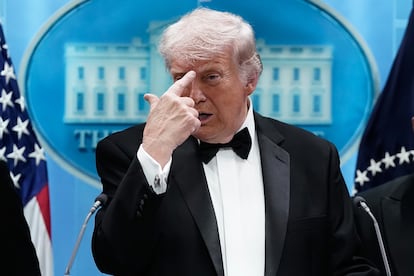
Q. The Correspondents’ Dinner, interrupted by an attack, is a gala in defense of the First Amendment, and Trump is the president who has attacked it the most…
A. I always hated that gala. When I was running the Post, I felt obligated to attend. First, because of the journalists who enjoyed going; I didn’t want to give the impression that I disapproved of their interest. Besides, my editor was always pressuring me. The year Trump said we were the enemy of the people, I refused to go. Finally, Trump declined the invitation, and I ended up attending. I think the image we project—dressed in tuxedos, surrounded by celebrities, mingling with the people we’re supposed to cover independently—is not in the press’ best interest. It makes us seem like we’re part of the elite, when in fact most journalists don’t earn much money. I thought it was a terrible mistake to invite Trump.
Q. After the attack, it seemed he wanted to bury the hatchet…
A. It didn’t last long. Soon after, Melania and Donald Trump launched attacks on [comedian Jimmy] Kimmel. Why? For a bad joke, which can’t be taken as an incitement to murder but as a comment on the age difference between them… He couldn’t have anticipated what would happen at the dinner…
Q. Nor could Karoline Leavitt, Trump’s spokesperson, have known, as she said that same afternoon, that “there will be some shots fired tonight in the room”…
A. If Kimmel had said that, he’d be crucified. This government is completely hypocritical in its defense of free speech. It only likes the kind exercised by its friends.
Q. Leavitt also blamed the attack on the “left-wing cult of hatred” against Trump. Does such a thing exist?
A. There are people on the left filled with hatred. And on the right, too. And one of the most hate-filled people is Trump. When [Special Counsel] Robert Mueller died, he said he was glad. He lacks the moral authority to criticize anyone. I don’t believe in hatred, nor in inciting violence against anyone. I do believe in criticism, especially of the president, the most powerful person in the world. If we lose that ability, we will have lost democracy in this country.
Q. After the attack, conspiracy theories flourished. Will we ever agree on what reality is?
A. I don’t think I’ll live to see it. With artificial intelligence, our inability to agree on a common set of facts will only get worse.
Q. Beyond that, are you afraid of the effects of AI on journalism?
A. It has advantages and disadvantages. It’s a powerful tool, for example, for data analysis, but it can be a terrible agent for spreading misinformation. And I think it’s a bad decision by some media outlets, which also happen to be the most respected ones, to refuse to allow AI engines to feed on their content. That leaves the field open for sources with flawed information to supply those robots.
Q. Do you use it?
A. Yes, when the Pentagon said it was ceasing to use Claude [Anthropic’s AI engine], I downloaded it. I asked it if Bezos was destroying the Post.
Q. What did it say?
A. Claude was quite harsh with him. In fact, he repeated my own statements and other criticisms. It doesn’t seem like it found anyone to defend him. It’s always nice to be agreed with, but it actually served to demonstrate one of AI’s weaknesses: it only relies on publicly available information.
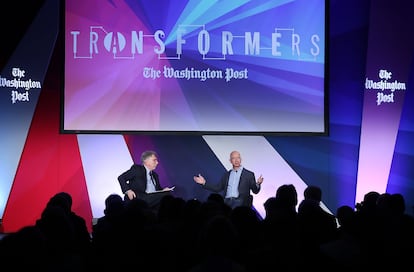
Q. In Collision of Power, your memoir of those years between Trump and Bezos, you write that Bezos always thought 20 years ahead. Did he give any indication of what he has ended up doing?
A. Many people, including Bezos himself, thought Trump’s career was over with the storming of the Capitol [on January 6, 2021]. Seeing that he could be president again, I think he got scared. And he wasn’t wrong, because Trump did exactly what he said he would do: get revenge on his enemies. And he always considered Bezos one of them, mainly because of the Post’s coverage. I think he was worried about the cancellation of government contracts with Amazon. Also, that at that time Trump’s best friend was Elon Musk, with whom Bezos competes in space. Larry Ellison, the founder of Oracle and a Republican campaign donor, is also a rival in the cloud computing sector. Seeing all those threats, he acted to safeguard his businesses. Otherwise, Bezos did an admirable and courageous job of standing up to Trump’s pressure during his first term. And he didn’t interfere with our journalistic work.
Q. You retired almost two months after Trump left the presidency. Were you tempted to return to the front lines with his second term?
A. No. First, Bezos didn’t ask me to. Second, I didn’t want to work every minute, 24 hours a day, 7 days a week, which is what the job of editor has become. I was 66 years old and had worked 45 years as a journalist, 20 of which I spent at the helm of three different newspapers, where I always arrived as an outsider. That’s never easy.
Q. Is a Post with hundreds fewer employees still the Post?
A. The Post still does very good work. But its ambitions are much more limited. They have very little local coverage, there are no photographers, and sports coverage has declined...
Q. Nor is there a book section, in such a book-loving city.
A. Many books are written in Washington, but always about Washington. Those books are read by going to the index and looking up your name. That’s why many don’t carry it. Beyond that, it is a city of readers, and to forgo literary coverage is to forgo ideas.
Q. In 1976, the year EL PAÍS was founded, All the President’s Men, the film about the Watergate scandal, premiered. To what extent did this influence your generation?
A. Very much so. I built my career between 1972 and 1976, right in the middle of Watergate. I never thought, “I’m going to be the next Woodward or Bernstein.” But I was very interested in the idea of holding those in power accountable. I still believe that’s our most important mission.
Q. And EL PAÍS? When did you learn of its existence?
A. I’m sorry to say it wasn’t 50 years ago [Laughs]. Probably in the 1990s. And definitely from 2000 onwards, when I was appointed editor of the Miami Herald and felt a real need to improve my Spanish, for obvious reasons. I went to Seville to learn. That was my final immersion in EL PAÍS. Now I’m a subscriber. I accepted a tempting offer.
Q. And if you had to start over, would you be a journalist again?
A.Yes, my parents wanted me to be a lawyer, but I’m still not interested in law.
Sign up for our weekly newsletter to get more English-language news coverage from EL PAÍS USA Edition