
From Philadelphia 1776 to Minnesota 2026: The new setting for an old conflict
Minneapolis is not an anomaly or an isolated episode, but rather another expression of a conflict as old as the federation itself

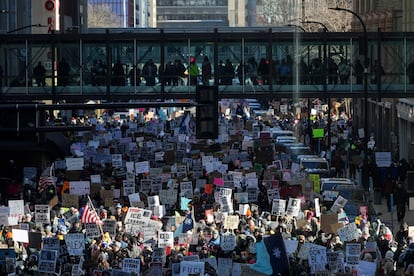
The recent tensions between local authorities in Minnesota and the immigration enforcement agencies of the Trump administration, particularly Immigration and Customs Enforcement (ICE), are not merely the stance of “rebellious” cities or states. They are the latest manifestation of a dispute as old as the nation itself: the resistance of local power against a federal center that periodically attempts to govern by imposition. To interpret what is happening today in Minneapolis — and its consequences — as an isolated episode of immigration policy is to remain on the surface. Underlying this is American federalism, conceived from its inception to preserve regional autonomy and limit the power of the central executive in certain matters.
The United States was born in 1776 as a direct reaction against a distant British crown. In seeking independence, the 13 colonies did not intend to replace London with another dominant center of power, but rather to preserve their political autonomy. Hence the structural distrust of the central government, embodied in the Articles of Confederation, in effect until 1787, which established a deliberately weak federal government. The experiment failed due to fiscal insolvency, disputes between the states, and an inability to guarantee basic order. The Constitution of 1787 strengthened central power, maintaining a counterbalance in the power of the former colonies, now states. Since then, internal frictions — rather than a failure of the system — have served as a tense balancing mechanism.
The next conflict emerged a decade later. In 1798, the Alien and Sedition Acts, passed amid fears of war with France and internal unrest, significantly expanded federal power to persecute foreigners and silence dissent. The reaction from several states was swift and decisive. Virginia and Kentucky argued that they were not obligated to enforce federal laws they deemed unconstitutional. This position did not prevail in the courts, but it reinforced the conviction that states do not exist solely to obey.
In reality, this logic had been developing for some time, with the founding slogan of the colonial rebellion: “No taxation without representation.” The resistance was not directed solely against taxes, but against a foreign power that made decisions without local representation or participation.
The most extreme chapter of that tension was slavery. In the 19th century, the federal government imposed laws requiring judges, police, and local authorities in the North to cooperate in the capture of enslaved people fleeing the South. Many states and cities openly refused and passed laws to sabotage that cooperation.

At that moment, the tension became unmanageable, and the system collapsed into secession and the Civil War, revealing the limits of federalism in an existential conflict resolved by force. The federal victory, more than 600,000 dead later, preserved unity and reinforced Washington’s authority, but it did not eliminate friction with local power. This violent clash also recognized that the federal government could not demand automatic obedience from state and local authorities. That principle, forged in the conflict that led to the country’s breakup, is invoked today by states and cities when they refuse to act as operational arms of ICE.
This pattern continued during Reconstruction and, decades later, in the struggle for civil rights, when Washington ordered desegregation and the expansion of rights for the Black population: many governors, state legislatures, and local police forces responded with open or covert resistance. The federal response was gradual and costly: litigation, political pressure, and, in some cases, direct intervention. Images of federal troops escorting Black students to public schools — as happened with the Little Rock Nine in 1957 when President Eisenhower ordered desegregation to be enacted by force — provided a stark lesson in how central power can be fully asserted, but at a high political and symbolic cost.
Immigration is now the new battleground of this structural conflict. The cooperation demanded by the federal government from local police, municipal jails, and state authorities is not merely a legal debate, but a new chapter in the struggle for the balance of federalism. Local responses are an explicit defense of their institutional autonomy. At the same time, the intensive deployment of armed and masked federal agents, the protests that have resulted in clashes and the deaths of citizens under arbitrary circumstances, and the lawsuits filed by local authorities mark a turning point: cooperation has broken down, and Washington seeks to replace it with direct presence and force.

The insistence on forcing this cooperation shows that the fight against immigration is the battleground where the White House is seeking to change the political system by subjugating local power to the federal government, imposing Washington’s will at all levels.
The ultimate paradox is clear. The United States has survived two and a half centuries, not because it has resolved these frictions, but because it has learned — sometimes through hardship and violence — to live with them. The challenge remains managing structural tensions without breaking the delicate balance that, for almost a quarter of a millennium, has kept the country relatively cohesive.
We’ll see how it turns out this time.
Sign up for our weekly newsletter to get more English-language news coverage from EL PAÍS USA Edition









































