
A journey into the Somali community of Minneapolis that Trump used as a pretext to seize the city
The president has turned this group — which he blames collectively for a massive public‑assistance fraud — into one of his favorite targets. More than 95% of its members are US citizens
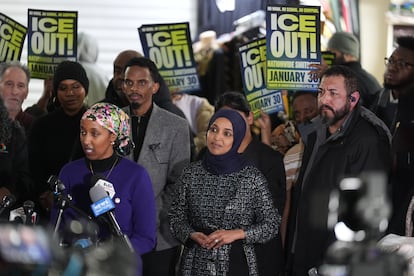

The attack on Minnesota Congresswoman Ilhan Omar, who was sprayed with vinegar from a syringe while speaking in public last Tuesday, brought the spotlight back on the Somali community in this Midwestern state. It is unwanted attention, adding to a campaign by U.S. President Donald Trump and the MAGA movement, who for months have been insulting them and blaming the community as a whole for a public‑assistance fraud scheme dating back to the pandemic.
The White House used those crimes — some already prosecuted, others still pending — as a pretext to order Operation Metro Surge, the deployment of roughly 3,000 federal agents who patrol the city heavily armed, often masked, and in unmarked vehicles. Many immigrants, documented or not, have been confined to their homes since the operation began two months ago. The crackdown has also triggered an uprising in Minneapolis: an unprecedented wave of civic resistance that has intensified following the fatal shootings of two U.S. citizens, Renee Good and Alex Pretti, at the hands of Trump’s immigration police.
The pretext of the Somali fraud scandal for the federal occupation doesn’t hold up. Of the 80,000 members of that community living in Minnesota, more than 95% are citizens or legal residents, meaning Immigration and Customs Enforcement (the feared ICE) has no jurisdiction over them — no matter how many times Trump has called them “garbage” or insisted they should go back to their country… which is, in fact, the United States.
The immigration deployment has also had another unexpected consequence. This month, six federal prosecutors resigned in protest over how the Justice Department is handling the investigation into Good’s death, leaving last year’s open cases involving medical‑assistance fraud in limbo. Quite simply, there is no one left to prosecute them.
On January 8, state authorities blocked new applications for 13 assistance programs. And after a far‑right influencer named Nick Shirley released a report on Minneapolis day‑care centers, the federal government froze the approval of additional aid and ultimately ordered the anti‑immigration deployment. The video was filled with unproven or outright debunked accusations, but that didn’t stop the MAGA world — led by Elon Musk and Vice President J. D. Vance — from turning it into the latest pretext for the occupation of a Democratic‑run city and state. It also put Governor Tim Walz on the ropes; he eventually announced he would not seek re‑election in November.
Over the course of several years, 98 people have been charged, 85 of them of Somali origin, according to White House figures. So far, there have been 60 convictions, and about 50 defendants have pleaded guilty. For the Justice Department, it is “staggering, industrial-scale fraud.” For Jaylani Hussein, executive director of the Council on American‑Islamic Relations (CAIR) and one of the most prominent figures in Minnesota’s Somali diaspora, it is the textbook definition of “racism and discrimination.”
“Blaming Black people for taking advantage of assistance programs is something Ronald Reagan and Bill Clinton already did, when it’s white people who rely on those benefits the most — but of course, that doesn’t sell,” the activist says. He notes that “the local newspaper did an investigation and found that these pandemic‑related fraud schemes happened everywhere, and that Minnesota isn’t even the most serious case.”
And on that point, Trump does agree. Whenever he attacks Minnesota, the Republican adds that California is next on the list. The president has written on his social network, Truth Social, that the state — under the leadership of his arch-nemesis, Gavin Newsom — is “more corrupt.”
“The proof that they are exploiting this fraud is that when it surfaced [in 2021] and went to court, Minnesota Republicans refused to equate these crimes with the community as a whole,” Hussein explains. “Why didn’t they? Because they knew it was slander and because it hasn’t been possible to win an election in this state for a long time without the Somalis.”
Civil war in Africa
Hussein was among the first to arrive in 1993, fleeing the civil war in the Horn of Africa. At the time, Minnesota was an overwhelmingly white state, a demographic that, after decades of diversification, still represents 77% of the population. The Somalis who came after Hussein arrived in waves. Congresswoman Omar, for example, arrived four years later.
It’s a predominantly Muslim and strikingly young community: just over 50% were born after their parents had settled in the United States. “The rest are divided between those who, over the years, obtained citizenship, like me or the congresswoman, and those who have residency,” Hussein explains. “It’s estimated that there are fewer than a thousand undocumented immigrants and refugees.” The activist adds that it’s also a community that, unlike others, “has taken care to establish itself as a political force in Minnesota.” “The fact that we have a representative in the Capitol is no coincidence; it’s the result of years of mobilization.”
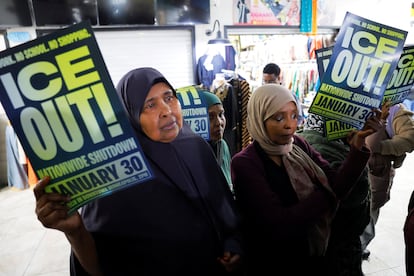
The cultural and social heart of Somali life in Minneapolis is the Karmel Mall, a four-story shopping center with clothing stores, barbershops, travel and insurance agencies, and restaurants. Omar appeared there on Wednesday, the day after the attack, and many of the business owners came up to see her speak and applaud her courage.
A woman named Zeynap, who runs a bakery, said she knew many Somalis who “don’t dare leave their homes,” and that she has organized herself to bring them food. Mohammed explained in his barbershop, as he finished with a customer, that his business “has dropped by half.” And Izzy, a young woman armed with one of those whistles activists use to warn of the presence of immigration agents, said that the struggle in Minneapolis “is a matter of moral decency.” She also denied that Trump’s constant insults were affecting her. “I think what hurts that person the most is being ignored,” she added.
The Somali presence in the city, however, is not limited to this shopping center. Mahmoud Isse, for example, owns the business in front of which Border Patrol agents killed Pretti. It’s a senior living facility and has yet to reopen. The businessman doesn’t know how long it will remain closed. For now, access is blocked by the hundred or so people who gather there at all hours to pay their respects to a neighbor who, Isse says, “sacrificed himself for the community, and especially for his immigrant brothers.”
Omar later said that she had visited the site hours earlier and noted that she is the member of Congress who receives the most death threats among the 435 representatives, due to Trump’s “obsession” with her. Hussein is also accustomed to far‑right attacks as the public face of CAIR, the largest Muslim civil‑rights organization, which the president has threatened to add to the list of terrorist organizations. “He’ll never do it; it’s just a gesture to curry favor with [Israeli Prime Minister Benjamin] Netanyahu,” the activist says.
A walk through the Karmel Mall confirmed Hussein’s assessment of how events in Minneapolis are affecting the Somali community differently depending on generation and class. “The younger ones laugh at Trump’s threats,” the CAIR director explained. “Some are worried about their finances and their jobs. The older ones are concerned about the rise of authoritarianism. Many have already experienced this: they know that when you live in an authoritarian regime and don’t fit the mold, they can come for you in the middle of the night.”
These days, it has also become clear in Minneapolis that a new generation of Somalis has awakened to political activism, both in the streets and on social media. They are a frequent presence at protests and at memorials for those killed by police brutality. They also take part in activist groups that track ICE movements in order to disrupt a harsh immigrant crackdown that is using them as a pretext.
Sign up for our weekly newsletter to get more English-language news coverage from EL PAÍS USA Edition









































