
The struggle of the most Afro-Latino city in the United States to accept itself
Too Black for Latinos and too Latino for African Americans, Boston’s Afro-Latino community is beginning to see the fruits of decades of activism against historical invisibility

Long before becoming Boston’s first Afro-Latina city councilwoman, Julia Mejía was Julia Melania Mejía Peña — a five-year-old girl who emigrated from the Dominican Republic to Massachusetts. Over time, she gradually shed two of her names. “I didn’t want anyone to know who I was, where I came from,” she recalls. She just wanted to fit in, even if it meant suppressing her Afro-Latin identity, something she wouldn’t recover until decades later.
With her brown skin and curly hair, Mejía never felt welcomed by the city’s Latino community. She remembers that her school was divided between Latinos and African Americans. She always chose to be on the African American side, because it was the one that accepted her. But even though that community embraced her, it came at the cost of denying her identity: she couldn’t be Black and speak Spanish at the same time, so she began to hide that part of herself.
When asked when she first saw herself as Afro-Latina, she says it must have been less than 10 years ago. “The other day, I was looking at old photos and found one from 2015 that said ‘Afro-Latina’ underneath. I think it was then that I truly understood the term and realized it reflected everything I am,” she notes. During her interview with EL PAÍS at her City Council office, she speaks mostly in English, although she throws in the occasional word or phrase in Spanish.
Councilor Mejía’s office is filled with Dominican flags. But the pride she feels today for her birthplace and her roots is the result of a long process of self-acceptance that, she admits, she continues to work on. Mejía’s struggle to understand herself and accept that Blackness exists within Latinidad is also Boston’s struggle.
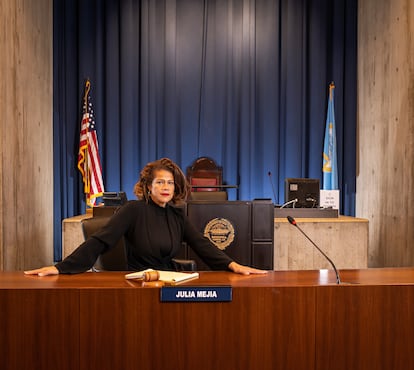
The Massachusetts capital has the highest proportion of Afro-Latinos in the entire country. They number nearly 88,000 (a figure that has doubled in the last decade), according to a study published in 2023 by the Boston Foundation, one of the oldest community organizations in the country. Founded in 1915, its mission is to promote equity in the city. The Afro-Latino residents of Boston are primarily Puerto Rican and Dominican. And together, they represent 15.3% of the city’s Latino community, surpassing large metropolises like New York, where they represent 9.1%.
However, even though they’re numerous, they’ve been — and remain — invisible. When considering the experience of individuals like Mejía, or when examining the Latino and Black communities in general, they don’t fit in anywhere.
A deep sense of denial
Yvette Modestin, an Afro-Panamanian activist who has lived in Boston for 30 years, explains that, behind these numbers, lies a “deep denial.” Born in the port city of Colón — the heart of the Afro-descendant community in Panama — the poet and writer was always proud of her Blackness. No one dared to question her identity as an Afro-Latina — that is, until she migrated to the United States in the late 1990s. She recalls arriving in Boston and “for the first time” in her life having a conversation with an Afro-Latina who didn’t identify as such.
“I had never had an experience like that, standing in front of someone who said to me, ‘Oh, I thought you were Black.’ And, when I responded, ‘I am… and you are, too,’ I heard them say, ‘No, I’m Puerto Rican,’ or ‘I’m Dominican,’” she recounts. “The disconnect was such that I spoke to them in Spanish and they answered me in English. They couldn’t believe I could be both Black and Latina. On top of that, the people who told me this were Blacker than me!” she exclaims, still incredulous three decades later.
Beyond her personal experience, through her career as a social worker Modestin gradually realized that what existed within the Latino community in Boston was a systematic erasure of Afro-Latin identity. Not only did Afro-Latinos not identify as such, but they also didn’t accept others who (like Modestin) did.
This marginalization, she explains — with a somewhat frustrated and tired tone, after so many years of having to explain herself — is largely due to the fact that the same racism that operates in broader American society is replicated within the Latino community. Especially in a place like Boston, which, for most of the 20th century, until new waves of Latin American immigrants began to arrive, was a city with a vastly white majority. “So, as immigrants, we come here and we’re aware of that racism. And we do everything we can to make our lives easier, leaning toward whiteness,” Modestin notes.
Thus, she continues, the term “Latino” has become consolidated as a category that only includes those who identify as white, while distancing itself from those who are considered to be the inferior race: Black people. “And, even if they’re not really white — even if they have slightly darker skin — they believe that the fact that they’re Latino already allows them to lean toward whiteness,” she elaborates. “It’s a caste system.” Latinos, she summarizes, are placed above African Americans and don’t accept that there can be Black Latinos.
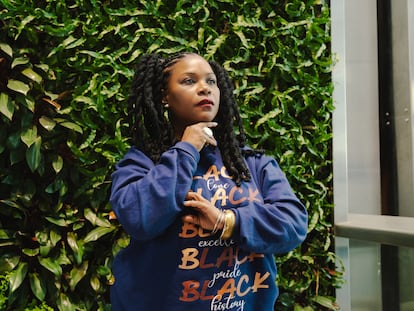
However, there are Afro-Latinos like Modestin who, even if they wanted to, cannot hide their Blackness. She points to her dark skin and her hair, which is now braided but sometimes worn in dreadlocks, or as a natural afro. “First and foremost, I am this.” Hence, she doesn’t have, nor would she ever want to have, the option of passing as white, as she has seen many other Afro-Latinos do, taking advantage of the privilege of colorism. As a result, she has ended up marginalized, on the one hand, by the Latino community, which doesn’t accept her because of her race, and, on the other, by the African-American community, which rejects her because of her ethnicity.
This invisibility has tangible consequences because the exclusion is also socioeconomic. Today, Afro-Latinos are the poorest group in Boston. The same Boston Foundation research published in 2023 found that this group has the lowest incomes in the entire city: their households earn around $45,000 a year, compared to the median income of $93,000. They also have the lowest homeownership rate: only 19% own their own homes, a staggering 41 percentage points below the overall homeownership rate. They’re also less likely to be able to start a business.
“It’s a system of racial hierarchy: of misrepresentation, marginalization and racism,” James Jennings emphasizes. He’s the co-author of the Boston Foundation report and an Afro-Puerto Rican expert on urban poverty, economic development and race relations. He’s been studying Boston’s Afro-Latino community for decades.
Jennings notes that the system has also kept this segment of the population stuck in poverty. For a long time, they’ve been ignored by those who should be looking out for their interests.
Half-a-century of activism
José Massó III recalls seeing this marginalization firsthand when he arrived in Boston in the 1970s. Half-a-century later, he’s one of the city’s most celebrated figures. He has received several awards and recognitions for his commitment to Boston, including an annual festival held in his honor, which was inaugurated last year. Wherever he goes in the city, he is welcomed with pride, whether at City Hall — where he’s been an advisor for decades — or at the small café where he grants an interview to EL PAÍS.
Massó arrives dressed in a vest, jacket and top hat. He has a wooden cane that he doesn’t really lean on, but it lends him an air of wisdom. His 74 years of age aren’t noticeable in his gaze or in his voice, which remains firm and unwavering. After ordering a coffee and a muffin, he takes a seat and launches into a half-an-hour-long monologue as he reviews the last 50 years of his life and the struggle he has led for Boston’s Afro-Latino community.
Originally from Puerto Rico, he came to the city proud of his Blackness, his African roots and his Afro. But, like Modestin, he encountered a barrier of rejection. He was too Black for Latinos, and too Latino for African Americans. “I would tell them, ‘I’m Black, I’m Afro-Puerto Rican.’ But they couldn’t connect the two because, in their minds, Black people are only from the United States. And anyone who was Black couldn’t be anything else,” he recalls.
“Still, I knew I could play a role as an agent of change, because my focus was on elevating and amplifying Blackness,” he explains. In 1975, the opportunity arose. He learned that Boston Public Radio wanted to launch a new project focused on Latinos, and he proposed one centered on celebrating the contributions of Afro-Latinos to Latin American and American music and culture.
Thus was born ¡Con Salsa! — now Boston’s longest-running music show — which placed Massó at the forefront of the battle that Afro-Latinos were waging to be accepted in the city. “From the beginning, I had a unique platform. There were already other Latin radio shows in the country, but the fact that I openly identified myself as Afro-Puerto Rican on air — and clearly stated that I was presenting the best Afro-Latin music, to educate the public about the contributions of people of African descent to this continent — was something completely different,” he acknowledges.
However, he admits, the start wasn’t easy. Not all Latinos accepted him. “They didn’t want to talk about Blackness. And they definitely didn’t want someone Black to represent them on such a scale, because of all the stereotypes and baggage they carried,” he notes. “They were used to the traditional role of the caste system and racism, where Black people fit in the hierarchy. I was breaking down all those barriers. So, for them, it was a challenge.”
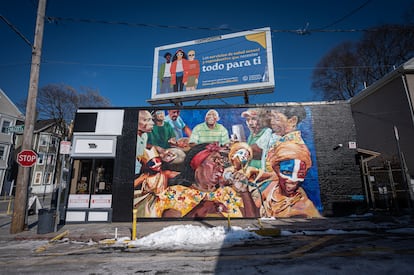
It was Massó who took on the responsibility of challenging them. Despite the rejection, he worked alongside other Afro-Latino organizers to set an example however he could. They took advantage of the fact that the country was experiencing a period of great social unrest: it was the height of the Black Power movement and student organizing against the Vietnam War. “We began to create our own Pan-Afro-Latino movement in the 1960s, 1970s and 1980s, which, to a certain extent, was part of the media landscape. Because suddenly, you heard our voices on the radio, you read us in the press, you saw us on television… something that hadn’t happened before. It didn’t mean we were the vast majority, but at least we were present."
The path to greater acceptance
It was a long process that, according to several Afro-Latino activists and community leaders in Boston, began to bear fruit over the last 20 years. There’s been more community-level organizing, more political participation and greater acceptance. “Now, we’re able to have more conversations. And we’re also in the spaces we need to occupy to talk about these issues. Because it wasn’t always like this; we had to lay the groundwork and create the spaces for these kinds of conversations to take place,” Massó explains.
One of those spaces was created by Yvette Modestin. In 2004, she founded the Encuentro Diaspora Afro, the first organization of its kind in Boston. Its mission is to empower the city’s Afro-Latino population through training courses, conferences and events.
At the center of everything she does, Modestin maintains the same thing that Massó has promoted on his radio program for half-a-century: the recognition of the African influence on Latinidad. Because, the Panamanian explains, the key lies in self-acceptance: “Our greatest healing is within ourselves. We have to understand that healing has to do with how we see ourselves, how we connect with ourselves.”
It was also in the last 20 years that another organization emerged — one dedicated exclusively to teaching young Afro-Latinos about their roots and culture. Hyde Square Task Force was originally born as a community-based organization in the 1990s. It was established in the Latino neighborhood of Jamaica Plain to address the neglect of the area, which was plagued by violence and drugs. Over time, however, the group evolved and adjusted its focus, eventually centering on the neighborhood’s youth, the vast majority of whom were Afro-Latinos, the children of immigrants from Cuba, Puerto Rico, or the Dominican Republic. In 2018, the organization adopted a strategic plan that explicitly named Afro-Latino culture as the lens they would use to work with the community’s youth.
“We wanted to be more intentional about the way we named it. We realized, in our work with youth, that their African roots were a silenced part of their identity,” Celina Miranda explains. Speaking from her office, which is still in Jamaica Plain, the organization’s current executive director recalls that, until recently, children attending the center talked about being Puerto Rican or Dominican, but never about their African roots. “So, for us, naming [Blackness] became very important in creating this space where young people realize it’s okay to think about the complexity of who they are. It’s about naming all the parts of themselves and not feeling like they have to choose, because their Afro-Latin identity is a fundamental part of their identity,” Miranda notes.
Hyde Square Task Force, the executive director details, has served as a “safe space” for these young people to undertake a “careful” process of self-exploration and acceptance. “They tell us that coming here has given them the ability to say, ‘I’m proud of my roots, I’ve learned more about who I am.’ And you think about the power of that, because, from the perspective of racial identity formation, that exploration typically doesn’t happen until much later, in college. But we’re starting those conversations with young people much earlier. Our hope is that, by the time they enter those other spaces, they’ll arrive with much more awareness and confidence about who they are.”
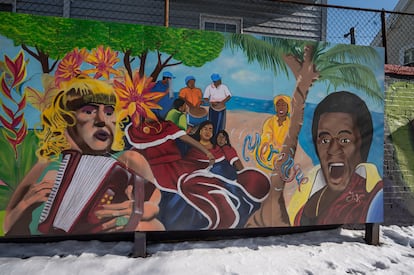
Today, Hyde Square Task Force has a three-story building, with spaces dedicated to the different artistic forms it uses to carry out its work. There are several music studios — including one for string instruments and another for percussion — as well as others for dance and theater.
Starting at three in the afternoon, the center’s hallways fill with children and teenagers arriving after the end of the school day. In total, the organization serves around 300 young people. “I’m not Afro-Latina, but this is very personal for me, because I have a daughter who is. I always think about her and what I’m doing to pave the way for her to feel a sense of belonging wherever she goes, so that she doesn’t have to leave a part of herself behind to fit in,” Miranda shares, while offering EL PAÍS a tour of the organization’s facilities.
The desire to break away from the need to hide oneself is something Julia Mejía knows all too well. She was elected to the City Council after running in the 2019 municipal elections, knowing that “she wasn’t the preferred Latina candidate.” “I was the hood rat who didn’t fit the mold they wanted to project on me,” she recalls. But she wanted to show that, by being herself, she could still win.
During the campaign, her own team doubted her. “They asked me not to say that I was Afro-Latina and not to say that I was an immigrant or that I was a single mother. They told me to be anything but what I was,” she says. But she didn’t back down and continued running her campaign the way she wanted to. “I said, ‘I’m not going to be invisible anymore.’” She ended up winning her seat by one vote and was reelected four years later.
During her time on the Boston City Council, she has served as a bridge between the Latino and African American communities. Before her, nobody in the local government had done this. But she acknowledges that, despite the progress that’s been made, it’s an ongoing task.
“I’ve had to learn to confront people on both sides when necessary. Because when you’re a light-skinned Afro-Latina claiming your Black roots, people think you’re crazy. And when you’re a light-skinned Afro-Latina denouncing colorism — even within your community — you become a problem,” she says. “When I meet with African American leaders, they tell me I’m not Black. And I ask them, ‘Am I not Black in what sense? Because I’m not African American?’ It’s a cycle that, little by little, we will continue to break.”